
Arizona Water Use Rules and Desert Landscaping Ordinances
Arizona water use rules and local landscaping ordinances. Stay compliant with ADWR guidelines and municipal watering schedules in the Valley of the Sun.
Last updated: October 1, 2026
Quick Answer: Arizona water use rules are set at three levels, state law, Active Management Area regulations, and local municipal ordinances. Homeowners in Phoenix, Tucson, Scottsdale, and other Valley cities face mandatory outdoor watering schedules, turf restrictions on new construction, and escalating fines for violations. With the federal government cutting Arizona's Colorado River allocation by roughly 31% for 2027-2028, these rules are tightening fast. [4][7]
Key Takeaways
- Arizona's Groundwater Management Act (1980) created Active Management Areas (AMAs) with strict water use targets, these are state-level rules, not just city guidelines.
- Phoenix currently limits lawn watering to three days per week and bans irrigation during peak daytime hours. [6]
- New subdivisions in AMAs must prove a 100-year assured water supply before a single lot can be sold.
- Arizona faces a mandatory 27-31% cut to its Colorado River supply through 2028, with deeper cuts possible if Lake Mead stays low. [4][7]
- Turf bans on non-functional grass in new commercial and municipal development are already in effect in several cities; residential restrictions are expanding.
- Fines for water ordinance violations start low but escalate sharply for repeat offenders, some cities charge per-day penalties.
- Rebate programs (including free water-conservation kits from cities like Mesa) can offset the cost of converting to desert landscaping. [6]
- HOA rules and city ordinances can both apply to your yard, the stricter rule governs.
- Federal conservation payments of $325 per acre-foot are currently incentivizing Arizona cities to expand outdoor water restrictions. [3]
Table of Contents
- Overview of the Arizona Groundwater Management Act
- Understanding Active Management Area (AMA) Restrictions
- Arizona Water Use Restrictions by County and City
- How Much Water Can You Use Per Day in Arizona?
- Arizona Desert Landscaping Requirements Explained
- Turf Grass Replacement Rules and What Plants Are Allowed
- Arizona Water Conservation Fines, Penalties, and Who Enforces Them
- How to Get a Water Variance in Arizona
- Arizona vs. California Water Use Regulations: A Quick Comparison
- Arizona Water Use Rules for Pools and Fountains
- Does Arizona Water Rationing Apply to New Construction?
- Common Mistakes People Make with Arizona Water Laws
- How to Landscape a Desert Yard Without Grass
- Avoiding Violations with a Water-Wise Landscape
- FAQ
- References
Overview of the Arizona Groundwater Management Act
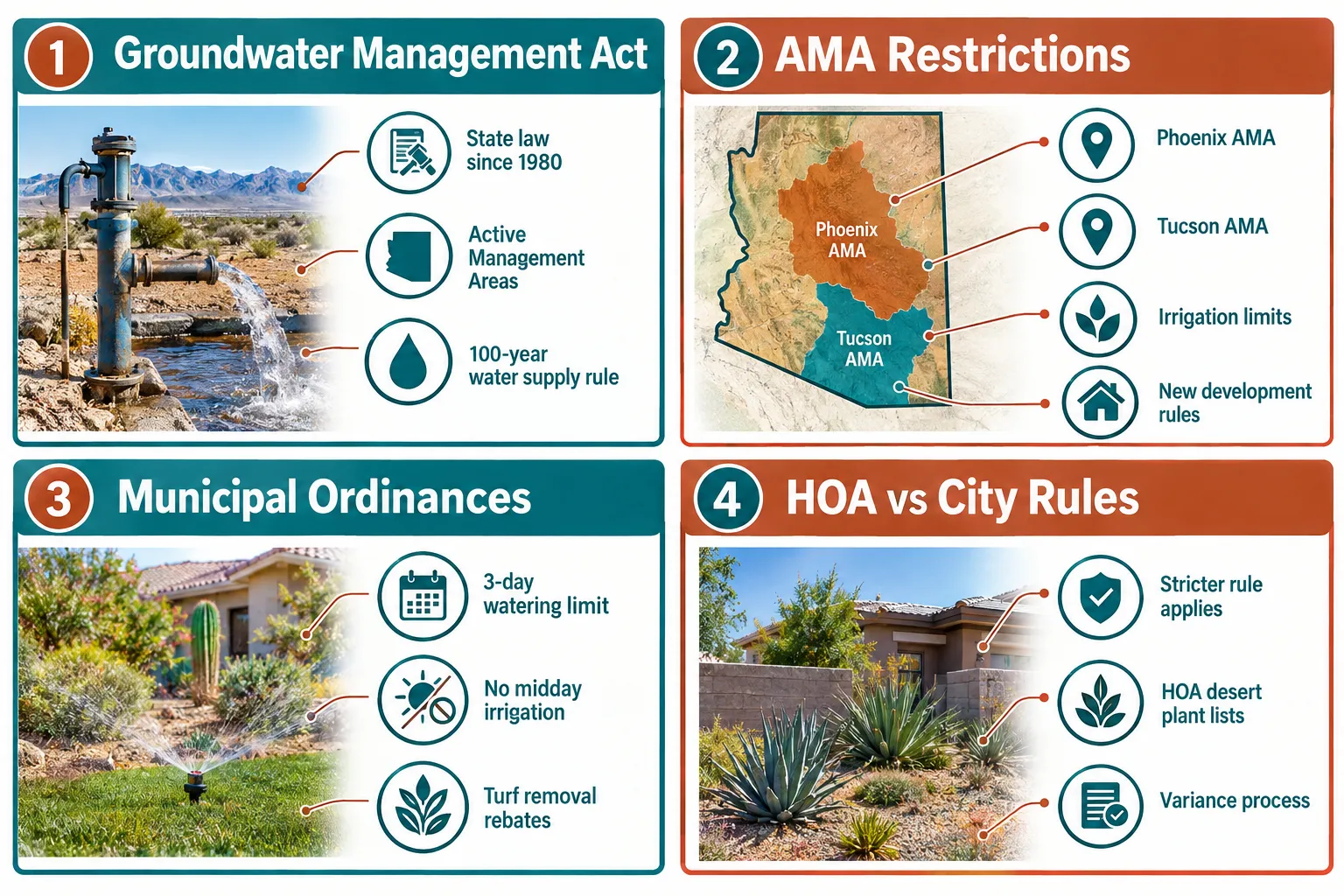
Arizona's Groundwater Management Act (GMA), passed in 1980, is the foundation of all residential water use rules in the state. It was a direct response to decades of unchecked groundwater pumping that was draining aquifers faster than rain could refill them.
The GMA did three things that still shape your yard today:
- It created Active Management Areas (AMAs), geographic zones with the most severe water stress.
- It set conservation goals for each AMA, with the strictest areas targeting "safe yield" (pumping no more than what recharges naturally).
- It established the 100-year assured water supply requirement for new developments.
This is a state law administered by the Arizona Department of Water Resources (ADWR). It sits above city ordinances. If a city rule conflicts with the GMA, the GMA wins.
Understanding Active Management Area (AMA) Restrictions
AMAs are the zones where Arizona water use rules carry the most legal weight. There are five AMAs in Arizona: Phoenix, Tucson, Prescott, Pinal, and Santa Cruz.
If your home is inside an AMA, you are subject to ADWR conservation requirements on top of whatever your city mandates. Key restrictions include:
- Irrigation efficiency standards for landscaping, drip systems are preferred over spray heads.
- Limits on new groundwater use for residential development.
- Mandatory water audits for large commercial users (residential audits are encouraged but not always required).
The Phoenix AMA covers most of Maricopa County. The Tucson AMA covers Pima County. If you live in Scottsdale, Tempe, Mesa, Chandler, or Gilbert, you are inside the Phoenix AMA and subject to its rules.
Choose this if: You are buying or building in a new subdivision, ask the developer which AMA you're in and whether the project has an approved assured water supply designation from ADWR.
Arizona Water Use Restrictions by County and City
Water restrictions in Arizona vary by municipality, but all Valley cities have tiered drought-response ordinances that can tighten quickly. Here is what is currently in effect as of 2026:
| City | Outdoor Watering Days | Daytime Ban | Current Stage |
|---|---|---|---|
| Phoenix | 3 days/week | Yes (10am, 6pm) | Stage 1 [6] |
| Tucson | 3 days/week | Yes | Stage 1 |
| Scottsdale | 3 days/week | Yes | Stage 1 |
| Mesa | 3 days/week | Yes | Stage 1 [6] |
| Glendale | 3 days/week | Yes | Stage 1 [3] |
Phoenix is currently discussing a move to Stage 2, which would add drought surcharges and requests for further reductions. [2] Stage 2 is not yet mandatory, but homeowners should prepare.
County-level rules are generally less detailed than city rules. Unincorporated Maricopa County follows state AMA rules but does not have its own watering schedule. If you live outside city limits, ADWR rules apply directly.
How Much Water Can You Use Per Day in Arizona?
There is no single statewide daily gallon limit for residential customers. What exists instead is a combination of watering-day restrictions, tiered rate structures, and AMA conservation targets.
A typical Arizona household uses roughly 80-100 gallons per person per day indoors. Outdoor irrigation, especially lawn watering, can double or triple that figure during summer months.
Under current Phoenix rules, outdoor irrigation is limited to three days per week and cannot run between 10 a.m. and 6 p.m. [6] Exceeding your tier threshold on your water bill triggers a higher rate per gallon, a financial penalty built into the pricing structure.
As federal cuts to Colorado River supplies take hold in 2027-2028, analysts expect cities to add mandatory per-household reduction targets, not just scheduling rules. [2][4] Household taps are not expected to run dry, but bills will rise. [4]
Arizona Desert Landscaping Requirements Explained
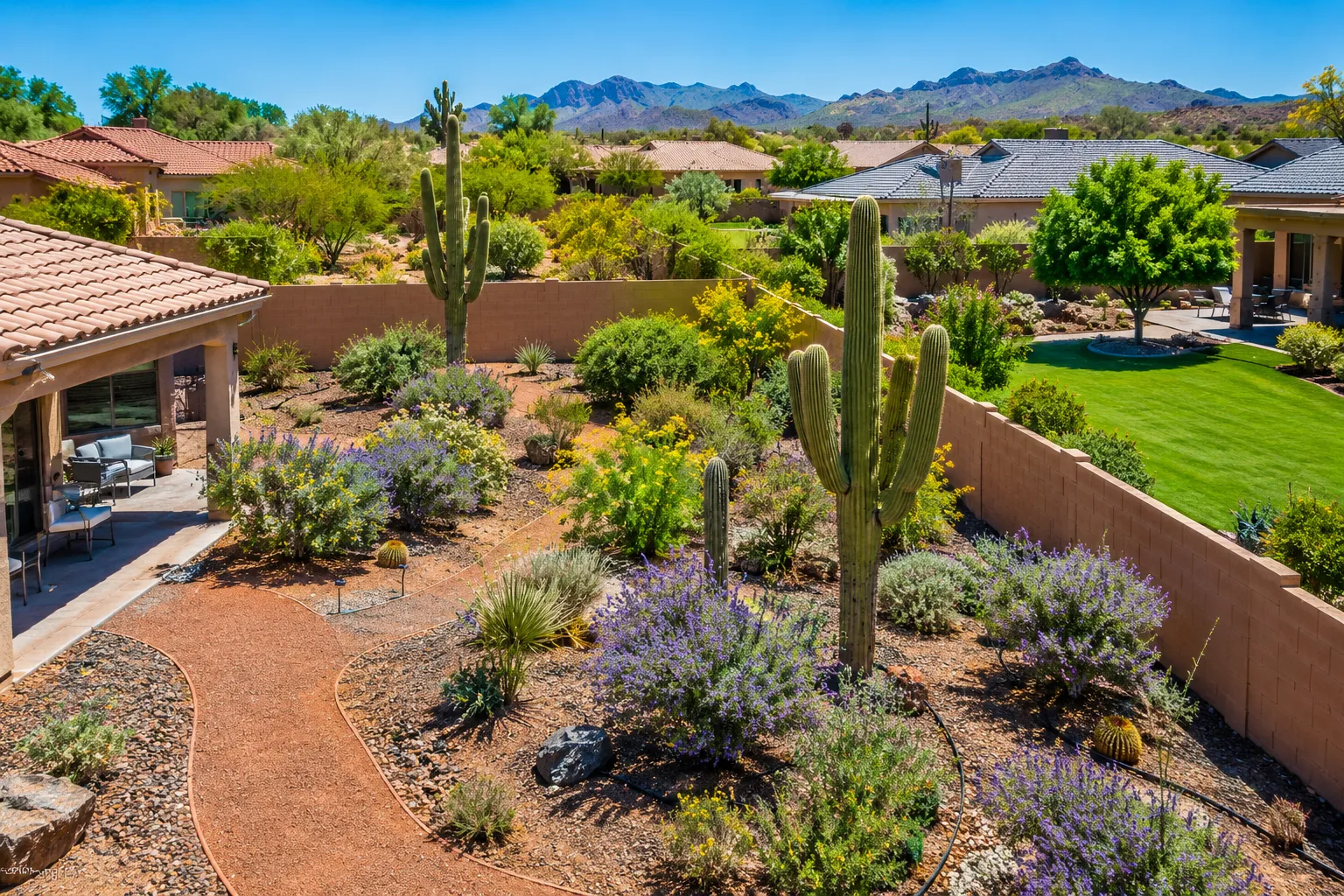
Desert landscaping is not just a style choice in Arizona, it is increasingly a legal requirement for new construction and a financial incentive for existing homeowners.
For new construction: Several Arizona cities, including Scottsdale and Chandler, prohibit non-functional turf in new residential development. "Non-functional turf" means decorative grass that is not used for recreation or sports. Front lawns that exist purely for looks are the primary target.
For existing homes: There is no statewide law forcing you to rip out your current lawn. However, rebate programs make conversion financially attractive, and watering restrictions make maintaining a traditional lawn increasingly expensive and difficult.
Cities like Mesa distributed more than 22,000 free water-conservation kits to residential customers in the first quarter of 2026 alone, supporting residents converting to desert-adapted systems. [6] Federal conservation payments of $325 per acre-foot are giving cities money to fund these programs. [3]
What counts as compliant desert landscaping?
- Native or low-water plants (see next section)
- Drip or bubbler irrigation (spray heads are being phased out in many zones)
- Permeable ground cover: decomposed granite, gravel, or mulch
- No overhead spray irrigation on slopes or near hardscape
Turf Grass Replacement Rules and What Plants Are Allowed
Arizona's turf grass rules are a mix of state guidance and local ordinance. The Arizona Department of Environmental Quality and several city codes restrict or ban non-functional turf in new construction, with residential retrofits following through rebate incentives rather than mandates (for now).
Turf rules by context:
- New commercial/municipal development: Non-functional turf is banned statewide under a 2023 law.
- New residential development in AMAs: Many cities require a minimum percentage of desert landscaping in front yards.
- Existing residential yards: No forced removal, but rebates of $1,$3 per square foot are common for turf replacement (check your city's current program, amounts change).
Plants approved for Arizona xeriscaping include:
- Saguaro, barrel cactus, prickly pear (native cacti)
- Desert willow, palo verde, mesquite (native trees)
- Brittlebush, desert marigold, blackfoot daisy (native perennials)
- Agave, yucca, ocotillo (succulents and structural plants)
- Lantana, bougainvillea (low-water non-natives, widely accepted)
Some HOAs maintain approved plant lists. Always check your HOA's CC&Rs before planting, HOA rules can be stricter than city rules, and the stricter rule governs.
Arizona Water Conservation Fines, Penalties, and Who Enforces Them
Arizona water use rules are enforced at two levels: the city (for municipal ordinance violations) and ADWR (for AMA and groundwater law violations).
Municipal fines for outdoor watering violations typically follow this pattern:
- First offense: written warning
- Second offense: $50,$150 fine
- Third and subsequent offenses: $250,$500 per day
Phoenix, Scottsdale, and Tucson all use tiered fine structures. Fines are issued by water services inspectors who respond to complaints or conduct neighborhood patrols during drought stages. [6]
ADWR enforcement is more serious. Illegal groundwater pumping or violating an AMA permit can result in fines up to $10,000 per day and permit revocation.
Who can report a violation? Any resident can file a complaint with their city's water services department. Anonymous complaints are accepted in most Valley cities.
How to Get a Water Variance in Arizona
A water variance allows you to temporarily exceed normal restrictions for a specific, documented reason, establishing new plants, filling a pool, or addressing a medical need, for example.
The process:
- Contact your city's water services department (not ADWR, unless the issue involves an AMA permit).
- Submit a written variance request explaining the reason and the estimated water volume needed.
- Provide supporting documentation (planting receipts, contractor quotes, medical letters).
- Wait for approval, most cities respond within 5-10 business days.
- Variances are time-limited, typically 30-90 days.
Variances are not guaranteed. Cities are less likely to approve them during Stage 2 or Stage 3 drought conditions. If you are establishing a new desert landscape after turf removal, mention the rebate program, cities tend to approve variances for conservation-aligned projects more readily.
Arizona vs. California Water Use Regulations: A Quick Comparison
Both states draw from the Colorado River and both face cuts under the August 2026 federal operating guidelines. [7] But their approaches to residential water rules differ in key ways.
| Factor | Arizona | California |
|---|---|---|
| State water law foundation | Groundwater Management Act (1980) | Sustainable Groundwater Management Act (2014) |
| AMA equivalent | 5 Active Management Areas | Groundwater Sustainability Agencies (local) |
| Turf ban (new construction) | Yes, non-functional turf banned | Yes, similar ban in effect |
| Daily use limits | No single gallon cap; tiered rates | Some districts cap at 55 gallons/person/day indoors |
| Colorado River cut (2027-28) | ~31% reduction [7] | Smaller proportional cut [7] |
| Rebate programs | City-level, federally funded [3] | State and utility-level |
Arizona's rules are older and more established at the state level, but California's per-capita indoor limits are stricter in some districts. For outdoor irrigation, both states are moving in the same direction: less turf, more drip, more native plants.
Arizona Water Use Rules for Pools and Fountains
Pools and decorative water features are regulated under municipal drought ordinances, not the GMA directly.
Current rules in most Valley cities:
- New pool construction requires a permit and water-efficient equipment (variable-speed pumps, covers).
- Decorative fountains on commercial and municipal property are restricted or banned during Stage 1 and above.
- Residential fountains are generally allowed but must use recirculating systems, no single-pass water flow.
- Pools may be filled under a variance during Stage 1. During Stage 2, new pool fills may be restricted.
- Evaporative coolers ("swamp coolers") are not restricted but are encouraged to use timers and recirculating systems.
Backwashing a pool filter wastes significant water. Scottsdale and Phoenix both recommend reducing backwash frequency and using a pool cover to cut evaporation by up to 30%.
Does Arizona Water Rationing Apply to New Construction?
Yes, but the mechanism is different from what applies to existing homes. New construction in an AMA must demonstrate a 100-year assured water supply before ADWR will approve the subdivision. [15, see note below]
This means a developer must prove, through documented water contracts, groundwater credits, or reclaimed water agreements, that enough water exists for every home in the project for 100 years. If they cannot prove it, the project does not get approved.
As Colorado River cuts deepen, this requirement is putting real pressure on developers. Projects that relied heavily on Colorado River allocations are now scrambling to substitute recycled water, banked groundwater, or alternative supplies. [4] Analysts expect this to push new developments further toward mandatory desert landscaping as a way to reduce per-home water demand and satisfy the assured supply calculation. [2]
Common Mistakes People Make with Arizona Water Laws
These are the errors that lead to fines, failed inspections, and wasted money.
- Assuming HOA approval means city approval. Your HOA can approve a plant or irrigation change that still violates city ordinance. Check both.
- Running spray irrigation during restricted hours. Automated systems don't know the rules. Program your timer correctly and check it after daylight saving time changes.
- Installing a new lawn without checking turf rules. In many AMA cities, adding turf to a front yard in a new development is prohibited. Verify before you sod.
- Ignoring the daytime watering ban. Watering between 10 a.m. and 6 p.m. is the most commonly cited violation in Phoenix. [6] It also wastes water to evaporation.
- Skipping the variance when establishing new plants. New plantings need more water for the first 30-90 days. Get a variance so you are not fined for doing the right thing.
- Assuming rural properties are exempt. Properties outside city limits in an AMA are still subject to ADWR rules. Groundwater pumping without a permit is illegal regardless of lot size.
How to Landscape a Desert Yard Without Grass
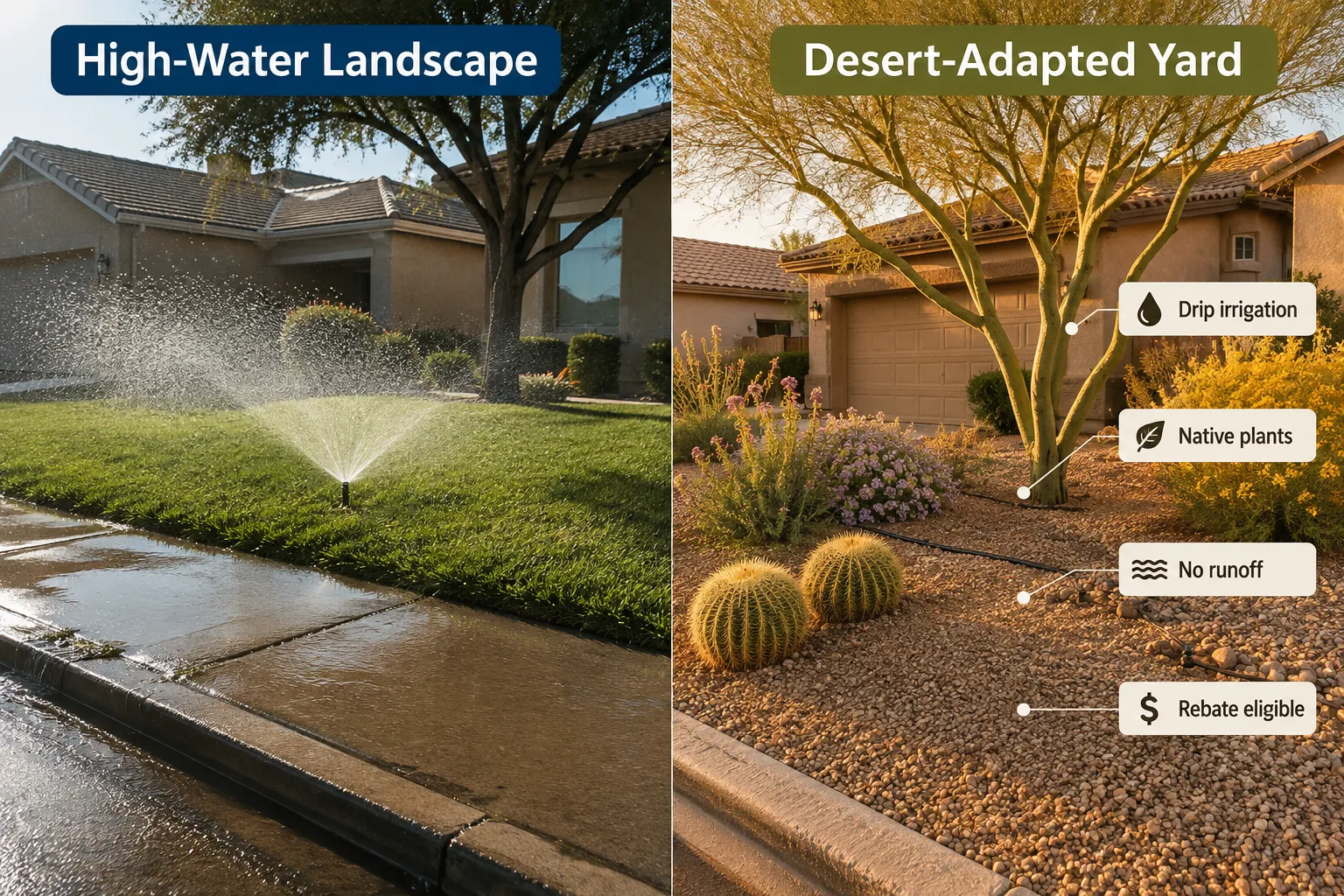
Converting a traditional yard to a desert landscape is a practical project with a clear return, lower water bills, fewer fines, and often a rebate check. Here is how to do it right.
Step 1: Remove existing turf. Sod cutters are available at equipment rental shops. Some cities offer free or subsidized removal through rebate programs, check before you pay full price.
Step 2: Install weed barrier and decomposed granite. Use a permeable landscape fabric, not plastic sheeting. Top with 3-4 inches of decomposed granite or gravel.
Step 3: Plan your plant layout. Group plants by water need (hydrozoning). Put the thirstiest plants closest to the house where you can hand-water during establishment.
Step 4: Install drip irrigation. Drip systems use 30-50% less water than spray systems. Use pressure-compensating emitters and a soil-moisture sensor to avoid overwatering.
Step 5: Plant in fall or early spring. Avoid planting in summer heat. Fall planting gives roots time to establish before the stress of a Sonoran summer.
Step 6: Apply for rebates. Contact your city's water services department before you start. Some programs require pre-approval to qualify for the rebate.
University of Arizona experts and regional conservation programs frame these steps as essential, not optional, for residents looking to align with current and coming Arizona water use rules. [9]
Avoiding Violations with a Water-Wise Landscape
The best way to stay compliant is to hire a contractor who actually knows Arizona water use rules, not just someone who can lay sod or plant a cactus.
Before hiring any landscaper, ask these questions:
- Are you licensed with the Arizona Registrar of Contractors (ROC)?
- Do you know the current watering schedule for my city?
- Have you installed drip systems that comply with AMA efficiency standards?
- Can you help me apply for turf removal rebates?
- Do you carry liability insurance?
Your yard deserves someone who knows what they're doing. A licensed, insured landscaper who understands local ordinances will save you money on fines and wasted water. Know who you're letting into your yard.
Local pros, local knowledge. Find the right landscaper for your yard through a directory that verifies licensing and reviews, the directory built for homeowners, not advertisers.
FAQ
Q: Is there a statewide law requiring desert landscaping in Arizona?
A: There is no single law forcing all existing homeowners to convert to desert landscaping. However, new construction in Active Management Areas must meet desert landscaping minimums, and non-functional turf is banned in new commercial and municipal development statewide. Rebate programs incentivize voluntary conversion for existing homes.
Q: Can my HOA override Arizona water use rules?
A: No. HOAs can be stricter than city rules, but they cannot override state law or city ordinances. If your city bans midday watering, your HOA cannot grant you an exception. If your HOA bans a plant the city allows, the HOA rule stands.
Q: What is the penalty for watering on a non-scheduled day in Phoenix?
A: First offense is typically a written warning. Repeat violations escalate to fines of $50,$500 per day depending on the drought stage and number of prior violations. [6]
Q: Do the Colorado River cuts affect my tap water directly?
A: Household taps are expected to remain reliable in the near term. [4] What changes is the cost, water bills will rise as cities pay more to secure alternative supplies and fund conservation programs.
Q: What is an Active Management Area and does it affect my yard?
A: An AMA is a state-designated zone where groundwater is managed under the Groundwater Management Act. If your home is in one (most of the Phoenix and Tucson metro areas are), you are subject to ADWR irrigation efficiency standards and the 100-year assured water supply requirement for new development.
Q: How do I find out if my landscaper is licensed in Arizona?
A: Search the Arizona Registrar of Contractors (ROC) online database at roc.az.gov. Enter the contractor's name or license number. Licensed, insured, and reviewed, that is the minimum standard. We verify so you don't have to.
Conclusion
Arizona water use rules are not abstract policy. They show up in your water bill, your HOA notices, and the fines that land in your mailbox when your sprinklers run at noon in August.
The rules are tightening. A 31% cut to Arizona's Colorado River allocation for 2027-2028 means cities will move from encouragement to enforcement faster than most homeowners expect. [7] The time to convert a water-hungry yard is before the fines and surcharges arrive, not after.
Actionable next steps:
- Look up your city's current drought stage and watering schedule on your municipal water department's website.
- Check ADWR's website to confirm whether your property is inside an AMA.
- Contact your city's water services department about turf removal rebates before starting any project.
- Hire a licensed Arizona ROC contractor who knows local ordinances, not just someone with a truck and a shovel.
- Program your irrigation timer correctly and check it twice a year.
From basic lawn care to full backyard transformations, find landscaping pros in your area who know these rules cold. Real reviews from real homeowners. No fluff, just useful advice. Find your next landscaper here.
References
[1] Phoenix Calls For New Federal Funds Basin Wide Action Following - https://www.phoenix.gov/newsroom/water-services-news/phoenix-calls-for-new-federal-funds--basin-wide-action-following.html
[2] AccuWeather: Colorado River Cuts Could Force a New Era of Water Conservation in the Southwest - https://www.accuweather.com/en/weather-news/colorado-river-cuts-could-force-a-new-era-of-water-conservation-in-the-southwest/1917827
[3] Arizona Cities Are Cutting Back On Colorado River Water Use Federal Money Makes It Easier - https://www.kjzz.org/science/2026-08-14/arizona-cities-are-cutting-back-on-colorado-river-water-use-federal-money-makes-it-easier
[4] Arizona's Taps Won't Run Dry But Water Bills Will Go Up Under Federal Plan For Colorado River - https://www.npr.org/2026/08/31/nx-s1-5945480/arizonas-taps-wont-run-dry-but-water-bills-will-go-up-under-federal-plan-for-colorado-river
[5] Water Use It Wisely: Conservation - https://wateruseitwisely.com/blog/category/environment-and-sustainability/conservation/
[6] Arizona Colorado River Shortage Phoenix Drought 2026 - https://www.waterverge.com/news/arizona-colorado-river-shortage-phoenix-drought-2026/
[7] Colorado River Drastic Water Cuts California Nevada Arizona Drought - https://www.cbsnews.com/news/colorado-river-drastic-water-cuts-california-nevada-arizona-drought/
[8] Water Use It Wisely: News And Events - https://wateruseitwisely.com/blog/category/news-and-events/
[9] Water Wisdom Following New Colorado River Framework - https://news.arizona.edu/employee-news/water-wisdom-following-new-colorado-river-framework
[10] Water Use It Wisely: Blog - https://wateruseitwisely.com/blog/
<!DOCTYPE html>
<html lang="en">
<head>
<meta charset="UTF-8">
<meta name="viewport" content="width=device-width,initial-scale=1">
<title>Arizona Watering Schedule Checker</title>
<style>
  .cg-wrap{font-family:Arial,sans-serif;max-width:480px;margin:2rem auto;background:#f9f5f0;border-radius:10px;padding:1.5rem;border:2px solid #c0714a}
  .cg-wrap h2{margin:0 0 .75rem;font-size:1.1rem;color:#7a3b1e}
  .cg-wrap label{display:block;font-size:.9rem;margin:.6rem 0 .2rem;color:#333}
  .cg-wrap select{width:100%;padding:.45rem;border-radius:6px;border:1px solid #c0714a;font-size:.9rem}
  .cg-btn{margin-top:1rem;background:#c0714a;color:#fff;border:none;padding:.6rem 1.4rem;border-radius:6px;cursor:pointer;font-size:.95rem;width:100%}
  .cg-btn:hover{background:#7a3b1e}
  .cg-result{margin-top:1rem;background:#fff;border-radius:8px;padding:1rem;border-left:4px solid #c0714a;font-size:.9rem;color:#222;display:none}
  .cg-result strong{color:#7a3b1e}
</style>
</head>
<body>
<div class="cg-wrap">
  <h2>Arizona City Watering Rules Checker</h2>
  <label for="cg-city">Your City</label>
  <select id="cg-city">
    <option value="">-- Select city --</option>
    <option value="phoenix">Phoenix</option>
    <option value="tucson">Tucson</option>
    <option value="scottsdale">Scottsdale</option>
    <option value="mesa">Mesa</option>
    <option value="glendale">Glendale</option>
  </select>
  <label for="cg-stage">Current Drought Stage</label>
  <select id="cg-stage">
    <option value="1">Stage 1</option>
    <option value="2">Stage 2</option>
  </select>
  <button class="cg-btn" onclick="cgCheck()">Check My Rules</button>
  <div class="cg-result" id="cg-result"></div>
</div>
<script>
var cgData={
  phoenix:{name:"Phoenix",days:"3 days/week",ban:"10am, 6pm",s2:"Drought surcharges apply; reduce use by 10%"},
  tucson:{name:"Tucson",days:"3 days/week",ban:"10am, 6pm",s2:"Mandatory 15% reduction; surcharges added"},
  scottsdale:{name:"Scottsdale",days:"3 days/week",ban:"10am, 6pm",s2:"Fountain restrictions; pool fill variance required"},
  mesa:{name:"Mesa",days:"3 days/week",ban:"10am, 6pm",s2:"Rebate programs expanded; surcharges apply"},
  glendale:{name:"Glendale",days:"3 days/week",ban:"10am, 6pm",s2:"Conservation deals active; surcharges likely"}
};
function cgCheck(){
  var c=document.getElementById("cg-city").value;
  var s=document.getElementById("cg-stage").value;
  var r=document.getElementById("cg-result");
  if(!c){r.style.display="block";r.innerHTML="Please select a city.";return;}
  var d=cgData[c];
  var extra=s==="2"?"<br><strong>Stage 2 adds:</strong> "+d.s2:"";
  r.style.display="block";
  r.innerHTML="<strong>"+d.name+", Stage "+s+"</strong><br>Watering days: "+d.days+"<br>Daytime ban: "+d.ban+extra;
}
</script>
</body>
</html>
Liked this guide? Follow us on Google Search
Related Directory Pages
Find a Landscaper Near You
Browse AZ landscaping professionals on LandscapeProsDirectory.
Search Landscapers