
Bakersfield Landscaping: Kern County Heat-Hardy Design
Bakersfield landscaping guide for 2026. Create a heat-hardy yard in Kern County using drought-resistant plants and soil management for the Southern Valley.
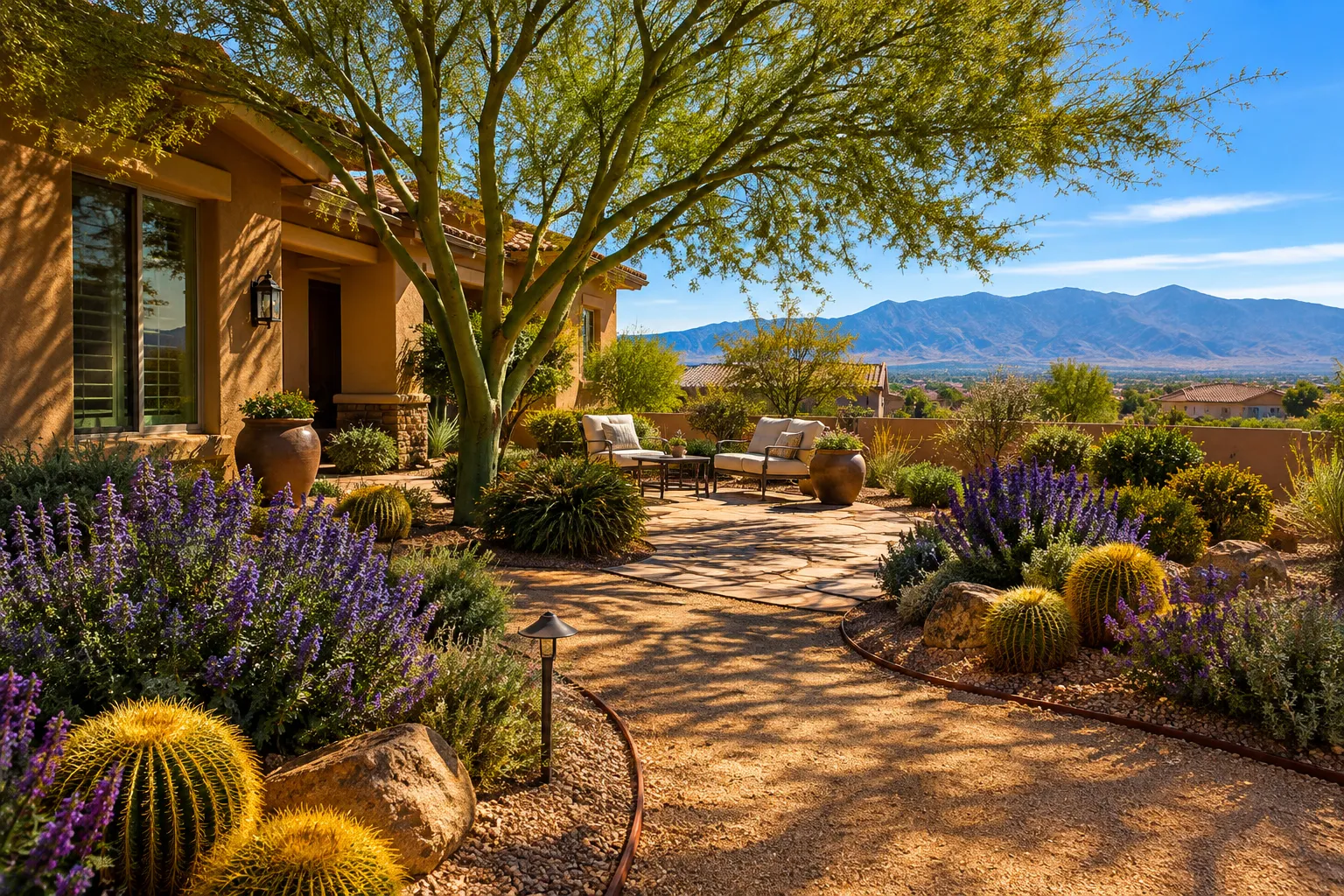
Last updated: October 1, 2026
Quick Answer: Bakersfield landscaping in 2026 means designing for 105°F-plus summers, roughly 6 inches of annual rain, and tiered water pricing that makes traditional lawns expensive to maintain. The most effective approach combines drought-tolerant plants, drip irrigation, decomposed granite groundcover, and strategic shade structures. Expect to pay $3 to $18 per square foot depending on scope, and always verify your contractor holds a valid California C-27 license.
Key Takeaways
- Bakersfield receives less annual rainfall than Phoenix, making drought-tolerant design a financial necessity, not just a trend
- Agaves, yuccas, salvias, palo verde, and desert willow are among the best performers in 110°F-plus conditions
- Replace spray heads with drip irrigation on 12-inch centers to cut outdoor water use dramatically
- California law (Civil Code 4735) prevents HOAs from banning drought-tolerant or native plants
- Xeriscape installations typically cost $6 to $12 per square foot installed; basic lawn care runs $50 to $150 per visit
- Always ask contractors for their C-27 Landscaping Contractor license number before signing anything
- Artificial turf is permitted in Bakersfield residential yards and eliminates mowing and fertilizing costs
- The City of Bakersfield follows California's MWELO ordinance for new and rehabilitated landscapes
Table of Contents
- What Is Xeriscaping and Why Does It Work in Bakersfield
- Best Drought-Resistant Plants for Bakersfield, California
- What Plants Survive 110-Degree Heat in Bakersfield
- Bakersfield Landscaping Cost Per Square Foot
- Professional Landscaping Maintenance Cost in Bakersfield
- How Often Should You Water Your Lawn in Bakersfield Summer
- How to Keep Landscaping Alive During Bakersfield Summer
- Desert Landscaping vs. Traditional Landscaping in Bakersfield
- Can You Grow Grass in Bakersfield Heat
- Is Artificial Turf Worth It in Bakersfield
- Low-Maintenance Landscaping Ideas for Hot Climates
- Bakersfield Landscaping Design for Small Yards
- Common Landscaping Mistakes in Kern County
- How to Find and Vet Bakersfield Landscaping Companies Near You
- FAQ
What Is Xeriscaping and Why Does It Work in Bakersfield
Xeriscaping is a landscaping method that reduces or eliminates the need for supplemental irrigation by using drought-tolerant plants, efficient water delivery, and non-living groundcovers like rock and decomposed granite. It works in Bakersfield because the city gets roughly 6 inches of rain per year, less than Phoenix, and summer temperatures routinely exceed 100°F for weeks at a time. [3]
A mature xeriscape in Bakersfield uses approximately 0.2 to 0.4 inches of water per week in summer. A traditional lawn needs 1.5 to 2 inches over the same period. That gap translates directly into lower water bills under Kern County's tiered pricing structure. [3]
Local design firms now treat "dryscape" and "water-conscious" design as standard practice rather than a specialty offering. [1][2] Core techniques include:
- Grouping plants by water need into distinct irrigation zones
- Using 3-inch layers of decomposed granite or rock mulch over weed-barrier fabric
- Installing drip irrigation instead of spray heads
- Adding dry riverbeds and flagstone paths to reduce planted area [3]
Bakersfield's Municipal Code (Section 14.02.010) requires outdoor watering between 6 p.m. and 9 a.m. for efficiency, prohibits runoff onto sidewalks, and ties irrigation schedules to State Water Resources Control Board rules during drought declarations. [5] California's Model Water Efficient Landscape Ordinance (MWELO) applies to all new and rehabilitated landscapes in the city. [5]
Best Drought-Resistant Plants for Bakersfield, California
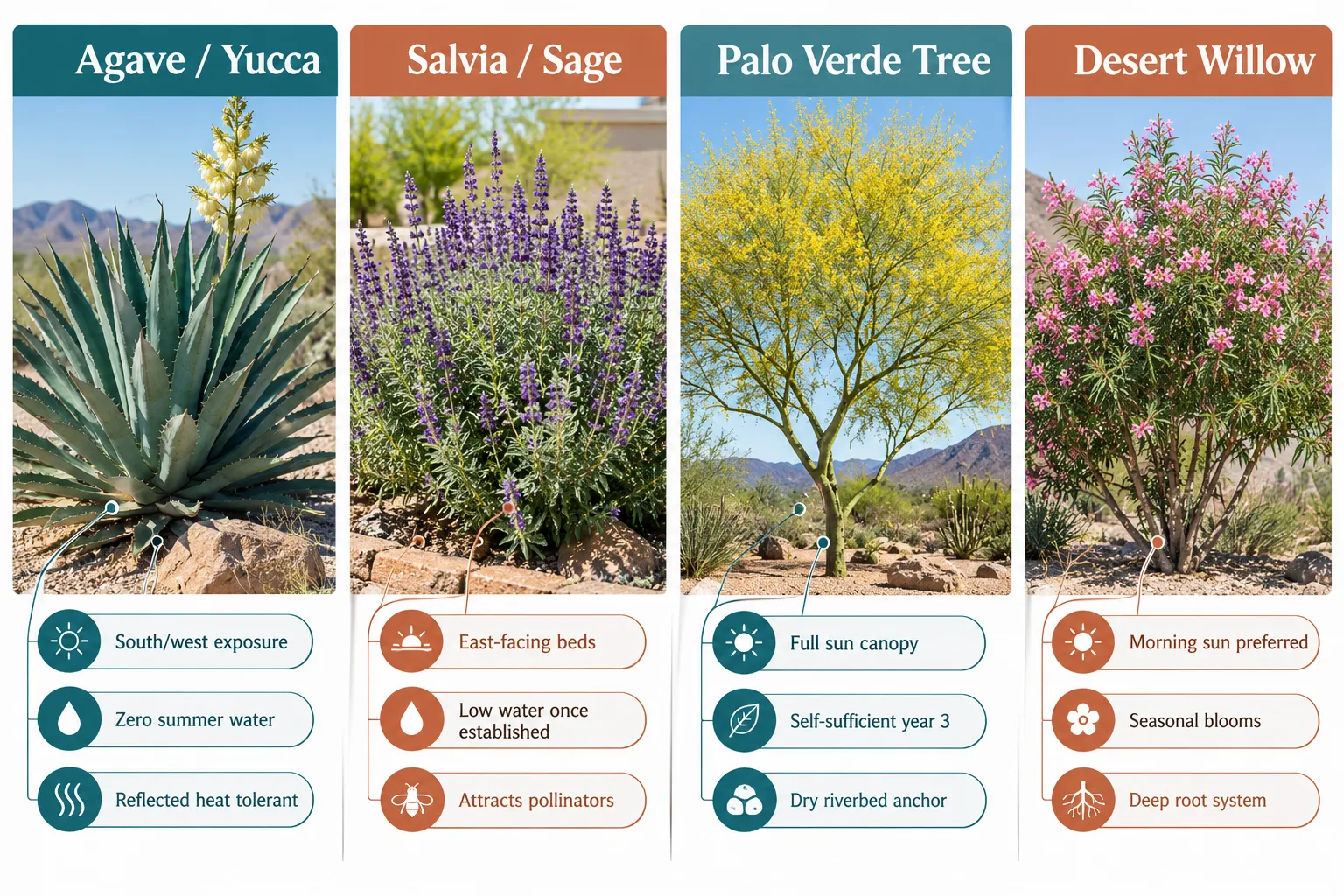
The best drought-resistant plants for Bakersfield are species that tolerate reflected heat from stucco walls, compacted valley soils, and extended dry periods without supplemental water after establishment. Agaves, yuccas, salvias, palo verde, and desert willow are proven performers in this climate. [3]
South- and west-facing exposures (where wall-reflected heat can exceed 110°F):
- Agave americana and Agave attenuata
- Yucca rostrata and Yucca filamentosa
- Salvia clevelandii (Cleveland sage)
- Trailing rosemary
East-facing beds (morning sun, less radiant heat):
- Mexican bush sage (Salvia leucantha)
- Desert willow (Chilopsis linearis)
- Bougainvillea trained against a wall
Trees for canopy and structure:
- Palo verde (Parkinsonia species), self-sufficient after roughly 3 years [3]
- Desert willow, seasonal blooms, deep roots, low water after year two
- California native oaks for larger lots
Establishment matters. During the first two growing seasons, run drip irrigation twice weekly from April through October, delivering about 1 gallon per plant per session. By the third summer, roots reach 18 to 24 inches deep and most species can survive on once-monthly watering or less. [3]
What Plants Survive 110-Degree Heat in Bakersfield
Plants that survive 110°F in Bakersfield share three traits: deep root systems, low leaf surface area, and the ability to go dormant rather than die under heat stress. Agaves, yuccas, and native cacti are the most reliable. [3]
Place the most heat-tolerant species along south- and west-facing walls where reflected heat from stucco adds 10 to 20 degrees above ambient air temperature. Reserve east-facing morning-sun spots for plants like Mexican bush sage and desert willow, which tolerate heat but benefit from afternoon shade. [3]
Quick rule: If a plant is native to the Sonoran or Chihuahuan Desert, it will almost certainly survive a Bakersfield summer. If it's native to the Mediterranean coast, test it in a protected east-facing spot first.
Bakersfield Landscaping Cost Per Square Foot
Bakersfield landscaping costs range from $3 to $18 per square foot installed, depending on the scope of work, materials, and whether grading or irrigation is included. These are 2026 local estimates based on regional contractor pricing, your actual quote will vary based on site conditions.
| Project Type | Estimated Cost Range |
|---|---|
| Decomposed granite install (materials + labor) | $3 to $6 per sq ft |
| Drought-tolerant planting bed | $6 to $10 per sq ft |
| Full xeriscape conversion (demo + install) | $8 to $18 per sq ft |
| Drip irrigation system (per zone) | $400 to $900 per zone |
| Concrete paver patio | $12 to $22 per sq ft |
| Artificial turf (installed) | $10 to $20 per sq ft |
Factors that push costs higher: removing existing sod, grading uneven ground, installing smart irrigation controllers, and adding hardscape like flagstone or concrete pavers. [2][3]
Decision rule: If your yard is under 500 square feet, a full xeriscape conversion often pays for itself within 3 to 5 years through water savings alone under Kern County's tiered rates.
Professional Landscaping Maintenance Cost in Bakersfield
Ongoing maintenance in Bakersfield typically runs $50 to $150 per visit for basic lawn care (mow, edge, blow), and $100 to $300 per month for full-service maintenance on a drought-tolerant yard. [10] Irrigation system checks, seasonal pruning, and mulch refreshes are usually billed separately.
For xeriscape yards, maintenance costs drop significantly after the two-year establishment period because plants need less water, less pruning, and no fertilizing. Budget for an annual mulch refresh (roughly $0.50 to $1.00 per square foot for materials) to maintain the 3-inch depth that suppresses weeds and retains soil moisture. [3]
How Often Should You Water Your Lawn in Bakersfield Summer
In Bakersfield summers, a traditional lawn needs watering 3 to 5 times per week to survive, typically delivering 1.5 to 2 inches of water total per week. Drought-tolerant landscapes need far less, about 0.2 to 0.4 inches per week once established. [3]
Bakersfield's Municipal Code requires watering between 6 p.m. and 9 a.m. to reduce evaporation loss. Watering during midday heat wastes 30 to 50% of applied water before it reaches roots. [5]
For drip systems on established xeriscapes:
- April through October: twice weekly, 1 gallon per plant per session during establishment years
- Year three onward: once monthly or eliminate entirely for most species [3]
Smart Wi-Fi irrigation controllers that pull data from California's CIMIS weather network will automatically skip watering after measurable rain and adjust run times based on evapotranspiration rates. They're worth the $150 to $300 upfront cost. [3]
How to Keep Landscaping Alive During Bakersfield Summer
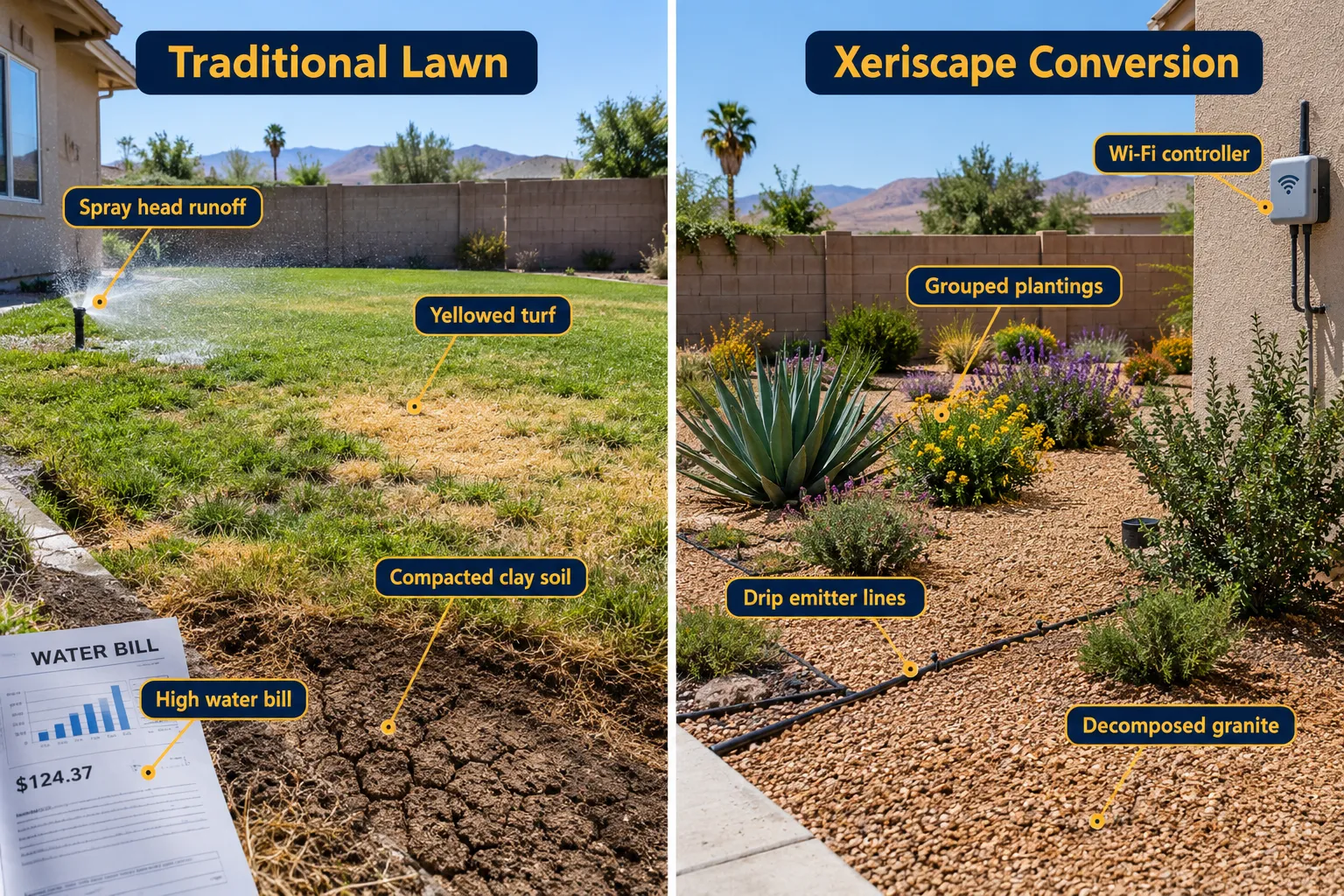
Keeping landscaping alive through a Bakersfield summer comes down to three things: the right plants in the right spots, drip irrigation instead of spray heads, and mulch that actually covers the soil. Most landscape failures in Kern County trace back to spray heads that waste water, plants placed in the wrong sun exposure, or bare soil that bakes roots. [3]
Practical checklist:
- Replace every spray head with inline drip tubing on 12-inch centers with pressure-compensating emitters rated at 0.6 gallons per hour [3]
- Apply a uniform 3-inch mulch layer (decomposed granite or organic mulch) refreshed annually
- Place agaves and yuccas on south and west walls; move less heat-tolerant species east
- Install a smart controller that reads CIMIS local weather data
- Check emitters monthly, clogged drip lines are the most common cause of plant death in summer
- Water deeply and infrequently to encourage deep root growth, not shallow surface roots [3]
Local contractors including Equity Landscapes and Gil's Garden Landscape offer irrigation audits and drip conversion services tailored to Kern County's soil and climate conditions. [1][8]
Desert Landscaping vs. Traditional Landscaping in Bakersfield
Desert landscaping in Bakersfield costs more upfront but saves money every year after installation. Traditional lawns cost less to plant but require 4 to 5 times more water, regular fertilizing, mowing, and often fail during extended heat waves above 105°F. [2][3]
Side-by-side comparison:
| Factor | Traditional Lawn | Desert/Xeriscape |
|---|---|---|
| Water use (summer) | 1.5 to 2 in/week | 0.2 to 0.4 in/week |
| Install cost | $2 to $5 per sq ft | $6 to $18 per sq ft |
| Maintenance | Weekly mowing, fertilizing | Annual mulch refresh |
| HOA rules | Usually allowed | Protected by CA Civil Code 4735 |
| Heat tolerance | Fails above 105°F | Designed for 110°F+ |
Choose desert landscaping if your water bill is a concern, you want a low-maintenance yard, or your HOA has historically pressured you to remove drought-tolerant plants (California law now protects you). [5]
Choose traditional landscaping if you have children or pets who need a grass surface and you're prepared to budget for higher water costs and weekly maintenance.
Can You Grow Grass in Bakersfield Heat
Yes, you can grow grass in Bakersfield, but it requires significant water and care during summer. Bermuda grass is the most heat-tolerant option for the San Joaquin Valley, it goes dormant rather than dying in extreme heat and recovers quickly with irrigation. Tall fescue is a common choice for shadier spots but struggles in full sun above 105°F without consistent watering. [10]
Realistic expectations for Bakersfield lawns:
- Bermuda grass: survives with 1 to 1.5 inches of water per week in summer, goes dormant in winter
- Tall fescue: needs 1.5 to 2 inches per week, may die in extended 110°F periods without shade
- Cool-season grasses (Kentucky bluegrass): not recommended for Bakersfield summers
The City of Bakersfield encourages turf reduction and applies MWELO standards to new landscaping projects. If you're installing new turf, budget for a drip or high-efficiency spray system to stay compliant. [5]
Is Artificial Turf Worth It in Bakersfield
Artificial turf is worth considering in Bakersfield if you want a green lawn appearance without the water cost. The city allows artificial turf in both front and rear residential yards, subject to drainage and coverage standards. [5]
Installed cost runs $10 to $20 per square foot in 2026. Payback period depends on your current water bill, but most Bakersfield homeowners with a 500-square-foot lawn see payback in 4 to 7 years through water savings alone.
Pros:
- No mowing, fertilizing, or overseeding
- Stays green through 110°F summers
- Works well for pet areas and play spaces
Cons:
- Surface temperature can reach 150°F+ in direct sun, not comfortable barefoot midday
- Upfront cost is higher than sod
- Requires occasional rinsing and infill replenishment every 5 to 8 years
Bottom line: Artificial turf makes the most financial sense for small front yards where appearance matters but foot traffic is low. For large backyards where kids and pets play, consider a hybrid approach: artificial turf in a defined zone, xeriscape in the rest. [5][2]
Low-Maintenance Landscaping Ideas for Hot Climates
Low-maintenance landscaping in Bakersfield means reducing irrigated planting area, choosing plants that need no care after establishment, and using hardscape to fill functional space. The goal is a yard that looks maintained without requiring weekly attention. [2][7]
Practical ideas that work in Kern County:
- Decomposed granite paths and beds: Compacted at 3 inches over weed-barrier fabric, edged with steel benderboard. Looks clean, suppresses weeds, requires no watering. [3]
- Dry riverbeds: Use river rock to create drainage channels that also add visual structure without any plant maintenance.
- Flagstone patios: Replace lawn with a functional outdoor living space. Pair with a shade sail or pergola for usability.
- Potted succulents: Group agaves and aloes in large containers near entries for a maintained look with almost zero water.
- Gravel mulch over drip lines: Eliminates evaporation, suppresses weeds, and requires only an annual top-up.
Local firms like Serenity Home Landscape and Equity Landscapes offer full design-and-install packages that combine these elements into cohesive, low-water yards. [9][1]
Bakersfield Landscaping Design for Small Yards
Small yards in Bakersfield (under 1,000 square feet) benefit most from a clear zoning strategy: one hardscape zone for living, one planting zone for visual interest, and no wasted space on irrigated turf. [2][3]
Small-yard design principles:
- Use vertical space: train bougainvillea or desert rose up a fence or trellis to add color without ground footprint
- Choose one statement plant (a large agave or palo verde) as a focal point instead of many small plants
- Use decomposed granite as the primary groundcover, it reads as clean and intentional, not empty
- Add a small flagstone patio or concrete paver area to make the space functional
- Keep irrigation to a single drip zone to simplify maintenance
A 600-square-foot front yard xeriscape conversion in Bakersfield typically costs $3,600 to $7,200 installed, depending on plant selection and hardscape complexity.
Common Landscaping Mistakes in Kern County
The most common landscaping mistakes in Kern County come down to planting the wrong species, using the wrong irrigation type, and ignoring soil conditions specific to the San Joaquin Valley. These mistakes are expensive to fix. [3][2]
Mistakes to avoid:
- Using spray heads instead of drip: Spray heads lose 30 to 50% of water to evaporation and wind drift in Bakersfield's summer heat. Switch to drip. [3]
- Planting without soil amendment: Valley soils are often heavy clay or compacted agricultural ground. Without amendment, roots can't penetrate and plants fail even with adequate water.
- Placing shade-preferring plants on west walls: West-facing walls radiate intense heat in the afternoon. Only place the most heat-tolerant species there.
- Skipping the establishment period: Even drought-tolerant plants need regular water for 2 full growing seasons. Cutting irrigation too early is the top cause of plant death. [3]
- Ignoring HOA rules before planting: Check your HOA's current rules, but know that California Civil Code 4735 protects your right to install drought-tolerant and native plants. [5]
- Hiring unlicensed contractors: In California, any landscaping job over $500 requires a licensed contractor. Verify the C-27 license at the California Contractors State License Board website before signing.
How to Find and Vet Bakersfield Landscaping Companies Near You
Finding a reliable Bakersfield landscaping company means verifying their license, checking real reviews, and asking the right questions before anyone starts digging. Your yard deserves someone who knows what they're doing, and in Kern County's climate, that means experience with drought-tolerant design specifically. [6][1]
What to verify before hiring:
- C-27 Landscaping Contractor license: Check at cslb.ca.gov. Any job over $500 requires this license in California.
- General liability insurance: Ask for a certificate of insurance naming you as an additional insured.
- Workers' compensation: If they have employees, they need it. Ask for proof.
- Local references: Ask for 2 to 3 Bakersfield-area jobs you can visit or call about.
Questions to ask before you hire:
- Have you done xeriscape or drought-tolerant installs in Kern County specifically?
- Do you pull permits for irrigation or hardscape work?
- What's your warranty on plants and installation?
- How do you handle soil amendment for valley clay soils?
- Who actually does the work, your employees or subcontractors?
Local firms with established Bakersfield portfolios include Equity Landscapes, Gil's Garden Landscape, and Serenity Home Landscape. [1][8][9] LawnStarter also lists vetted local providers with pricing transparency. [10]
Know who you're letting into your yard. Licensed, insured, and reviewed, that's the baseline, not a bonus.
FAQ
Q: How much does a basic xeriscape conversion cost in Bakersfield?
A full xeriscape conversion in Bakersfield typically runs $8 to $18 per square foot installed, including demolition of existing lawn, soil prep, decomposed granite, plants, and drip irrigation. A 500-square-foot front yard conversion usually costs $4,000 to $9,000.
Q: Is xeriscaping required in Bakersfield?
It's not required for existing landscapes, but California's MWELO ordinance applies to all new construction and major rehabilitations. The city strongly encourages drought-tolerant landscaping and ties water use to state drought regulations. [5]
Q: Can my HOA force me to remove drought-tolerant plants in Bakersfield?
No. California Civil Code 4735 prohibits HOAs from banning drought-tolerant or native plants and requires them to tolerate dead lawns during declared droughts. [5]
Q: What license should a Bakersfield landscaping contractor have?
A C-27 Landscaping Contractor license issued by the California Contractors State License Board. Verify it at cslb.ca.gov before signing any contract for work over $500.
Q: When is the best time to plant drought-tolerant landscaping in Bakersfield?
Fall (October through November) is ideal. Cooler temperatures and occasional winter rain help new plants establish roots before facing their first Bakersfield summer. Spring planting works but requires more attentive irrigation through the first hot season.
Q: How long does it take for a xeriscape to be self-sustaining in Bakersfield?
Most drought-tolerant plants reach self-sufficiency after two full growing seasons. Trees like palo verde and desert willow typically need about three years before they can survive on rainfall alone. [3]
Q: Does Bakersfield offer rebates for removing turf?
Water agencies in Kern County have offered turf replacement rebates in past years. Check with California Water Service and the Kern County Water Agency for current 2026 program availability, as programs change with drought conditions.
Q: What's the surface temperature of artificial turf in Bakersfield summer?
Artificial turf surface temperatures can exceed 150°F in direct afternoon sun during Bakersfield summers. It's functional for low-traffic areas and pet runs but uncomfortable for barefoot use during peak heat hours.
Conclusion
Bakersfield landscaping in 2026 is not about following trends. It's about designing for a climate that will test every plant, every sprinkler head, and every design decision you make. The homeowners who get it right do three things: they choose plants built for 110°F heat, they replace spray irrigation with drip, and they hire contractors who actually know Kern County soils.
Your next steps:
- Walk your yard and identify south- and west-facing walls where heat is most intense, those spots need the toughest plants
- Get at least three quotes from C-27-licensed Bakersfield landscaping contractors
- Ask each contractor specifically about their drought-tolerant and xeriscape experience in Kern County
- Verify every license at cslb.ca.gov before signing
- Check with California Water Service for any current turf replacement rebates before starting demolition
Find the right landscaper for your yard. Local pros, local knowledge, that's what makes the difference between a yard that survives a Bakersfield summer and one that doesn't.
References
[1] Equity Landscapes - https://www.equity-landscapes.com/
[2] Landscape Design Bakersfield - https://www.equity-landscapes.com/landscape-design-bakersfield
[3] Bakersfield Ca Drought Tolerant Landscaping - https://hadaa.app/blog/bakersfield-ca-drought-tolerant-landscaping
[5] Landscaping - https://cityrulelookup.com/cities/bakersfield-ca/landscaping
[6] Bakersfield Ca - https://www.trees.com/gardening-and-landscaping/bakersfield-ca
[7] Equity Landscapes - https://equitylandscapes.com/
[8] Gil's Garden Landscape - https://gilsgardenlandscape.com/
[9] Serenity Home Landscape - https://www.serenityhomelandscape.com/
[10] Bakersfield Ca Landscaping - https://www.lawnstarter.com/bakersfield-ca-landscaping
<!DOCTYPE html>
<html lang="en">
<head>
<meta charset="UTF-8">
<meta name="viewport" content="width=device-width, initial-scale=1.0">
<title>Bakersfield Landscaping Water Calculator</title>
<style>
  .cg-calc{font-family:Arial,sans-serif;max-width:480px;margin:24px auto;background:#f7f4ef;border:1px solid #d4c9b0;border-radius:8px;padding:20px}
  .cg-calc h3{margin:0 0 4px;font-size:1.1rem;color:#2c4a2e}
  .cg-calc p{margin:0 0 14px;font-size:.85rem;color:#555}
  .cg-row{margin-bottom:12px}
  .cg-row label{display:block;font-size:.85rem;font-weight:bold;color:#2c4a2e;margin-bottom:4px}
  .cg-row input,.cg-row select{width:100%;box-sizing:border-box;padding:7px 10px;border:1px solid #bbb;border-radius:5px;font-size:.9rem}
  .cg-btn{background:#2c7a3e;color:#fff;border:none;padding:10px 20px;border-radius:5px;font-size:.95rem;cursor:pointer;width:100%}
  .cg-btn:hover{background:#235f30}
  .cg-result{margin-top:14px;background:#fff;border:1px solid #b5d4b9;border-radius:5px;padding:12px;font-size:.88rem;color:#2c4a2e;display:none}
  .cg-result strong{font-size:1rem}
</style>
</head>
<body>
<div class="cg-calc">
  <h3>Bakersfield Summer Water Estimator</h3>
  <p>Compare weekly water use for your yard type in Kern County heat.</p>
  <div class="cg-row">
    <label>Yard size (square feet)</label>
    <input type="number" id="cg-sqft" placeholder="e.g. 800" min="100" max="10000">
  </div>
  <div class="cg-row">
    <label>Landscape type</label>
    <select id="cg-type">
      <option value="lawn">Traditional lawn</option>
      <option value="xeri">Established xeriscape</option>
      <option value="mixed">Mixed (50/50)</option>
    </select>
  </div>
  <button class="cg-btn" onclick="cgCalc()">Calculate Weekly Water Use</button>
  <div class="cg-result" id="cg-result"></div>
</div>
<script>
function cgCalc(){
  var sf=parseFloat(document.getElementById('cg-sqft').value);
  var t=document.getElementById('cg-type').value;
  if(!sf||sf<100){alert('Enter a yard size of at least 100 sq ft.');return;}
  var rates={lawn:1.75,xeri:0.3,mixed:1.025};
  var inch=rates[t];
  var gal=Math.round(sf*inch*0.623);
  var labels={lawn:'Traditional lawn',xeri:'Established xeriscape',mixed:'Mixed yard'};
  var r=document.getElementById('cg-result');
  r.style.display='block';
  r.innerHTML='<strong>'+labels[t]+' ('+sf.toLocaleString()+' sq ft)</strong><br>Estimated weekly water: <strong>'+inch+' inches / ~'+gal.toLocaleString()+' gallons</strong><br><br>Source: Drought-tolerant landscapes use 0.2-0.4 in/week vs 1.5-2 in/week for turf (hadaa.app, 2026). Gallon estimate uses 0.623 gal/sq ft per inch.';
}
</script>
</div>
</body>
</html>
Liked this guide? Follow us on Google Search
Related Directory Pages
Find a Landscaper Near You
Browse CA landscaping professionals on LandscapeProsDirectory.
Search Landscapers