
California Statewide Drought Rules and Water Use Laws
California drought rules and statewide water use laws for 2026. Stay informed on MWELO requirements and mandatory irrigation restrictions for CA homes.
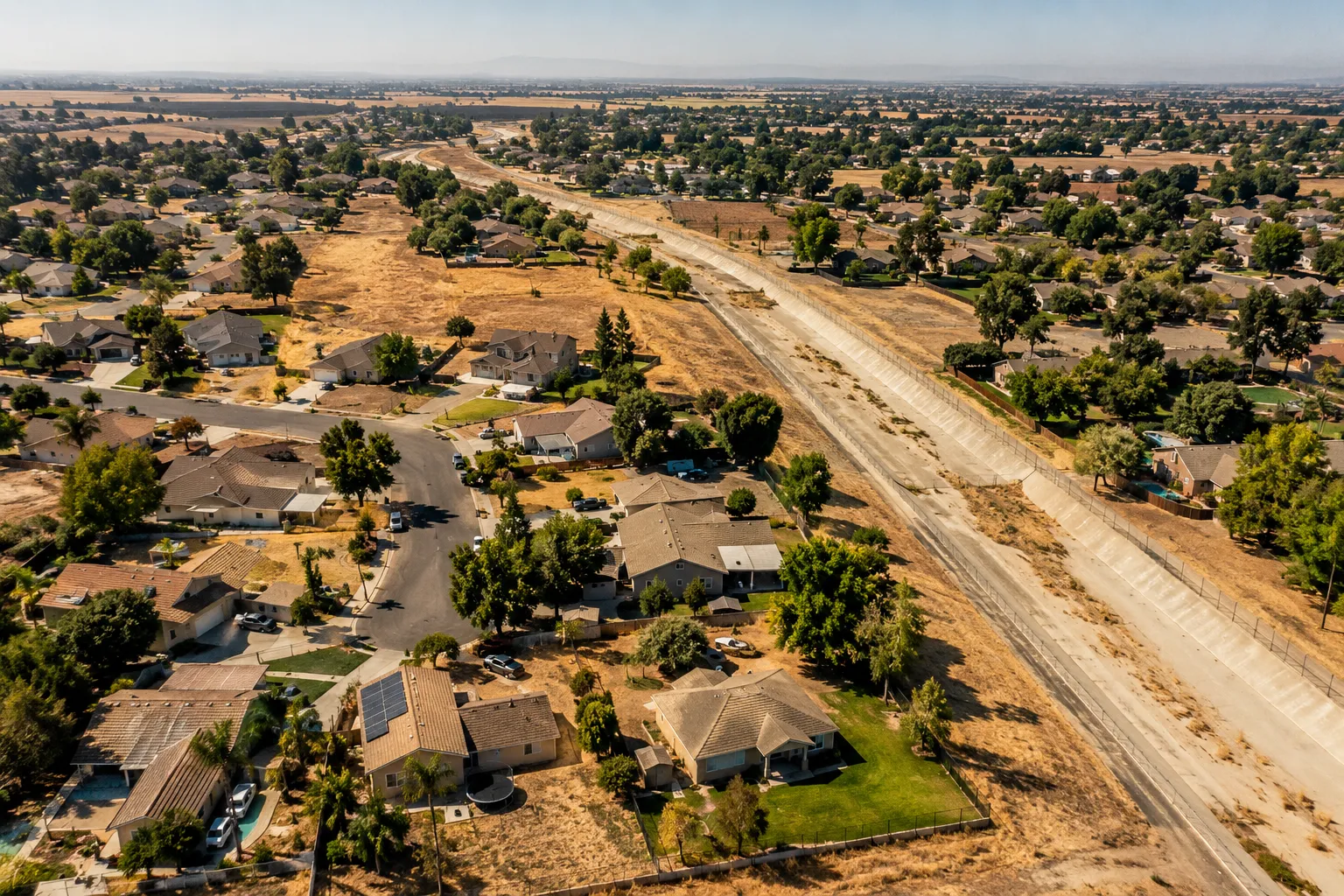
Last updated: October 1, 2026
Quick Answer: California has no active statewide emergency drought declaration as of 2026, but permanent year-round water-waste rules apply to every property in the state. On top of those baseline rules, local water districts set their own watering schedules and shortage stages. The Model Water Efficient Landscape Ordinance (MWELO) adds mandatory efficiency standards for new and renovated landscapes above certain size thresholds. Violating any of these rules can result in fines from your local water agency.
Key Takeaways
- California's statewide emergency drought rules from 2015-2016 are not currently in effect; the State Water Resources Control Board reports no active emergency conservation regulation as of 2026 [1][2]
- Permanent baseline rules ban wasteful water practices statewide year-round, regardless of drought status, including runoff onto streets, hosing down driveways, and irrigating within 48 hours of measurable rainfall [9]
- MWELO applies to new landscapes over 500 square feet and to renovations meeting certain size thresholds; it sets water budgets, irrigation efficiency requirements, and plant selection standards
- Local water districts layer their own restrictions on top of state rules; your county or city agency sets actual watering days, times, and shortage-stage penalties
- The Metropolitan Water District of Southern California issued a Level 1 conservation notice in March 2026, affecting about 19 million residents across Southern California [9]
- Enforcement of individualized water budgets for urban suppliers begins in 2027 under the "Conservation as a California Way of Life" framework [9]
- Turf replacement rebate programs exist through many local agencies, but program availability and rebate amounts vary widely by district
- Fines for water waste violations typically start at $100 per day per violation and can escalate with repeat offenses
Table of Contents
- What Are the Current California Drought Restrictions in 2026?
- Are California Drought Rules Permanent or Temporary?
- The Model Water Efficient Landscape Ordinance (MWELO) Explained
- Statewide vs. Local Water District Restrictions
- Mandatory Irrigation Efficiency Standards
- California Drought Lawn Watering Restrictions Explained
- California Drought Rules for Pools and Fountains
- What Counts as Essential Water Use in California?
- California Drought Rules for Businesses vs. Residential
- Turf Replacement Programs and Compliance
- What Happens If You Violate California Drought Rules?
- How to Get a Drought Exemption in California
- California Drought Water Conservation Tips That Actually Work
- When Will California Drought Restrictions Be Lifted?
- FAQ
- References
What Are the Current California Drought Restrictions in 2026?
As of 2026, there is no active statewide emergency drought regulation in California. The State Water Resources Control Board confirms the extraordinary emergency rules used during the 2015-2016 drought are not currently in force [1][2]. That does not mean anything goes.
California now operates under two permanent layers of water rules:
- Statewide baseline prohibitions that apply everywhere, all the time
- Local water district restrictions that vary by region and can tighten based on local supply conditions
Some regions face tighter management. The Scott River and Shasta River watersheds in Northern California have active curtailment orders in 2026, with Addendum 12 (dated June 9, 2026) reinstating curtailments for surface water rights when river flows fell below required thresholds [4].
Are California Drought Rules Permanent or Temporary?
The baseline water-waste prohibitions are permanent. They are not tied to a drought declaration and do not expire. California's "Making Conservation a California Way of Life" framework established these as ongoing standards, not emergency measures [9].
Emergency rules, by contrast, can be adopted by the State Water Board after a gubernatorial drought proclamation. Those rules can last up to one year and be renewed if drought conditions persist [6]. The 2025 emergency regulation for the Scott and Shasta River watersheds, extended by Assembly Bill 263 on September 26, 2025, runs until January 1, 2031, or until permanent instream flow rules are adopted, whichever comes first [4].
Bottom line: Permanent rules are always in effect. Emergency rules come and go based on conditions. Know which type applies to your area.
The Model Water Efficient Landscape Ordinance (MWELO) Explained
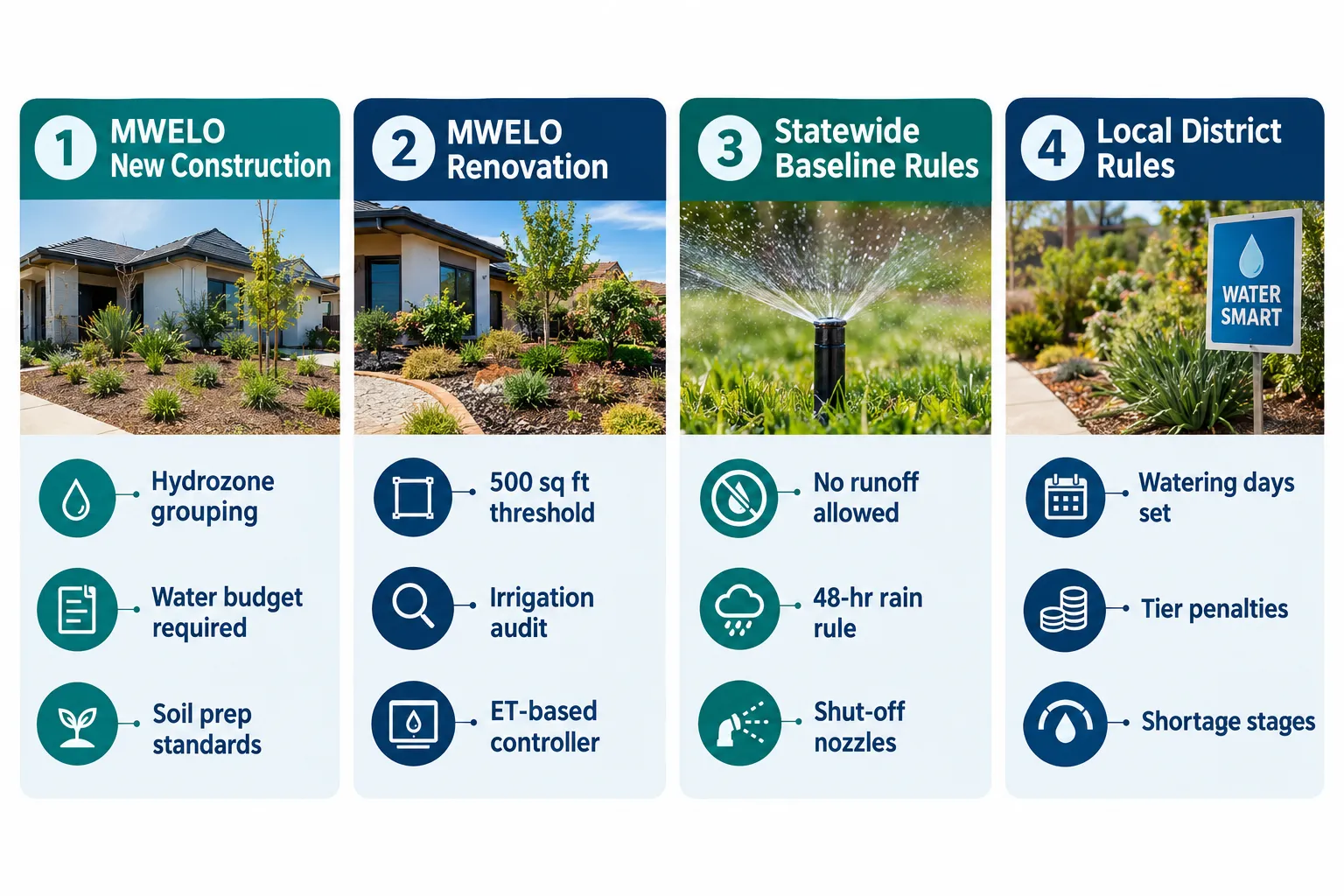
MWELO is California's statewide minimum standard for water-efficient landscaping. It applies to new construction and to landscape renovations that meet certain size thresholds. Local agencies can adopt MWELO as written or create a stricter local ordinance.
When MWELO applies:
- New landscapes of 500 square feet or more at single-family homes
- New commercial, multifamily, and public agency landscapes of 500 square feet or more
- Rehabilitated landscapes where the total cost of the project exceeds 50 percent of the value of the existing landscaping, and the area being rehabilitated is 2,500 square feet or more (for homeowner-initiated projects) or 1,000 square feet or more (for developer projects)
What MWELO actually requires:
- A Landscape Documentation Package submitted before a permit is issued, including a site plan, plant list, and water use calculations
- A Maximum Applied Water Allowance (MAWA), which is a water budget calculated using local evapotranspiration (ET) data
- Plants grouped into hydrozones so irrigation matches actual plant water needs
- A soil preparation and amendment plan to improve water retention
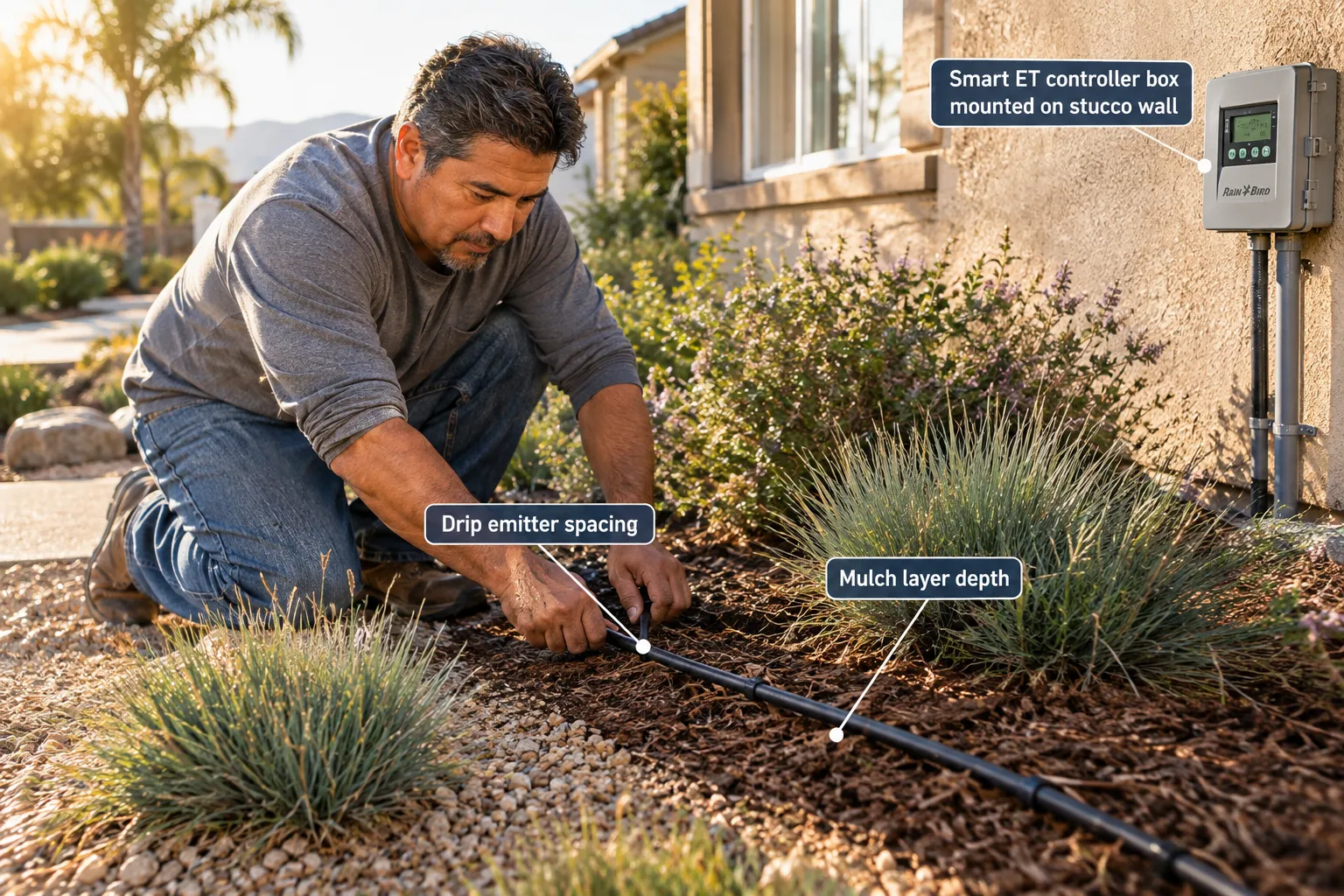
- Irrigation system design that meets efficiency standards, including pressure regulators and weather-based controllers
- A Certificate of Completion signed by the licensed contractor or property owner after installation
Who enforces MWELO? Local agencies, typically the city or county building department, enforce MWELO through the permit process. The State does not directly inspect individual residential landscapes for MWELO compliance, but local agencies are required to implement it.
Statewide vs. Local Water District Restrictions
Statewide rules set the floor. Local water districts set the ceiling for what is allowed in their service area.
Statewide permanent baseline rules include [9]:
- No using potable water to wash sidewalks or driveways, except for health and safety
- No irrigation that causes runoff into streets or neighboring properties
- Hoses used for vehicle washing must have a shut-off nozzle
- Decorative fountains must use recirculating water systems
- No outdoor irrigation for 48 hours after measurable rainfall (approximately 0.25 inches)
- No watering ornamental turf on public street medians
Local districts add rules such as:
- Specific watering days (for example, odd/even address schedules)
- Restrictions on watering hours (often before 9 a.m. or after 6 p.m.)
- Shortage stages (Stage 1 through Stage 4) that trigger progressively tighter cuts
- Mandatory irrigation audits for large properties
- Prohibitions on new turf installation during shortage stages
The Metropolitan Water District of Southern California issued a Level 1 conservation notice in March 2026 to all 26 member agencies [9]. That affects cities across Los Angeles, Orange, Riverside, San Bernardino, San Diego, and Ventura counties. If you are in that region, check with your local retailer (such as LADWP, Irvine Ranch Water District, or Eastern Municipal Water District) for the specific rules in effect.
California drought watering schedule by county: There is no single statewide watering schedule. Each water district sets its own. Find your district at the California Urban Water Agencies website or call your water bill provider directly.
Mandatory Irrigation Efficiency Standards
For any landscape subject to MWELO, the irrigation system must meet specific performance standards. These are not suggestions.
Required irrigation components:
| Requirement | Standard |
|---|---|
| Controller type | Weather-based (ET) or soil moisture sensor |
| Pressure regulation | Required at each valve or head |
| Distribution uniformity | Minimum 0.71 for spray; 0.81 for drip |
| Matched precipitation rates | Required within each hydrozone |
| Backflow prevention | Required per local plumbing code |
| Flow sensor (large landscapes) | Required for landscapes over 5,000 sq ft |
Drip irrigation is strongly preferred for shrubs and groundcovers. Spray irrigation is only allowed where it is the most efficient option for the plant type.
Common mistake: Installing a smart controller without pressure regulators. A smart controller reduces run time, but if pressure is too high, you still get misting and runoff. Both components are required.
California Drought Lawn Watering Restrictions Explained
Lawn watering is the single largest category of residential outdoor water use in California. It is also the most regulated.
Under permanent statewide rules, you cannot water in a way that causes runoff or waters during or within 48 hours after rain [9]. Beyond that, local restrictions vary significantly.
Typical local watering restrictions during shortage stages:
- Stage 1: Limit irrigation to two or three days per week
- Stage 2: Limit to one or two days per week; no watering between 9 a.m. and 6 p.m.
- Stage 3: Significant cuts; new turf installation often prohibited
- Stage 4: Emergency restrictions; outdoor irrigation may be suspended except for food gardens and trees
Ornamental turf on public medians is permanently banned from potable water irrigation statewide [9]. That rule applies regardless of drought status.
California Drought Rules for Pools and Fountains
Filling or refilling a pool with potable water is not banned statewide under current rules, but local agencies may restrict it during shortage stages. Check with your water district.
What is permanently banned statewide:
- Operating a decorative fountain or water feature that does not use a recirculating pump [9]
- Allowing pool water to overflow or spill onto adjacent property or streets
What local agencies may restrict during shortages:
- Initial filling of new pools
- Refilling pools that have been drained for non-essential reasons
- Spa and hot tub refills
If you are building a new pool or water feature, your contractor must comply with local plumbing codes and any active shortage-stage restrictions from your water district.
What Counts as Essential Water Use in California?
Essential water use is not a formal legal category in most California water codes, but the concept shapes which uses are protected from restriction.
Uses generally considered essential and protected from restriction:
- Drinking, cooking, and basic sanitation
- Watering food gardens and edible crops (though times and methods may be regulated)
- Watering newly planted trees and shrubs during an establishment period (typically up to two years)
- Fire suppression
- Water needed for livestock and animals
- Dust control on construction sites (with approved methods)
Uses that are not considered essential and are subject to restriction:
- Irrigating ornamental turf
- Washing vehicles without a shut-off nozzle
- Hosing down hard surfaces
- Filling decorative water features without recirculation
If your landscape contractor tells you that watering restrictions do not apply to newly installed sod, that is partially true. Most districts allow an establishment watering period for new plantings, but the period is limited and must be requested or documented. Ask your contractor and your water district for specifics before installation.
California Drought Rules for Businesses vs. Residential
The permanent baseline rules apply equally to residential and commercial properties. Both are subject to the same bans on runoff, driveway washing, and post-rain irrigation [9].
Where businesses face additional requirements:
- Commercial car washes must use water recycling systems
- Restaurants may not serve water to customers unless requested (this rule has been in effect since 2015 and remains in place)
- Hotels must offer guests the option to reuse linens and towels
- Commercial irrigation systems over 5,000 square feet must have flow sensors under MWELO
- Large commercial landscapes may be subject to mandatory irrigation audits
Where residential faces stricter scrutiny:
- Ornamental turf is a primary target of local shortage-stage restrictions
- Single-family homes with large lots may face tiered water pricing that penalizes high use
- New single-family construction must comply with MWELO for all landscaped areas over 500 square feet
Under the "Conservation as a California Way of Life" framework, urban retail water suppliers (the utilities that serve both homes and businesses) must meet individualized water-use objectives. Enforcement of those objectives begins in 2027 [9][10]. Suppliers that fail to meet their targets can receive conservation orders from the State Water Board [10].
Turf Replacement Programs and Compliance
Many California water districts offer rebates for replacing water-thirsty turf with drought-tolerant plants, mulch, or permeable hardscape. These programs are locally funded and vary widely.
Typical rebate structures (estimates; verify with your district):
- Turf removal rebates: commonly $1 to $3 per square foot removed, up to a maximum area
- Smart controller rebates: typically $50 to $200 per controller
- Drip conversion rebates: varies by district
To qualify for most turf replacement programs:
- Apply and receive approval before removing turf
- Remove turf and irrigation to a minimum depth (often 3 to 4 inches)
- Install approved replacement materials (drought-tolerant plants, mulch, permeable pavers)
- Submit photos and documentation for inspection
- Maintain the replacement landscape for a minimum period (often one to three years)
Compliance note: If your landscape contractor installs new turf as part of a renovation subject to MWELO, and the project exceeds the applicable size threshold, the turf must meet MWELO's water budget limits. High-water-use turf may not be plantable in the quantities that were standard before 2010.
Your yard deserves someone who knows what they're doing. When hiring a landscaper for a turf replacement or irrigation upgrade, ask specifically whether they have completed MWELO-compliant projects and whether they are familiar with your local water district's rebate application process.
What Happens If You Violate California Drought Rules?
Violations of permanent statewide rules and local restrictions are enforced by local water agencies, not the State Water Board directly.
Typical enforcement process:
- First offense: Written warning in most districts
- Second offense: Fine, commonly $100 to $500 per day per violation
- Third offense: Fine escalation; some districts install flow restrictors on the meter
- Repeated violations: Potential service interruption
During a declared statewide drought emergency, fines can increase. Under the 2015-2016 emergency, fines reached up to $10,000 per day for water suppliers and $500 per day for individual users. Those specific amounts are not currently in effect, but they illustrate what can happen when a statewide emergency is declared.
Who reports violations? Neighbors, code enforcement officers, and water district inspectors can all report violations. Many districts have online reporting portals.
How to Get a Drought Exemption in California
There is no single statewide drought exemption process. Exemptions are granted at the local water district level, and the process varies.
Common grounds for exemption or variance:
- Newly installed landscaping in an approved establishment period
- Medical or health conditions that require specific water use
- Agricultural or food-production uses on residential properties
- Fire protection systems that require specific water pressure or flow
- Local cooperative solutions (LCSs) in regulated watersheds, such as the Scott and Shasta Rivers, where alternative conservation measures can substitute for curtailment [4]
How to apply:
- Contact your local water district's conservation department
- Ask specifically about variance or exemption procedures for your situation
- Submit documentation (contractor receipts, medical letters, or other supporting materials)
- Get the approval in writing before assuming the exemption applies
Do not rely on verbal assurances from a contractor that your project is exempt. Get confirmation from your water district directly.
How Do California Drought Rules Differ by Region?
California drought rules vary significantly by region because water supply conditions, water rights, and local ordinances differ across the state.
Key regional differences:
- Northern California (Scott/Shasta watersheds): Active curtailment orders in 2026 for surface water rights; Local Cooperative Solutions available as alternatives [4]
- Southern California (MWD service area): Level 1 conservation notice in effect as of March 2026; local agencies set specific watering schedules [9]
- Central Valley: Agricultural water use governed by water rights and groundwater sustainability plans under SGMA; urban rules still apply to residential landscapes
- Bay Area: Local agencies such as East Bay MUD and SFPUC have their own tiered shortage stages and watering schedules
- Inland Empire and San Diego: Some of the strictest local turf restrictions in the state; active rebate programs
The 2026 Annual Water Supply and Demand Assessment from the Department of Water Resources documents how local shortage response actions vary across the state, with common measures including restricting landscape irrigation days and prohibiting potable water use for hard surface washing [8].
California Drought Water Conservation Tips That Actually Work
No fluff, just useful advice. These measures consistently reduce outdoor water use for California homeowners.
- Switch to a weather-based (ET) controller. It adjusts run times automatically based on local evaporation data. Most districts offer rebates. A properly programmed ET controller can cut outdoor water use by 20 to 40 percent compared to a timer-based system.
- Fix leaks before planting season. A single dripping emitter or broken spray head can waste thousands of gallons per month. Walk your system once a month.
- Water deeply and infrequently. Deep watering encourages roots to go down, not sideways. Shallow daily watering keeps roots near the surface and increases evaporation loss.
- Mulch everything. A 3-inch layer of wood chip mulch over plant beds reduces evaporation significantly and suppresses weeds that compete for water.
- Replace high-water turf with California natives or low-water alternatives. Fescue, buffalo grass, and native groundcovers use a fraction of the water that traditional Kentucky bluegrass requires.
- Group plants by water need. Do not put a thirsty hydrangea next to a drought-tolerant agave on the same valve. Hydrozoning is required under MWELO and it works.
- Check your water bill for usage spikes. A sudden increase in usage often signals a leak or a controller malfunction. Catch it early.
When Will California Drought Restrictions Be Lifted?
The permanent baseline rules will not be lifted. They are now California law, not emergency measures [9]. The "Conservation as a California Way of Life" framework treats these as ongoing standards.
Emergency restrictions, if imposed during a future drought, would be lifted when the Governor ends the drought emergency declaration and the State Water Board determines that conditions no longer require emergency action.
Looking ahead, California's drought management strategy is shifting away from blanket emergency bans toward supplier-level performance accountability. Enforcement of individualized water budgets for urban water suppliers begins in 2027. Starting in 2026 and again in 2028, the State Water Board can issue conservation orders to suppliers that fail to meet their objectives [10]. This means future drought response is more likely to come through your water utility's local rules than through a single statewide household ban.
FAQ
Q: Do California drought rules apply to me if I rent my home?
A: Yes. Water-waste prohibitions apply to the property and the person using the water. Renters can be cited for violations such as runoff or post-rain irrigation. Check your lease to understand who is responsible for the irrigation system.
Q: Can my water district fine me for watering on the wrong day?
A: Yes. If your district has a designated watering day schedule in effect, watering outside those days can result in a warning and then a fine. First offenses are usually a written warning. Fines typically start at $100 per violation.
Q: Does MWELO apply to my backyard vegetable garden?
A: MWELO applies to the total landscaped area of a project, not specific plant types. If your renovation project exceeds the size threshold (500 to 2,500 square feet depending on project type), the entire project must comply with MWELO, including vegetable areas. However, food gardens are not subject to the same water-budget restrictions as ornamental landscapes in most local ordinances.
Q: What is the 48-hour rain rule?
A: California's permanent statewide rules prohibit outdoor irrigation for 48 hours after measurable rainfall, generally defined as approximately 0.25 inches. A weather-based ET controller with a rain sensor will handle this automatically.
Q: Are there California drought rules for agriculture and farming?
A: Yes, but they operate differently from urban rules. Agricultural water users hold water rights administered by the State Water Board. During droughts, the Board can issue curtailment orders to rights holders when river flows fall below required thresholds, as seen in the Scott and Shasta River watersheds in 2026 [4]. Groundwater use by farmers is also subject to Groundwater Sustainability Plans under the Sustainable Groundwater Management Act (SGMA).
Q: How do I find out my local water district's current restrictions?
A: Call the number on your water bill or visit your water district's website. Search for "conservation," "water shortage," or "watering schedule." The California Urban Water Agencies and the Association of California Water Agencies both maintain directories of member agencies.
Conclusion
California drought rules in 2026 are not a single set of rules. They are a layered system: permanent statewide baseline prohibitions, MWELO efficiency standards for new and renovated landscapes, and local water district restrictions that change based on supply conditions.
Here are your actionable next steps:
- Call your water district and ask what shortage stage is currently in effect and what the watering schedule is for your address.
- Walk your irrigation system once a month. Fix broken heads, check for runoff, and make sure your controller is programmed correctly.
- If you are planning a landscape project, ask your contractor whether MWELO applies to your project size and whether they have completed MWELO-compliant installations before.
- Ask about rebates before removing turf or upgrading your irrigation controller. Many districts will pay part of the cost.
- Get exemptions in writing if you believe your situation qualifies. Do not assume a contractor's verbal assurance covers you.
Find the right landscaper for your yard at LandscapeProsDirectory. Local pros, local knowledge, licensed, insured, and reviewed. Know who you're letting into your yard before they show up with a shovel.
References
[1] Emergency Regulation - https://www.waterboards.ca.gov/water_issues/programs/conservation_portal/regs/emergency_regulation.html
[2] Emergency Regulation - https://www.waterboards.ca.gov/conservation/regs/emergency_regulation.html
[4] 41bc94f - https://content.govdelivery.com/accounts/CAWRCB/bulletins/41bc94f
[6] 2026 01 22 Item 6b Bill Report - https://www.deltacouncil.ca.gov/pdf/council-meeting/meeting-materials/2026-01-22-item-6b-bill-report.pdf
[8] 2026 Awsda Summary Report B 161 9 17 26 - https://water.ca.gov/-/media/DWR-Website/Web-Pages/Programs/Water-Use-And-Efficiency/Files/2026-AWSDA-Summary-Report-B-161_9-17-26.pdf
[9] Conservation Way Of Life - https://waterboards.ca.gov/stories/2026/conservation-way-of-life.html
[10] Billcompareclient - https://leginfo.legislature.ca.gov/faces/billCompareClient.xhtml?bill_id=202320240SB1330&showamends=false
<!DOCTYPE html>
<html lang="en">
<head>
<meta charset="UTF-8">
<meta name="viewport" content="width=device-width, initial-scale=1.0">
<title>California Drought Rules Checker</title>
<style>
  .cg-wrap{font-family:system-ui,sans-serif;max-width:560px;margin:2rem auto;background:#f7f9fc;border:1px solid #d0dce8;border-radius:10px;padding:1.5rem}
  .cg-wrap h3{margin:0 0 .75rem;font-size:1.1rem;color:#1a3a5c}
  .cg-label{display:block;font-size:.85rem;font-weight:600;color:#2d4a6a;margin:.9rem 0 .3rem}
  .cg-select,.cg-btn{width:100%;padding:.55rem .75rem;border-radius:6px;border:1px solid #b0c4d8;font-size:.9rem;box-sizing:border-box}
  .cg-btn{background:#1a6fa8;color:#fff;border:none;cursor:pointer;margin-top:1rem;font-weight:600}
  .cg-btn:hover{background:#155d8e}
  .cg-result{margin-top:1rem;background:#fff;border-left:4px solid #1a6fa8;padding:.75rem 1rem;border-radius:0 6px 6px 0;font-size:.88rem;line-height:1.55;display:none}
  .cg-result.show{display:block}
  .cg-tag{display:inline-block;background:#e2f0fb;color:#1a3a5c;border-radius:4px;padding:.15rem .5rem;font-size:.78rem;font-weight:700;margin-bottom:.4rem}
</style>
</head>
<body>
<div class="cg-wrap">
  <h3>California Drought Rules Quick Checker</h3>
  <p style="font-size:.85rem;color:#4a6070;margin:.25rem 0 .5rem">Answer two questions to see which rules likely apply to your property.</p>
  <label class="cg-label" for="cg-region">Your region</label>
  <select class="cg-select" id="cg-region">
    <option value="">-- Select --</option>
    <option value="socal">Southern California (MWD area)</option>
    <option value="norcal">Northern CA / Scott-Shasta watershed</option>
    <option value="bay">Bay Area</option>
    <option value="central">Central Valley</option>
    <option value="other">Other / Not sure</option>
  </select>
  <label class="cg-label" for="cg-project">Project type</label>
  <select class="cg-select" id="cg-project">
    <option value="">-- Select --</option>
    <option value="new">New landscape (500+ sq ft)</option>
    <option value="reno">Renovation (2,500+ sq ft homeowner)</option>
    <option value="small">Small yard changes (under 500 sq ft)</option>
    <option value="pool">Pool or water feature</option>
    <option value="turf">Turf removal / replacement</option>
  </select>
  <button class="cg-btn" onclick="cgCheck()">Show My Rules</button>
  <div class="cg-result" id="cg-result"></div>
</div>
<script>
function cgCheck(){
  var r=document.getElementById('cg-region').value;
  var p=document.getElementById('cg-project').value;
  var el=document.getElementById('cg-result');
  if(!r||!p){el.innerHTML='<strong>Please select both options.</strong>';el.className='cg-result show';return;}
  var rules={
    new:'<span class="cg-tag">MWELO Required</span><br>Submit a Landscape Documentation Package before permit. Water budget (MAWA) calculation required. ET-based controller and pressure regulators mandatory.',
    reno:'<span class="cg-tag">MWELO May Apply</span><br>Applies if renovation area is 2,500+ sq ft (homeowner) or 1,000+ sq ft (developer). Confirm threshold with your local building dept.',
    small:'<span class="cg-tag">Baseline Rules Only</span><br>MWELO does not apply. Statewide permanent rules still apply: no runoff, no irrigation within 48 hrs of rain, shut-off nozzle required.',
    pool:'<span class="cg-tag">Check Local District</span><br>Statewide: decorative fountains must recirculate. Pool filling not banned statewide but local shortage stages may restrict it.',
    turf:'<span class="cg-tag">Rebate Available</span><br>Apply before removing turf. Most districts pay $1,$3/sq ft. Get approval in writing first. Replacement must be maintained for 1-3 years.'
  };
  var regional={
    socal:'<br><strong>Southern CA note:</strong> MWD Level 1 conservation notice in effect (March 2026). Check your local retailer for watering day schedule.',
    norcal:'<br><strong>Northern CA note:</strong> Active curtailment orders for Scott/Shasta watershed surface water rights (Addendum 12, June 2026). Verify your water rights status.',
    bay:'<br><strong>Bay Area note:</strong> Check East Bay MUD or SFPUC for current shortage stage and watering schedule.',
    central:'<br><strong>Central Valley note:</strong> SGMA groundwater plans apply. Urban baseline rules still apply to residential landscapes.',
    other:'<br><strong>Tip:</strong> Call the number on your water bill to find your district\'s current shortage stage and watering schedule.'
  };
  el.innerHTML=rules[p]+(regional[r]||'');
  el.className='cg-result show';
}
</script>
</body>
</html>
Liked this guide? Follow us on Google Search
Related Directory Pages
Find a Landscaper Near You
Browse CA landscaping professionals on LandscapeProsDirectory.
Search Landscapers