
Los Angeles Landscaping: Modern SoCal Style Guide
Los Angeles landscaping trends for 2026. Discover modern design ideas, native plant palettes, and water-saving strategies for LA homes. Compare local pros and g
Last updated: October 1, 2026
Quick Answer: Los Angeles landscaping in 2026 means drought-tolerant plants, smart irrigation, and multi-use outdoor spaces, not traditional grass lawns. LADWP's LEAP program currently offers no-cost front-yard conversions for eligible homeowners, and major turf-removal rebates expire at the end of 2026. If you're comparing contractors or planning a yard overhaul, this guide covers design styles, real cost ranges, licensing rules, and the right questions to ask before hiring.
Key Takeaways
- Modern LA landscaping prioritizes drought-tolerant plants, permeable paving, and outdoor living zones over traditional lawns
- LADWP's LEAP program offers no-cost front-yard conversions for eligible customers through December 31, 2026 [4]
- Turf-removal rebates from the Metropolitan Water District reach up to $9 per sq ft for commercial properties and expire in 2026 [15, see research notes]
- California will ban watering decorative grass in 2027, making drought-tolerant redesigns urgent for both homeowners and landlords
- Native plants like California fescue, salvia, and deer grass thrive in LA's climate with minimal water once established
- Artificial turf is the single most requested feature in LA backyards in 2026, saving an estimated 55 gallons per sq ft annually [8]
- Always verify a landscaper's C-27 license (Landscaping Contractor) through the California Contractors State License Board before signing anything
- Small LA backyards benefit most from permeable hardscape, vertical planting, and multi-zone layouts
Table of Contents
- What Is Modern Landscaping Design in Los Angeles?
- Best Drought-Resistant Plants for LA Yards
- Why Xeriscaping Is Popular in Southern California
- How Much Does Professional Landscaping Cost in Los Angeles?
- Hardscape vs. Softscape: What's the Difference?
- LA Landscaping Ideas for Small Backyards
- Artificial Turf vs. Native Plants in Los Angeles
- Best Time to Landscape in Los Angeles
- Common Landscaping Mistakes in the LA Climate
- Who Needs a Landscape Architect vs. a Contractor?
- How to Maintain an LA Landscape in Summer Heat
- LADWP Turf Replacement Rules and Rebates
- FAQ
What Is Modern Landscaping Design in Los Angeles?
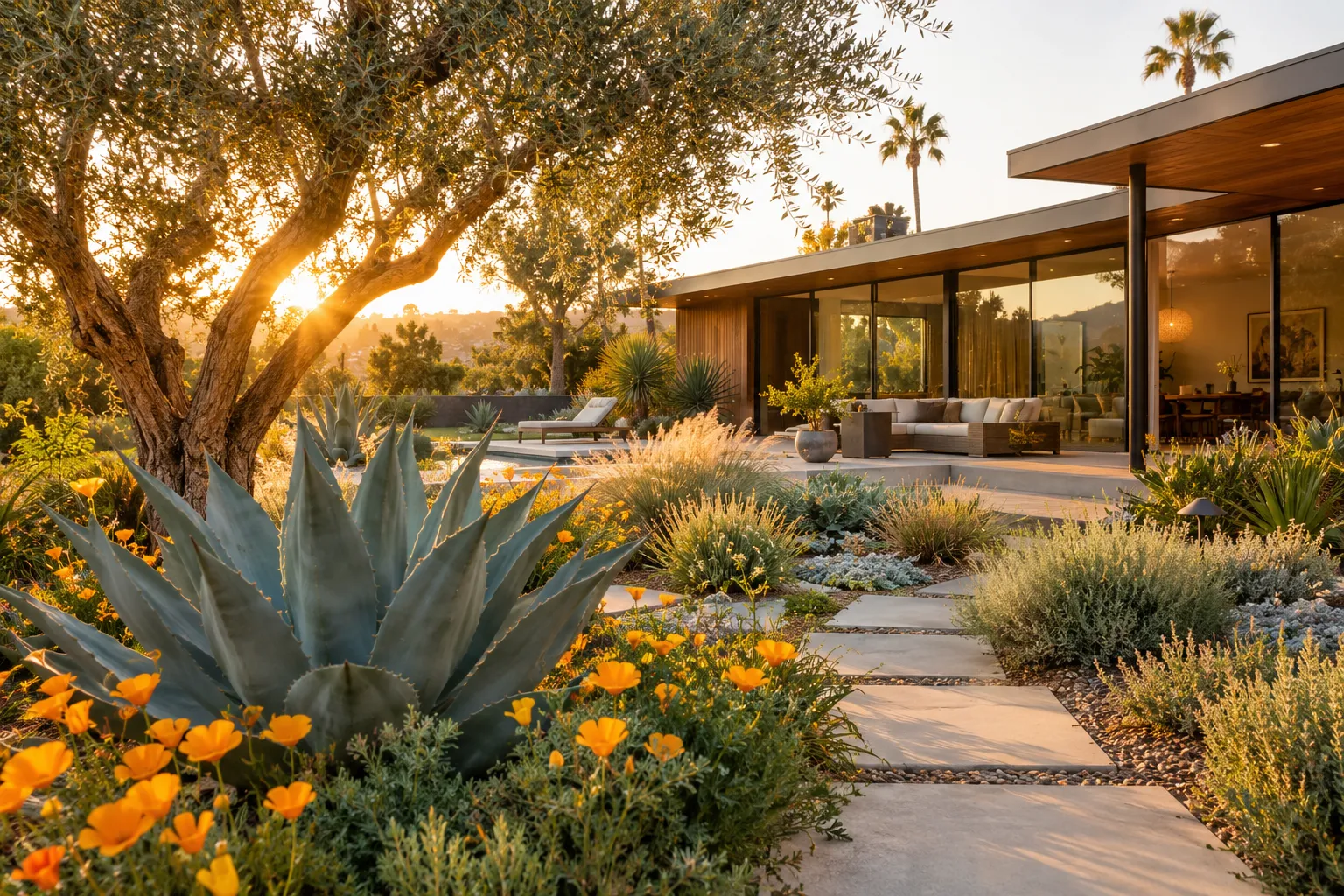
Modern Los Angeles landscaping blends clean architectural lines with climate-smart plant choices. It treats the yard as a functional outdoor room, not just a patch of grass between the house and the sidewalk.
In 2026, the dominant design direction is what local firms call "Soft Modern": structured hardscape with organic, textural planting. Think concrete or decomposed granite pathways, low-profile raised beds, and mixed palettes of succulents, ornamental grasses, California natives, and Mediterranean species like lavender and rosemary. [8]
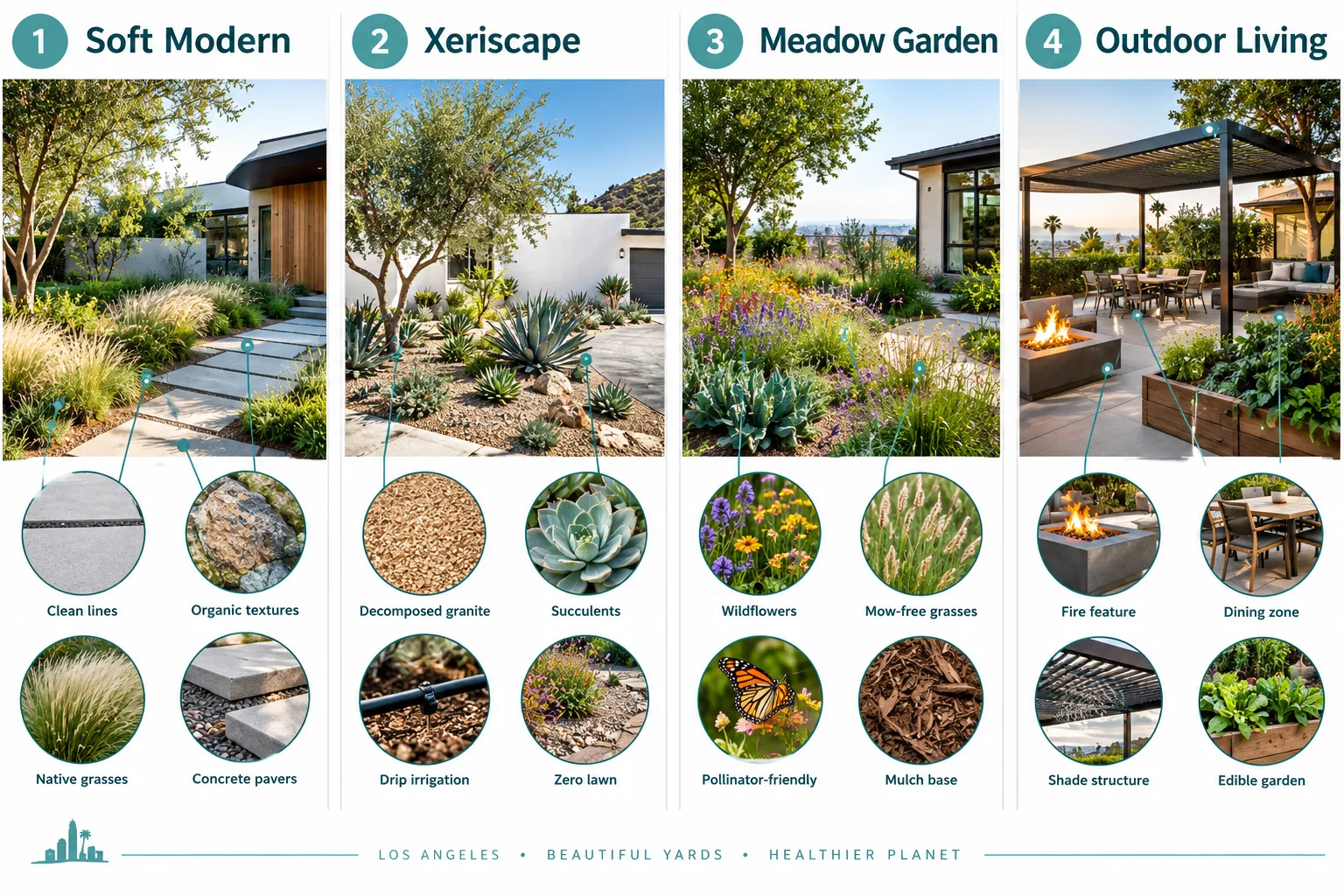
Key elements showing up across LA neighborhoods from Silver Lake to Pasadena to Culver City:
- Multi-zone layouts, separate areas for dining, lounging, and gardening
- Outdoor kitchens and fire features integrated with native plantings
- Meadow gardens replacing turf with mow-free grasses and wildflowers that support pollinators [7]
- Permeable hardscaping, gravel, decomposed granite, or spaced pavers that let stormwater soak in
- LED landscape lighting and mature specimen trees like olives and palms for instant visual impact [8]
- Wellness additions, cold plunges, yoga decks, and shade structures [7]
The mid-century modern homes common in Los Feliz, Hancock Park, and the Hollywood Hills suit this style well. Clean horizontal lines on the house pair naturally with low-water plantings and flat stone or concrete hardscape.
Your yard deserves someone who knows what they're doing, and in LA, that means someone who understands Title 24 energy requirements, hillside grading rules, and what actually survives a dry summer in the San Fernando Valley.
Best Drought-Resistant Plants for LA Yards
The best drought-tolerant plants for Los Angeles yards are California natives and Mediterranean species that evolved in climates similar to SoCal's, hot, dry summers and mild, wet winters.
California natives that thrive in LA:
- California fescue (Festuca californica), fine-textured grass for shaded spots
- Deer grass (Muhlenbergia rigens), tough, low-water, and striking in mass plantings
- Purple sage (Salvia leucophylla), fragrant, drought-hardy, loved by hummingbirds
- California aster (Symphyotrichum chilense), late-season color, very low water
- Golden yarrow (Eriophyllum confertiflorum), bright yellow, thrives in full sun [6]
- Toyon (Heteromeles arbutifolia), native shrub, red berries in winter, fire-resistant
Mediterranean and low-water additions:
- Lavender, rosemary, and catmint handle LA summers with minimal irrigation
- Agave and aloe anchor modern xeriscape designs with dramatic form
- Ornamental grasses like Nassella tenuissima (Mexican feather grass) add movement
A 3,000 sq ft native garden in Del Rey documented in August 2026 used a drought-tolerant fescue lawn anchored by layered native plantings, replacing both concrete and conventional turf while creating genuine habitat. [3] That's a real-world proof point, not a theory.
Why Xeriscaping Is Popular in Southern California
Xeriscaping is popular in Southern California because water is expensive, increasingly scarce, and soon legally restricted. California is set to ban watering decorative grass in 2027, which means the shift away from lawns isn't optional for much longer.
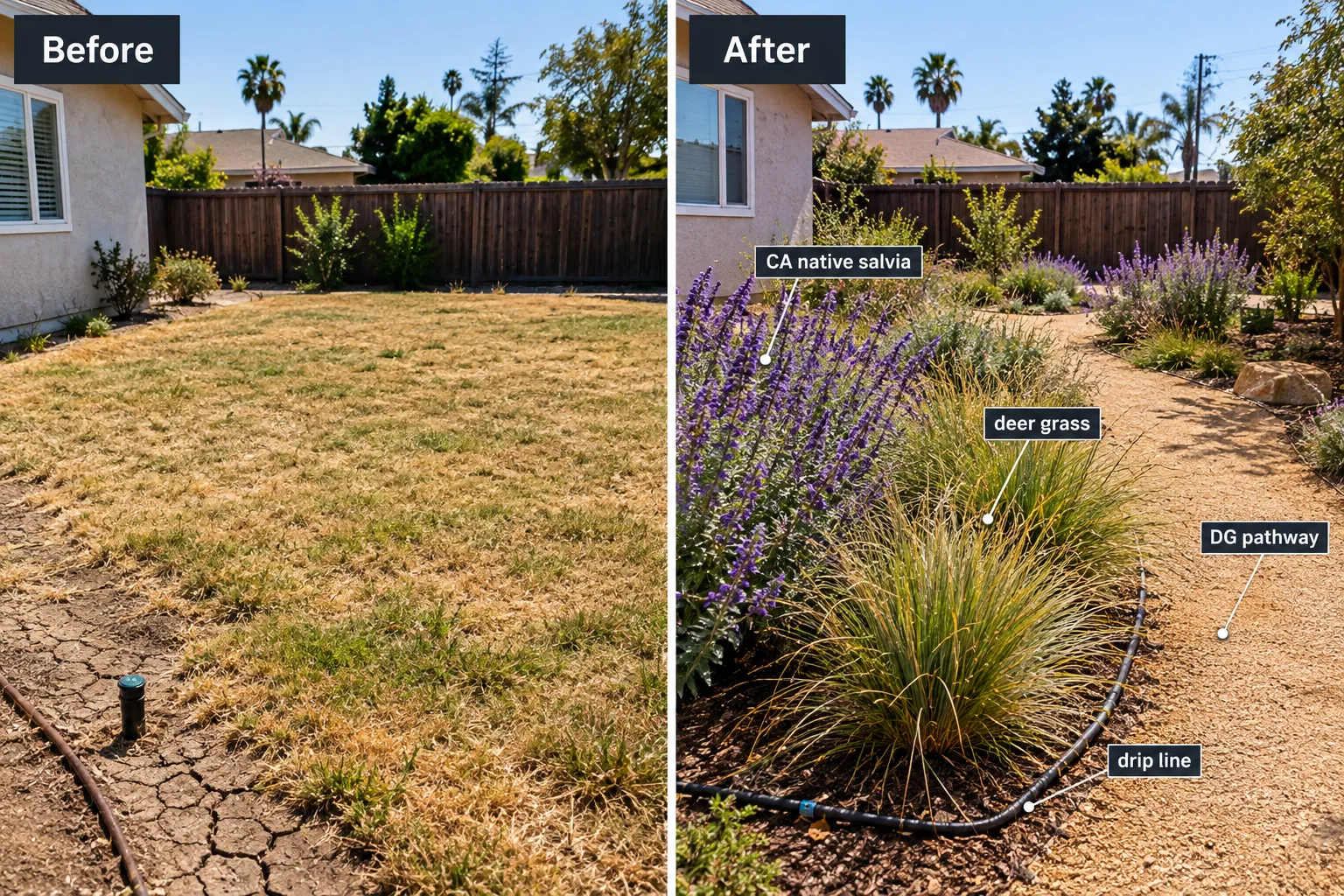
Xeriscaping replaces thirsty turf with succulents, decorative gravel, smart irrigation, and drought-tolerant plants that need little or no supplemental water once established. [6] The result is a yard that looks intentional and modern, not neglected.
In LA specifically, urban heat island effects in neighborhoods like Downtown, Koreatown, and the East Valley make traditional lawns even harder to maintain. Xeriscape designs using light-colored gravel and shade trees actually reduce surface temperatures compared to dark pavement or dry brown grass.
How Much Does Professional Landscaping Cost in Los Angeles?
Los Angeles landscaping costs vary widely depending on scope, materials, and whether you're doing a full redesign or ongoing maintenance. Here are realistic ranges based on 2026 market conditions:
| Project Type | Estimated Cost Range |
|---|---|
| Basic lawn care (monthly) | $80, $200/month |
| Full front-yard xeriscape (500-1,000 sq ft) | $4,000, $12,000 |
| Backyard hardscape + planting | $15,000, $60,000+ |
| Artificial turf installation | $10, $20 per sq ft installed |
| Drip irrigation system | $1,500, $5,000 |
| Landscape design consultation | $150, $400/hour |
These are estimates based on typical LA market conditions in 2026. Final costs depend on lot size, soil conditions, hillside access, permit requirements, and contractor demand in your specific neighborhood.
What drives costs up in LA specifically:
- Hillside lots in Bel Air, Laurel Canyon, or Eagle Rock require retaining walls and drainage, add $5,000 to $30,000 depending on slope
- Permit fees for hardscape over 300 sq ft or grading work
- Water meter upgrades if adding significant irrigation
- Material costs for decomposed granite, concrete pavers, and specimen trees
Cost guides that actually tell you what things cost don't hide these variables. Ask any contractor for an itemized bid, not a round-number estimate.
Hardscape vs. Softscape: What's the Difference?
Hardscape refers to the non-living elements of a landscape, patios, pathways, retaining walls, pergolas, and driveways. Softscape is everything living: plants, trees, grass, and groundcovers.
In modern LA landscaping, the two work together. A well-designed yard typically splits roughly 40-60% hardscape to softscape, though small urban lots in neighborhoods like Echo Park or Mid-City often skew higher toward hardscape to maximize usable space.
Hardscape options common in LA:
- Decomposed granite (DG), affordable, permeable, and very SoCal in aesthetic
- Concrete pavers, durable, available in many finishes, works with mid-century architecture
- Flagstone, natural look, good for hillside paths
- Permeable pavers, allow stormwater infiltration, increasingly required in some LA jurisdictions
Softscape considerations for LA's climate:
- Choose plants rated for USDA Zone 10 (coastal LA) or Zone 9b (inland valleys)
- Group plants by water needs (hydrozoning) to avoid overwatering drought-tolerant species
- Use 3-4 inches of mulch to retain soil moisture and reduce water bills
LA Landscaping Ideas for Small Backyards
Small backyards in Los Angeles, common in Silver Lake, Atwater Village, and West Adams, can still function as full outdoor rooms with the right layout.
The most effective strategies for small LA lots:
- Vertical planting walls, use fence lines for climbing plants like bougainvillea or passionflower
- Multi-zone micro-layouts, even a 400 sq ft yard can have a dining corner, a small planting bed, and a lounging area
- Built-in seating, concrete benches or raised planter walls double as seating and save floor space
- Light-colored hardscape, reflects heat and makes small spaces feel larger
- Container planting, citrus trees, herbs, and succulents in large containers add greenery without permanent planting beds
- Pergolas or shade sails, define the space and reduce afternoon heat in east-facing yards
Avoid large specimen trees in small lots unless you're accounting for root spread and future maintenance access. A 15-gallon olive tree is a better choice than a 36-inch box specimen in a 20x25 ft yard.
Artificial Turf vs. Native Plants in Los Angeles
Artificial turf is the single most requested feature in LA backyards in 2026, largely because it eliminates mowing and saves an estimated 55 gallons of water per square foot annually. [8] Native plants, however, provide ecological benefits that synthetic turf cannot: habitat for pollinators, stormwater absorption, and lower surface temperatures.
Choose artificial turf if:
- You have kids or pets who need a durable, mud-free surface
- Your yard gets heavy shade and nothing grows well
- You want zero ongoing maintenance
Choose native plants if:
- You want to participate in LADWP's LEAP program (requires living plants) [4]
- You care about supporting local wildlife and reducing urban heat
- You want a landscape that qualifies for water rebates
The honest middle ground: Many LA homeowners use a small artificial turf patch for a play area or pet zone, surrounded by native plantings and DG pathways. That combination satisfies both practical and environmental goals.
One homeowner in the LA hillsides tore out her entire lawn starting in 2022, worked with LADWP's free design program, and documented a water-wise, drought-tolerant garden that cut her water bill significantly. [2] [5] That's the kind of real-world outcome worth knowing about before you decide.
Best Time to Landscape in Los Angeles
The best time to plant and install landscaping in Los Angeles is fall, October through December. Cooler temperatures and winter rains help new plants establish roots before summer heat arrives.
Spring (February through April) is the second-best window. Summer planting is possible but requires more irrigation and more attention during the establishment period.
Timing by project type:
- Planting native and drought-tolerant species: October, December (optimal)
- Hardscape installation (patios, walls, pavers): Year-round, but avoid rainy weeks for concrete work
- Lawn removal and turf replacement: Fall or early spring
- Irrigation upgrades: Any time, but coordinate with planting schedule
Avoid planting large trees or shrubs in July and August in the San Fernando Valley or Inland Empire areas, where temperatures regularly exceed 100°F. Even drought-tolerant plants need water to establish, and summer heat makes that window very narrow.
Common Landscaping Mistakes in the LA Climate
The most common LA landscaping mistakes come down to ignoring the climate and planting the wrong things in the wrong places.
Mistakes that cost homeowners money:
- Planting thirsty plants on a slope, water runs off before it soaks in, plants die, and erosion follows
- Using overhead sprinklers on drought-tolerant plants, overwatering kills succulents and natives faster than drought does
- Ignoring hydrozoning, mixing high-water and low-water plants on the same irrigation valve wastes water and kills one group
- Skipping permits for retaining walls, LA requires permits for walls over 4 feet, and unpermitted work creates problems at resale
- Choosing plants by appearance at the nursery, a plant that looks great in a 5-gallon container may not survive in your specific microclimate (coastal fog zone vs. hot inland valley)
- Hiring unlicensed contractors, California law requires a C-27 license for landscaping work over $500. Know who you're letting into your yard.
Who Needs a Landscape Architect vs. a Contractor?
A landscape architect is required when your project involves grading, drainage design, or structural elements on hillside lots, or when the city requires stamped plans for permits. A licensed landscaping contractor (C-27) handles installation work, planting, irrigation, hardscape, and ongoing maintenance.
Hire a landscape architect if:
- Your lot has a slope greater than 15%
- You need city-approved grading or drainage plans
- You're doing a full property redesign that requires coordinating with a structural engineer or architect
- You're in a hillside overlay zone (common in Bel Air, Topanga, Silverlake hills)
Hire a C-27 licensed contractor if:
- You need installation work: planting, irrigation, patios, walls under 4 feet
- You want ongoing maintenance
- Your project doesn't require stamped engineering plans
Always verify the C-27 license number at the California Contractors State License Board (CSLB) website before signing a contract. Licensed, insured, and reviewed, that's the baseline. We verify so you don't have to, but double-checking takes 90 seconds and protects you.
How to Maintain an LA Landscape in Summer Heat
Summer maintenance in Los Angeles focuses on protecting established plants from heat stress and managing irrigation efficiently. Most drought-tolerant landscapes need less water than homeowners think, the mistake is usually overwatering, not underwatering.
Summer maintenance checklist for LA yards:
- Check drip emitters monthly, clogged emitters are the most common irrigation failure
- Water deeply and infrequently (2-3 times per week maximum for established natives)
- Mulch bare soil to 3-4 inches depth to reduce evaporation
- Deadhead spent blooms on salvias and yarrow to extend flowering
- Avoid pruning large shrubs or trees in summer, it stresses plants and can invite pests
- Monitor for signs of heat stress: leaf curl, yellowing, or premature leaf drop
- Adjust weather-based irrigation controllers after heat waves (now required by code in new LA installations) [8]
For hillside properties, check drainage channels after any summer thunderstorm. LA's monsoon moisture in August and September can cause erosion on recently planted slopes.
LADWP Turf Replacement Rules and Rebates
LADWP's Landscape Efficiency Assistance Program (LEAP) is the most significant official driver of front-yard transformation in Los Angeles right now. For eligible customers in disadvantaged communities, LEAP offers no-cost conversions of traditional lawns to native and drought-tolerant landscapes, covering design, installation, drip irrigation upgrades, weather-based controllers, rain-capture features, and smart water-use monitoring devices. [4]
The program is expected to run through December 31, 2026, or until grant funds are exhausted. [10] As of August 21, 2026, roughly 20 projects had been completed and about 130 applications were approved and in progress. [1]
Key LEAP details:
- Targets approximately 1,000 customers with an average of 1,400 sq ft of turf removed per household [4]
- Funded by state grants, no cost to eligible participants [10]
- Covers front yards only; back yards are not included in the current program scope
For commercial properties, the Metropolitan Water District has doubled turf-replacement rebates to at least $7 per sq ft, with combined LA incentives reaching $9 per sq ft for the first 50,000 sq ft removed. These rebates also expire in 2026. [Research notes, see source material provided]
California's 2027 ban on watering decorative grass means homeowners and landlords who act in 2026 can access rebates that won't be available next year. Local pros with local knowledge can help you move quickly.
FAQ
Q: Do I need a permit to remove my lawn in Los Angeles?
Lawn removal itself typically doesn't require a permit. However, if you're adding hardscape over 300 sq ft, grading soil, or installing a retaining wall over 4 feet, you will need permits from the LA Department of Building and Safety.
Q: How do I verify a landscaper's license in California?
Go to the California Contractors State License Board (CSLB) website at cslb.ca.gov and search by license number or company name. A legitimate landscaping contractor should hold a C-27 license. This takes about 90 seconds and tells you if they're active, insured, and in good standing.
Q: What is the LADWP LEAP program and how do I apply?
LEAP (Landscape Efficiency Assistance Program) offers no-cost front-yard conversions to native and drought-tolerant plants for eligible LADWP customers in disadvantaged communities. Applications are open through December 31, 2026, or until funds run out. Visit ladwp.com or the LA City Office of Public Accountability for current eligibility and application details. [4]
Q: Is artificial turf allowed in Los Angeles?
Yes, artificial turf is allowed in Los Angeles for residential properties. It does not qualify for LADWP's LEAP program, which requires living plants. Some HOAs have restrictions, so check your CC&Rs before installing.
Q: What questions should I ask before hiring a landscaper in LA?
Ask for their C-27 license number, proof of general liability insurance, a list of recent projects in your neighborhood, an itemized written bid, and their process for handling permits. Also ask whether they have experience with hillside lots or drought-tolerant planting if those apply to your yard. What to ask before you hire a landscaper matters more than the price alone.
Q: How long does it take for native plants to establish in an LA yard?
Most California native plants take one to two full growing seasons (roughly 12-18 months) to establish deep root systems. During that period, they need supplemental irrigation. After establishment, many need little or no irrigation beyond normal rainfall in coastal and mid-city LA neighborhoods.
Conclusion
Los Angeles landscaping in 2026 is at a turning point. Rebates are expiring, water restrictions are tightening, and the design direction is clear: drought-tolerant, multi-functional, and built for the actual climate.
Here's what to do next:
- Check LEAP eligibility at ladwp.com before December 31, 2026, it's the last window for no-cost front-yard conversions [4]
- Verify any contractor's C-27 license at cslb.ca.gov before signing anything
- Get three itemized bids for any project over $5,000, not ballpark estimates
- Match your plant palette to your microclimate, coastal LA, the Valley, and hillside zones all behave differently
- Ask about permits upfront, any contractor who says you don't need them for a retaining wall or major grading is a red flag
From basic lawn care to full backyard transformations, find the right landscaper for your yard. Local pros, local knowledge, real reviews from real homeowners, that's what LandscapeProsDirectory is built for. No fluff, just useful advice, and landscaping pros in your area who are licensed, insured, and reviewed.
References
[1] A Leap Toward Water Conservation Ladwp Lawn Transformations Aim Change Calif Future - https://highschool.latimes.com/features/a-leap-toward-water-conservation-ladwp-lawn-transformations-aim-change-calif-future/
[2] She Tore Out Her La Hillside Lawn Planted Drought Tolerant Plants - https://www.latimes.com/lifestyle/story/2026-06-10/she-tore-out-her-la-hillside-lawn-planted-drought-tolerant-plants
[3] La Replaced Lawn Drought With Tolerant Native Plants - https://www.latimes.com/lifestyle/story/2026-08-03/la-replaced-lawn-drought-with-tolerant-native-plants
[4] Rethinking La Lawn Guide Ladwps No Cost Landscape Replacement Program - https://opa.lacity.gov/blog/rethinking-la-lawn-guide-ladwps-no-cost-landscape-replacement-program
[5] Her Water Bill Was Insane So She Tore Out Her - https://www.newstribune.com/news/2026/jun/28/her-water-bill-was-insane-so-she-tore-out-her/
[6] Los Angeles Ca Landscaping - https://www.lawnstarter.com/los-angeles-ca-landscaping
[7] Blog - https://www.gardendesignandlandscapes.com/blog/
[8] Backyard Remodeling Los Angeles Complete Guide - https://modaoutdoorliving.com/blog/backyard-remodeling-los-angeles-complete-guide
[9] Ridgeline Outdoor Living Launches Premier Outdoor Living And Landscape Construction Services In Pasadena - https://www.globenewswire.com/news-release/2026/05/23/3300430/0/en/ridgeline-outdoor-living-launches-premier-outdoor-living-and-landscape-construction-services-in-pasadena.html
[10] Want To Rip Up Your Lawn And Install Native Plants How To Do It For Free - https://laist.com/brief/news/climate-environment/want-to-rip-up-your-lawn-and-install-native-plants-how-to-do-it-for-free
<!DOCTYPE html>
<html lang="en">
<head>
<meta charset="UTF-8">
<meta name="viewport" content="width=device-width, initial-scale=1.0">
<title>LA Landscaping Cost Estimator</title>
<style>
  .cg-wrap{font-family:system-ui,sans-serif;max-width:520px;margin:2rem auto;background:#f8f7f4;border:1px solid #d6d0c4;border-radius:10px;padding:1.5rem}
  .cg-wrap h3{margin:0 0 1rem;font-size:1.1rem;color:#1a3a2a}
  .cg-row{margin-bottom:1rem}
  .cg-row label{display:block;font-size:.85rem;color:#444;margin-bottom:.3rem;font-weight:600}
  .cg-row select,.cg-row input{width:100%;padding:.45rem .6rem;border:1px solid #bbb;border-radius:6px;font-size:.9rem;background:#fff;box-sizing:border-box}
  .cg-btn{background:#2d6a4f;color:#fff;border:none;padding:.6rem 1.4rem;border-radius:6px;font-size:.95rem;cursor:pointer;width:100%;margin-top:.5rem}
  .cg-btn:hover{background:#1b4332}
  .cg-result{margin-top:1.2rem;background:#fff;border:1px solid #c3d9cc;border-radius:8px;padding:1rem;display:none}
  .cg-result p{margin:.3rem 0;font-size:.9rem;color:#222}
  .cg-result .cg-range{font-size:1.15rem;font-weight:700;color:#2d6a4f}
  .cg-note{font-size:.75rem;color:#777;margin-top:.8rem}
</style>
</head>
<body>
<div class="cg-wrap">
  <h3>LA Landscaping Cost Estimator</h3>
  <div class="cg-row">
    <label for="cg-type">Project Type</label>
    <select id="cg-type">
      <option value="maint">Monthly Lawn Care</option>
      <option value="xeri">Front-Yard Xeriscape</option>
      <option value="back">Backyard Hardscape + Planting</option>
      <option value="turf">Artificial Turf Installation</option>
      <option value="irrig">Drip Irrigation System</option>
    </select>
  </div>
  <div class="cg-row">
    <label for="cg-size">Approximate Area (sq ft)</label>
    <input type="number" id="cg-size" placeholder="e.g. 500" min="50" max="10000">
  </div>
  <div class="cg-row">
    <label for="cg-hill">Hillside Lot?</label>
    <select id="cg-hill">
      <option value="0">No</option>
      <option value="1">Yes</option>
    </select>
  </div>
  <button class="cg-btn" onclick="cgCalc()">Estimate My Cost</button>
  <div class="cg-result" id="cg-result">
    <p>Estimated range for your project:</p>
    <p class="cg-range" id="cg-out"></p>
    <p id="cg-tip"></p>
    <p class="cg-note">Estimates based on 2026 LA market conditions. Get 3 itemized bids before committing.</p>
  </div>
</div>
<script>
function cgCalc(){
  var t=document.getElementById('cg-type').value;
  var s=parseFloat(document.getElementById('cg-size').value)||500;
  var h=parseInt(document.getElementById('cg-hill').value);
  var lo,hi,tip;
  if(t==='maint'){lo=80;hi=200;tip='Per month. Hillside access may add $30,$60/visit.'}
  else if(t==='xeri'){lo=Math.round(s*6);hi=Math.round(s*14);tip='Check LADWP LEAP for possible no-cost front-yard conversion.'}
  else if(t==='back'){lo=15000;hi=Math.round(s*55);tip='Outdoor kitchens and fire features add $8,000,$25,000+.'}
  else if(t==='turf'){lo=Math.round(s*10);hi=Math.round(s*20);tip='Saves ~55 gal/sq ft/yr in water. Does not qualify for LEAP.'}
  else{lo=1500;hi=5000;tip='Weather-based controllers now required by code in new LA installs.'}
  if(h&&t!=='maint'){lo+=5000;hi+=15000;tip+=' Hillside surcharge applied.'}
  var fmt=function(n){return'$'+n.toLocaleString()};
  document.getElementById('cg-out').textContent=fmt(lo)+', '+fmt(hi);
  document.getElementById('cg-tip').textContent=tip;
  document.getElementById('cg-result').style.display='block';
}
</script>
</body>
</html>
Liked this guide? Follow us on Google Search
Related Directory Pages
Find a Landscaper Near You
Browse CA landscaping professionals on LandscapeProsDirectory.
Search Landscapers