
Mesa Landscaping: Desert Design for the East Valley
Mesa landscaping guide for 2026. Master East Valley desert gardening with local tips on soil, water rules, and heat-hardy plant selection. Compare local pros an
Last updated: October 1, 2026
Quick Answer: Mesa landscaping means designing and maintaining yards for the Sonoran Desert, using drought-tolerant plants, decomposed granite, drip irrigation, and hardscape instead of traditional turf. In 2026, a full xeriscape install in Mesa runs roughly $5,$15 per square foot, and the City of Mesa offers water-conservation rebates that can offset a meaningful portion of that cost. The right contractor knows Mesa's caliche soils, HOA rules, and monsoon drainage, and that knowledge makes or breaks the project.
Key Takeaways
- Mesa landscaping is Sonoran Desert design, not standard lawn care, it centers on xeriscape, native plants, and drip irrigation
- Mesa soils are clay over caliche hardpan; breaking through caliche adds labor cost but is non-negotiable for healthy plant roots
- Typical 2026 project costs: $5,$15/sq ft for xeriscaping, $8,$15/sq ft for artificial turf, $14,$22/sq ft for concrete pavers [5]
- The City of Mesa offers water-conservation rebates and free publications to help homeowners plan desert landscapes [4]
- Best plants for Mesa include palo verde, saguaro, agave, brittlebush, lantana, red yucca, barrel cactus, and ocotillo [1]
- East Valley HOAs in communities like Las Sendas, Eastmark, and Red Mountain Ranch have strict plant palette and hardscape rules, check before you dig
- Drip irrigation should run 60-90 minutes every 10-14 days during the July, September monsoon window [11]
- Always verify a contractor's ROC (Registrar of Contractors) license before signing anything, Arizona requires it for projects over $1,000
Table of Contents
- What Is Mesa Landscaping and Why Is It Popular in Arizona
- Mesa's Climate and Soil Challenges
- How Much Does Mesa Landscaping Cost in 2026
- Mesa Landscaping vs. Traditional Landscaping: What's the Difference
- Best Plants for Mesa Landscaping in the Desert
- How to Maintain a Mesa Landscape Yard
- Is Mesa Landscaping Good for Low Water Use
- Mesa Landscaping for Beginners: Where Do You Start
- Common Mistakes People Make with Desert Landscaping
- Mesa Landscaping Ideas for the Front Yard
- How Long Does It Take to Install a Desert Landscape
- Can You Do Mesa Landscaping on a Small Budget
- Mesa Landscaping Companies Near Me: What to Look For
- FAQ
- References
What Is Mesa Landscaping and Why Is It Popular in Arizona
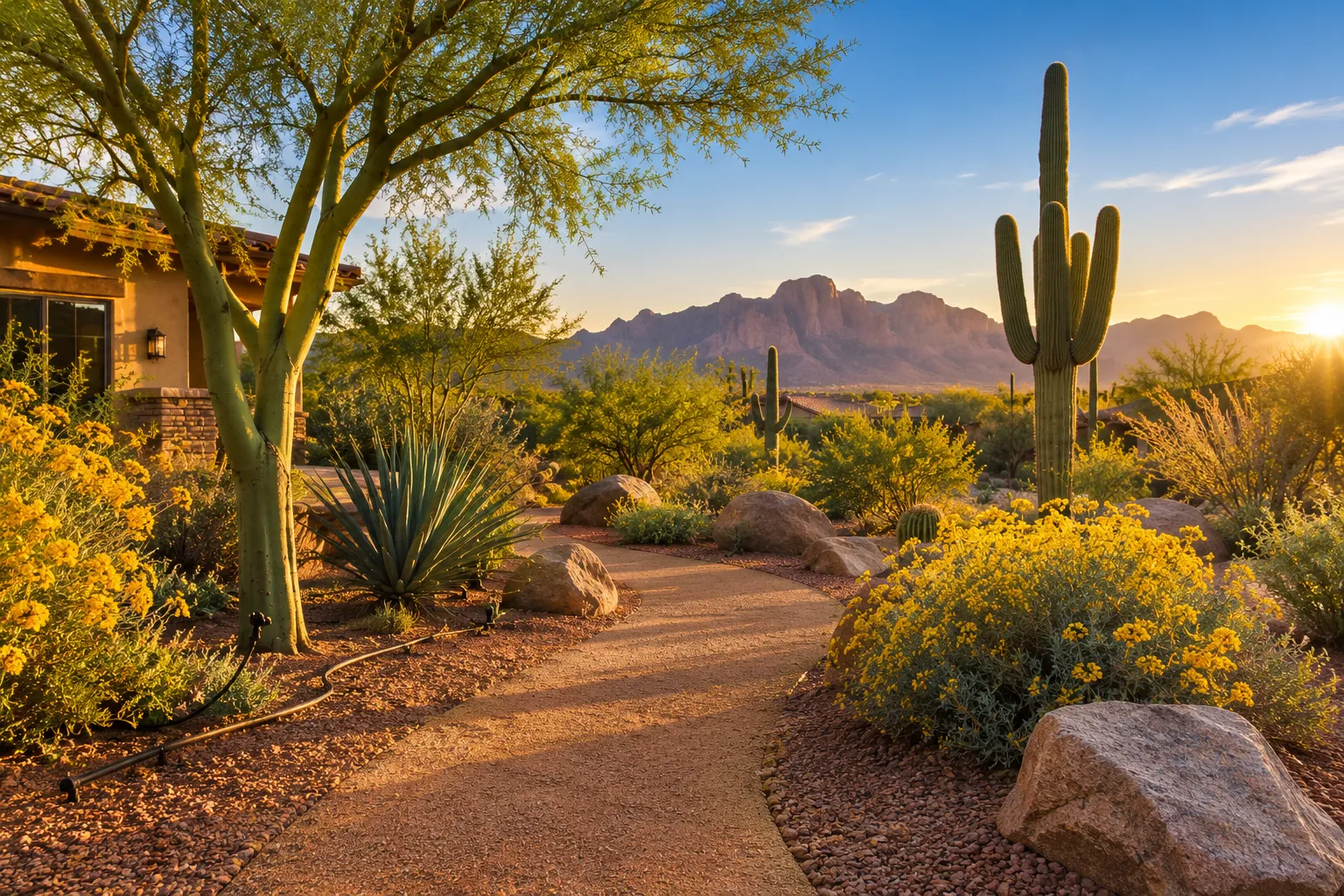
Mesa landscaping is Sonoran Desert design applied to residential yards in and around Mesa, Arizona. It replaces water-hungry turf with drought-tolerant plants, decomposed granite, boulders, and drip irrigation systems built for extreme heat and limited rainfall. [1]
It's popular because it works. Mesa gets under 10 inches of rain per year and sees July highs averaging around 104°F. [5] A traditional grass lawn in those conditions isn't just expensive, it's a constant fight against the climate. Desert design stops that fight.
The approach has also gained traction because the City of Mesa actively supports it through rebates, free planning publications, and workshops. [4] That combination of climate logic and municipal backing has made desert landscaping the default choice for East Valley homeowners replacing aging turf.
Mesa's Climate and Soil Challenges
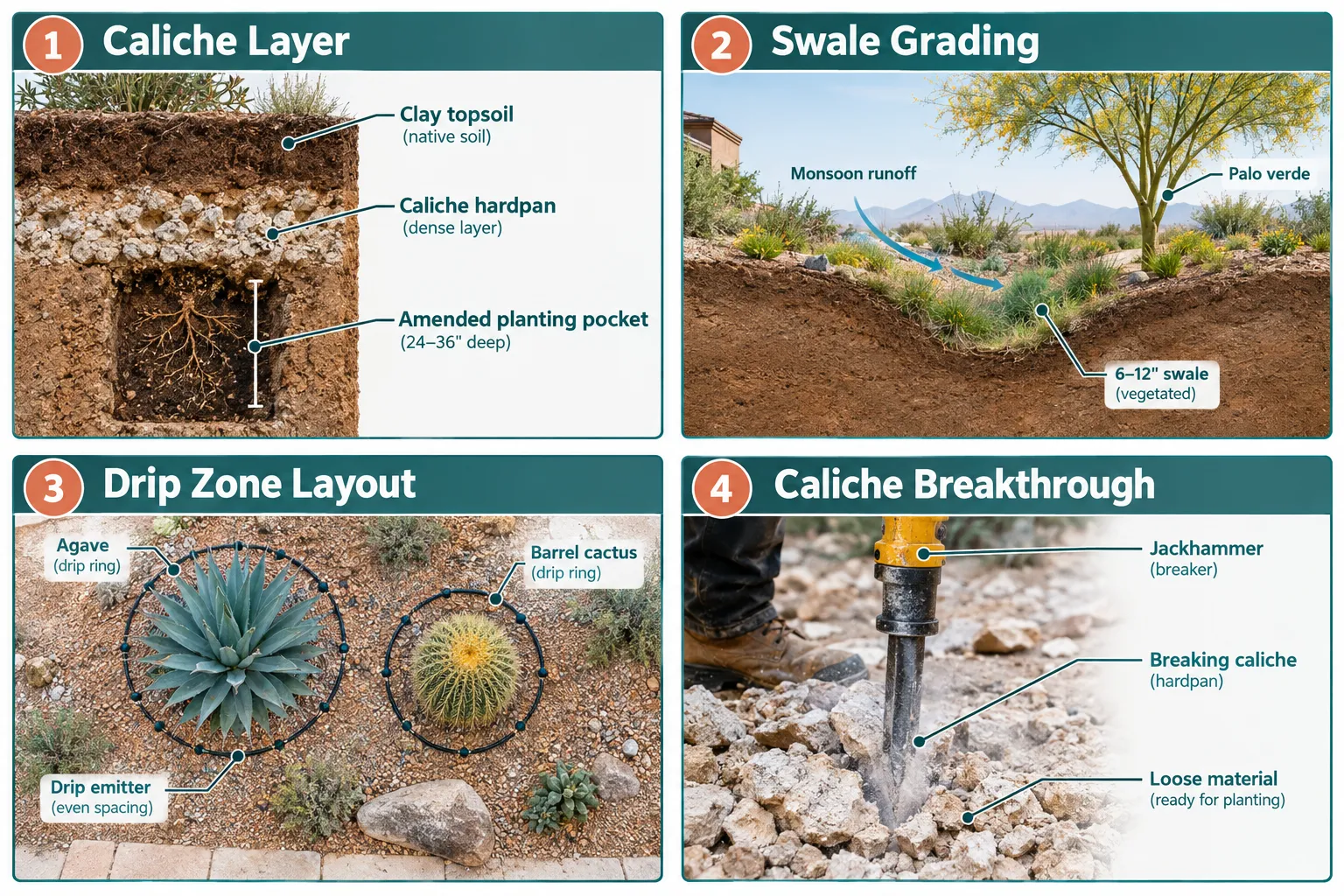
Mesa's biggest landscaping challenge isn't the heat, it's what's under the ground. Soils in Mesa are typically clay over a layer of caliche, a calcium carbonate hardpan that can sit just inches below the surface. Roots can't penetrate it, and water pools on top of it instead of draining. [5]
What this means for your yard:
- Planting pockets need to be dug 24-36 inches deep and about three times the root-ball width [11]
- Caliche layers often require a jackhammer or power auger, not a standard shovel
- Native soil should be amended with roughly 30% composted granite fines to improve drainage [11]
- Vegetated swales, shallow channels about 6-12 inches deep and 3-5 feet wide, help slow and absorb monsoon stormwater before it erodes bare soil [11]
The City of Mesa recommends grading yards with low mounds under about one foot and creating swales that direct rainfall toward plants rather than away from them. [2] This isn't decorative, it's how desert yards survive monsoon season without washing out.
East Valley neighborhoods like Las Sendas and Eastmark sit on foothill terrain where drainage is especially critical. Contractors who work in those areas know the grading requirements. Ask any bidder how they handle monsoon runoff before you sign a contract.
How Much Does Mesa Landscaping Cost in 2026
A full xeriscape install in Mesa typically runs $5,$15 per square foot, depending on plant density, soil prep, and irrigation complexity. [5] For a 1,500-square-foot front yard, that's roughly $7,500,$22,500 before any rebates.
2026 cost benchmarks for Mesa projects: [5]
| Service | Estimated Cost |
|---|---|
| Xeriscaping (plants + DG + drip) | $5,$15 per sq ft |
| Artificial turf installation | $8,$15 per sq ft |
| Concrete pavers | $14,$22 per sq ft |
| Maintenance visit | $45,$95 per visit |
Caliche removal adds labor. If a contractor hits a thick caliche layer, common in older Mesa neighborhoods near downtown and in parts of Gilbert Road corridor, expect additional charges for equipment and disposal.
The City of Mesa's water-conservation rebate program can offset some of these costs. [4] Check with Mesa's Water Conservation office for current rebate amounts before finalizing your budget, since program terms update periodically.
Mesa Landscaping vs. Traditional Landscaping: What's the Difference
Traditional landscaping in Arizona means turf grass, high-volume sprinklers, and plants that need regular water and fertilizer. Mesa landscaping means designing with the desert, not against it, using native plants, decomposed granite, and drip irrigation. [1]
The practical differences matter for your wallet and your schedule:
- Water use: A turf lawn in Mesa can use 50-70% more water than a xeriscape yard
- Maintenance: Desert yards need less mowing and fertilizing, but more attention to irrigation calibration and seasonal pruning
- Durability: Desert-adapted plants survive 110°F+ summers without intervention; turf goes dormant or dies
- HOA rules: Many East Valley HOAs now require or incentivize xeriscape, check your CC&Rs before installing turf
Best Plants for Mesa Landscaping in the Desert
The best plants for Mesa are those native to the Sonoran, Mojave, or Chihuahuan deserts. They've evolved for caliche soils, low rainfall, and extreme heat. [2]
Shade trees:
- Palo verde (Arizona's state tree, green bark, fast-growing)
- Mesquite (deep-rooted, excellent shade)
- Desert willow (flowering, attracts hummingbirds)
Structural plants:
- Saguaro cactus (iconic, slow-growing, protected by Arizona law)
- Barrel cactus (low maintenance, bold form)
- Agave (architectural, nearly zero water once established)
- Ocotillo (tall, spiny, spectacular red blooms after rain)
Color and groundcover:
- Brittlebush (yellow flowers, native, spreads well)
- Lantana (heat-tolerant, long blooming season)
- Red yucca (coral flower spikes, deer-resistant)
The City of Mesa recommends grouping plants in natural clusters and repeating species for a unified look. [2] Deciduous trees on south and west exposures shade the house in summer and let light through in winter, a real energy benefit in the East Valley. [2]
Your yard deserves someone who knows what they're doing with these plants, not someone who just throws in whatever's cheapest at the nursery.
How to Maintain a Mesa Landscape Yard
A desert yard isn't no-maintenance, it's low-maintenance done right. The biggest maintenance task is irrigation calibration, not weeding or mowing. [5]
Seasonal maintenance checklist:
- Spring: Prune frost-damaged growth, check drip emitters for clogs, apply pre-emergent weed control to DG areas
- Summer (monsoon): Run drip zones 60-90 minutes every 10-14 days during July, September [11]; check swales after storms for erosion
- Fall: Reduce irrigation frequency as temps drop, plant new shrubs and trees (best planting season in Mesa)
- Winter: Protect frost-sensitive plants like bougainvillea and citrus; reduce irrigation to once every 3-4 weeks
The City of Mesa runs free Landscape Watering Workshops, one was held in September 2026 at the Mesa Public Library, covering how to measure irrigation output and adjust for seasons. [9] These are worth attending if you're new to desert irrigation.
Is Mesa Landscaping Good for Low Water Use
Yes, and that's the primary reason most Mesa homeowners make the switch. A properly designed xeriscape yard uses significantly less water than turf, with established desert plants often surviving on rainfall alone during the monsoon season. [4]
Mesa's water-conservation program provides free step-by-step guides for planning and installing water-efficient landscapes. [4] The city's design tips also emphasize using swales to capture rainfall and direct it to plants, essentially turning monsoon storms into free irrigation. [2]
Low water use also means lower utility bills. In a city where summer water costs spike sharply, that's a real financial benefit, not just an environmental one.
Mesa Landscaping for Beginners: Where Do You Start
Start with a site assessment, not a plant list. Before choosing plants or hardscape, understand your yard's sun exposure, drainage patterns, and soil depth. [3]
A practical starting sequence:
- Walk the yard after a monsoon rain and note where water pools, those are your drainage problem spots
- Dig a test hole 18-24 inches deep to check for caliche depth
- Identify your HOA's plant palette and hardscape rules (many East Valley HOAs in communities like Eastmark, Red Mountain Ranch, and Las Sendas have specific requirements)
- Contact Mesa's Water Conservation office for free planning publications [4]
- Get at least three bids from licensed contractors, verify each ROC license at the Arizona Registrar of Contractors website
- Ask each contractor how they handle caliche, monsoon drainage, and drip irrigation zoning
Know who you're letting into your yard. A contractor who's never worked in Mesa's East Valley may not know the soil conditions or the local HOA rules.
Common Mistakes People Make with Desert Landscaping
The most common mistake is treating desert landscaping as "set it and forget it." Desert yards need calibrated irrigation, seasonal adjustments, and proper soil prep, skipping any of those leads to plant failure. [5]
Other mistakes to avoid:
- Skipping caliche removal: Roots can't grow through hardpan; plants will struggle and die within a few years
- Overwatering new plants: Desert plants establish best with deep, infrequent watering, not daily sprinkles
- Ignoring drainage: Flat yards with no swales flood during monsoon and erode decomposed granite
- Choosing non-native plants: Tropical-looking plants may survive one summer but fail the next; stick to Sonoran Desert species
- Not checking HOA rules: Some East Valley HOAs prohibit certain rock colors, boulder sizes, or plant species, find out before you install
Mesa Landscaping Ideas for the Front Yard
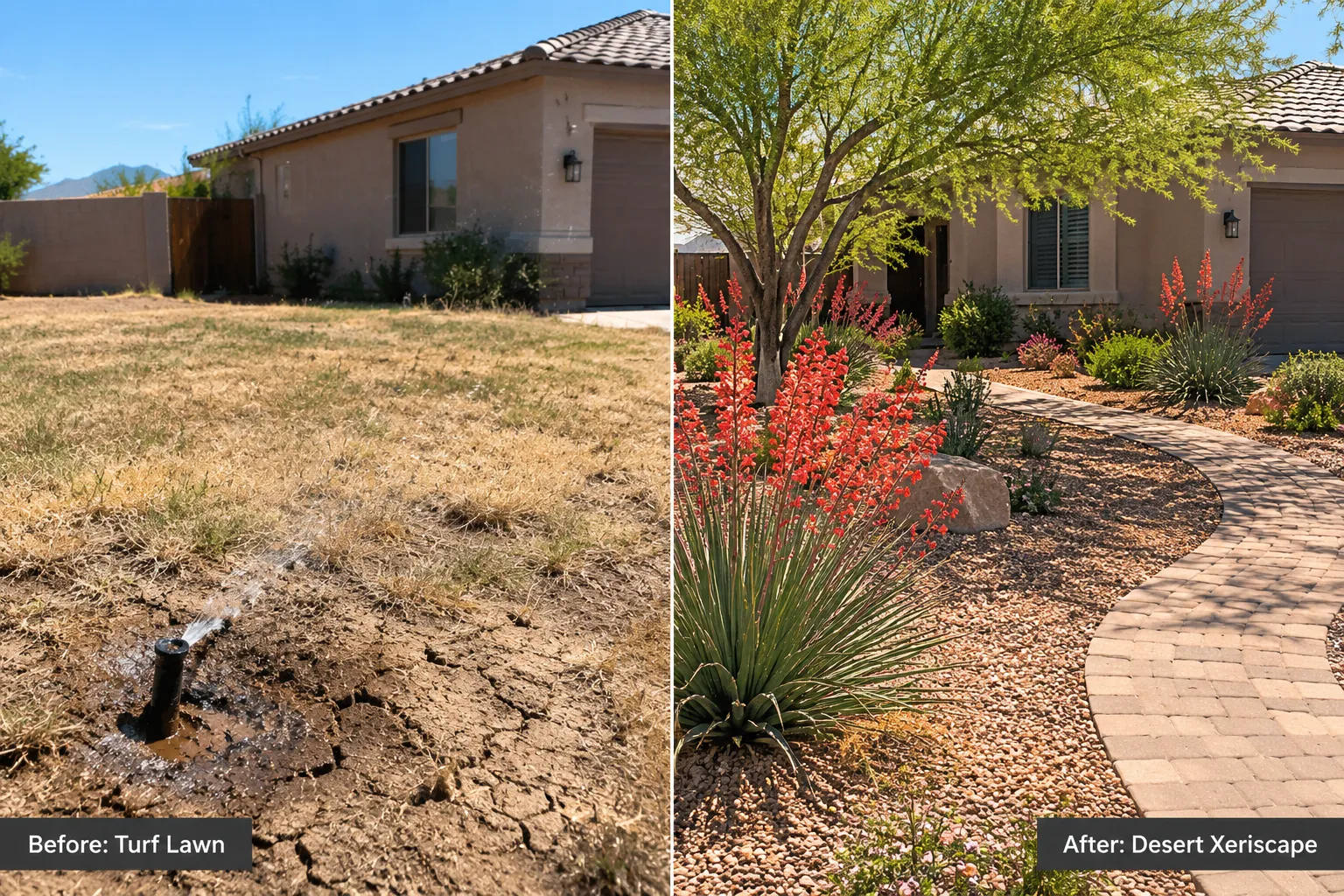
The most effective East Valley front yards combine a shade tree, a structural cactus or agave, low groundcover, and a clean decomposed granite surface. [14] That formula works because it's visually balanced, low-water, and survives Mesa summers without constant attention.
Front yard ideas that work in Mesa:
- Pair a palo verde with agave and lantana groundcover for a low-maintenance, high-impact look
- Use curved DG pathways with smooth Arizona boulders to create natural flow from the street to the door
- Orient shade trees toward the south and west exposures to reduce summer heat on the house [2]
- Keep plantings low enough to preserve views of the Superstition Mountains if your property faces east [3]
- Add a small seating area with compacted-base pavers, designed to handle monsoon runoff and high winds [3]
For newer neighborhoods like Eastmark, contractors like Diamond Cut Landscaping combine native planting with artificial turf patches and paver work designed for Mesa's heat. [8] That hybrid approach satisfies HOA aesthetics while keeping water use low.
How Long Does It Take to Install a Desert Landscape
A typical Mesa xeriscape project takes one to three weeks from start to finish, depending on yard size, caliche depth, and irrigation complexity. Soil prep, especially caliche removal, is usually the longest single task. [5]
Fall (October, November) is the best time to install in Mesa. Cooler soil temperatures help new plants establish roots before summer stress. Spring (February, March) is the second-best window. Avoid installing during July, August heat unless the contractor has a strong irrigation plan in place from day one.
Can You Do Mesa Landscaping on a Small Budget
Yes. Desert landscaping doesn't require a full contractor install. Homeowners with smaller budgets can phase the project over one to two years, starting with soil prep and irrigation, then adding plants seasonally. [4]
Budget-friendly approaches:
- Start with decomposed granite and drip irrigation, the infrastructure matters most
- Buy plants in one-gallon containers (cheaper) and let them establish over two seasons rather than buying five-gallon specimens
- Use Mesa's free conservation publications to plan before spending anything [4]
- Apply for city rebates before breaking ground, some programs require pre-approval
- Focus the first phase on the front yard, which has the most visual impact and often the most HOA scrutiny
Cost guides that actually tell you what things cost: a basic DG and drip irrigation install on a 500-square-foot front yard can run as low as $2,500,$4,000 if you limit plant density and do some of the prep work yourself.
Mesa Landscaping Companies Near Me: What to Look For
The East Valley has dozens of landscaping contractors, but not all of them understand Mesa's specific soil conditions, HOA requirements, and monsoon drainage needs. [6] Local pros with local knowledge are worth more than a low bid from a company that mostly works in Scottsdale or Tempe.
What to verify before hiring:
- ROC license: Arizona requires a Registrar of Contractors license for any project over $1,000. Check it at roc.az.gov, it takes two minutes
- Insurance: General liability and workers' comp protect you if something goes wrong on your property
- Local references: Ask for three references from Mesa or East Valley projects completed in the past 12 months
- Caliche experience: Ask directly: "How do you handle caliche, and what equipment do you use?"
- Irrigation knowledge: A good contractor designs drip zones by plant type and sun exposure, not just by area
We verify so you don't have to, but you should still ask these questions yourself. Real reviews from real homeowners in your neighborhood are the most reliable signal. Find the right landscaper for your yard by checking verified local listings before you call.
FAQ
What is the difference between xeriscaping and mesa landscaping?
Xeriscaping is a water-conservation landscaping method used across many climates. Mesa landscaping is a specific application of xeriscape principles to the Sonoran Desert conditions of Mesa, Arizona, using locally native plants, caliche-appropriate soil prep, and irrigation designed for monsoon patterns.
Does the City of Mesa offer rebates for removing grass?
Mesa's water-conservation program supports water-efficient landscape conversions and offers free planning publications. Contact Mesa's Water Conservation office directly for current rebate amounts and eligibility requirements, as program terms change. [4]
Do I need a permit to landscape my yard in Mesa?
Most residential planting and DG installs don't require a permit. However, irrigation systems, retaining walls over a certain height, and significant grading may require permits. Check with the City of Mesa's Development Services department before starting work.
How do I know if a Mesa landscaping contractor is licensed?
Search the Arizona Registrar of Contractors (ROC) database at roc.az.gov. Enter the contractor's name or license number. A valid ROC license is required for projects over $1,000 in Arizona.
Can I plant a saguaro cactus in my Mesa yard?
Yes, but saguaros are protected under Arizona's Native Plant Law. You can purchase nursery-grown saguaros from licensed dealers. Moving or transplanting a wild saguaro requires a permit from the Arizona Department of Agriculture.
What soil amendment do I need for desert plants in Mesa?
For most desert plants, amend native Mesa soil with about 30% composted granite fines to improve drainage around the root zone. [11] Avoid adding too much organic compost, desert plants adapted to lean soils can struggle with nutrient-rich mixes.
Conclusion
Mesa landscaping isn't a trend, it's the practical response to living in one of the hottest, driest cities in the country. The homeowners who get it right in 2026 are the ones who start with the soil, design for monsoon drainage, choose plants that actually belong in the Sonoran Desert, and hire contractors who know the difference between a Las Sendas HOA palette and a standard Tempe install.
Your next steps:
- Order free planning publications from Mesa's Water Conservation office [4]
- Dig a test hole to check your caliche depth before calling any contractor
- Pull your HOA's CC&Rs and confirm plant and hardscape rules
- Get three bids from ROC-licensed contractors with East Valley references
- Ask each one how they handle caliche, monsoon drainage, and drip irrigation zoning
No fluff, just useful advice: the right desert landscape saves water, survives summers, and adds real value to your property. Find your next landscaper here, and make sure they know Mesa.
References
[1] Mesa Landscaping - https://phoenixprolandscape.com/mesa-landscaping/
[2] Landscape Design Tips - https://www.mesaaz.gov/Environment-Sustainability/Water-Conservation/Landscape-Design-Tips
[3] Mesa - https://www.azoutsideliving.com/areas/mesa
[4] Order Conservation Publications - https://www.mesaaz.gov/Environment-Sustainability/Water-Conservation/Order-Conservation-Publications
[5] ecospherelandscaping - https://www.ecospherelandscaping.com/
[6] Blog - https://mesquitelandscapinginc.com/blog/
[7] Landscape Design Services Custom Outdoor Living - https://mesquitelandscapinginc.com/landscape-design-services-custom-outdoor-living/
[8] Mesa - https://diamondcutaz.com/locations/mesa
[9] 54798 Mesa Landscape Watering Workshop Scheduled - https://localhousingreports.com/events/september-2026/54798-mesa-landscape-watering-workshop-scheduled.html
<!DOCTYPE html>
<html lang="en">
<head>
<meta charset="UTF-8">
<meta name="viewport" content="width=device-width, initial-scale=1.0">
<title>Mesa Landscaping Budget Estimator</title>
<style>
  .cg-wrap{font-family:Arial,sans-serif;max-width:480px;margin:2rem auto;background:#fdf8f2;border:1px solid #d4a96a;border-radius:8px;padding:1.5rem}
  .cg-wrap h3{margin:0 0 1rem;color:#7a3e00;font-size:1.1rem}
  .cg-label{display:block;font-size:.85rem;color:#444;margin:.7rem 0 .2rem}
  .cg-input,.cg-select{width:100%;box-sizing:border-box;padding:.45rem .6rem;border:1px solid #c8a97a;border-radius:5px;font-size:.9rem;background:#fff}
  .cg-btn{margin-top:1rem;width:100%;padding:.6rem;background:#7a3e00;color:#fff;border:none;border-radius:5px;font-size:.95rem;cursor:pointer}
  .cg-btn:hover{background:#5c2d00}
  .cg-result{margin-top:1rem;padding:.8rem;background:#fff3e0;border-radius:6px;font-size:.9rem;color:#333;display:none}
  .cg-result strong{color:#7a3e00}
</style>
</head>
<body>
<div class="cg-wrap">
  <h3>Mesa Landscaping Cost Estimator</h3>
  <label class="cg-label">Yard size (square feet)</label>
  <input class="cg-input" id="cg-sqft" type="number" placeholder="e.g. 1200" min="100" max="10000">
  <label class="cg-label">Project type</label>
  <select class="cg-select" id="cg-type">
    <option value="xeri">Xeriscaping (DG + plants + drip)</option>
    <option value="turf">Artificial turf</option>
    <option value="paver">Concrete pavers</option>
  </select>
  <label class="cg-label">Caliche removal needed?</label>
  <select class="cg-select" id="cg-caliche">
    <option value="0">No / Unknown</option>
    <option value="1">Yes (adds ~$1-2/sq ft)</option>
  </select>
  <button class="cg-btn" onclick="cgCalc()">Estimate My Cost</button>
  <div class="cg-result" id="cg-result"></div>
</div>
<script>
function cgCalc(){
  var s=parseFloat(document.getElementById('cg-sqft').value);
  var t=document.getElementById('cg-type').value;
  var c=parseInt(document.getElementById('cg-caliche').value);
  if(!s||s<100){alert('Please enter a yard size of at least 100 sq ft.');return;}
  var lo,hi;
  if(t==='xeri'){lo=5;hi=15;}
  else if(t==='turf'){lo=8;hi=15;}
  else{lo=14;hi=22;}
  if(c){lo+=1;hi+=2;}
  var low=(s*lo).toLocaleString('en-US',{maximumFractionDigits:0});
  var high=(s*hi).toLocaleString('en-US',{maximumFractionDigits:0});
  var el=document.getElementById('cg-result');
  el.style.display='block';
  el.innerHTML='<strong>Estimated range: $'+low+', $'+high+'</strong><br><span style="font-size:.8rem">Based on 2026 Mesa/Phoenix-metro pricing. Actual costs vary by contractor, soil conditions, and plant density. Always get 3 licensed bids. Source: Ecosphere Landscaping, 2026.</span>';
}
</script>
</body>
</html>
Liked this guide? Follow us on Google Search
Related Directory Pages
Find a Landscaper Near You
Browse AZ landscaping professionals on LandscapeProsDirectory.
Search Landscapers