
Oakland Landscaping: Slopes and Bay Views Guide
Oakland landscaping guide for 2026. Master the challenges of hillside gardening, fire safety, and Bay Area native plant selection. Compare local pros and get fr
Last updated: October 1, 2026
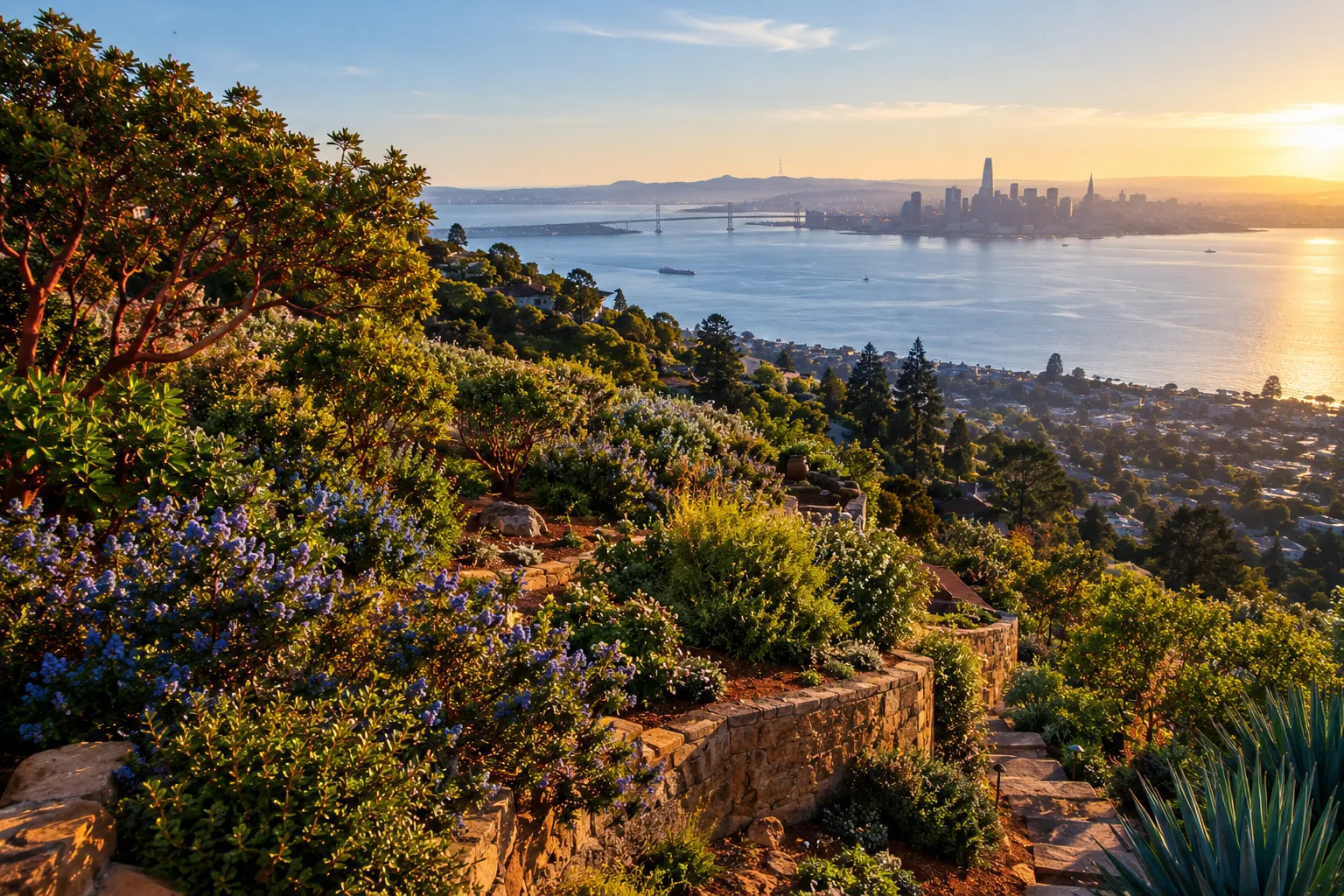
Quick Answer: Oakland landscaping on hillside properties requires three things working together: erosion control, fire-safe plant selection, and smart grading. The East Bay's steep terrain and wildland-urban interface fire risk mean your plant choices and yard layout are regulated, not just aesthetic decisions. Expect to budget $15,000 to $80,000+ for full hillside work, depending on slope steepness, retaining wall needs, and permit requirements.
Key Takeaways
- Oakland Hills properties sit inside the Wildland-Urban Interface Fire Area, where defensible space zones (0 to 100 feet from structures) are legally required and annually inspected
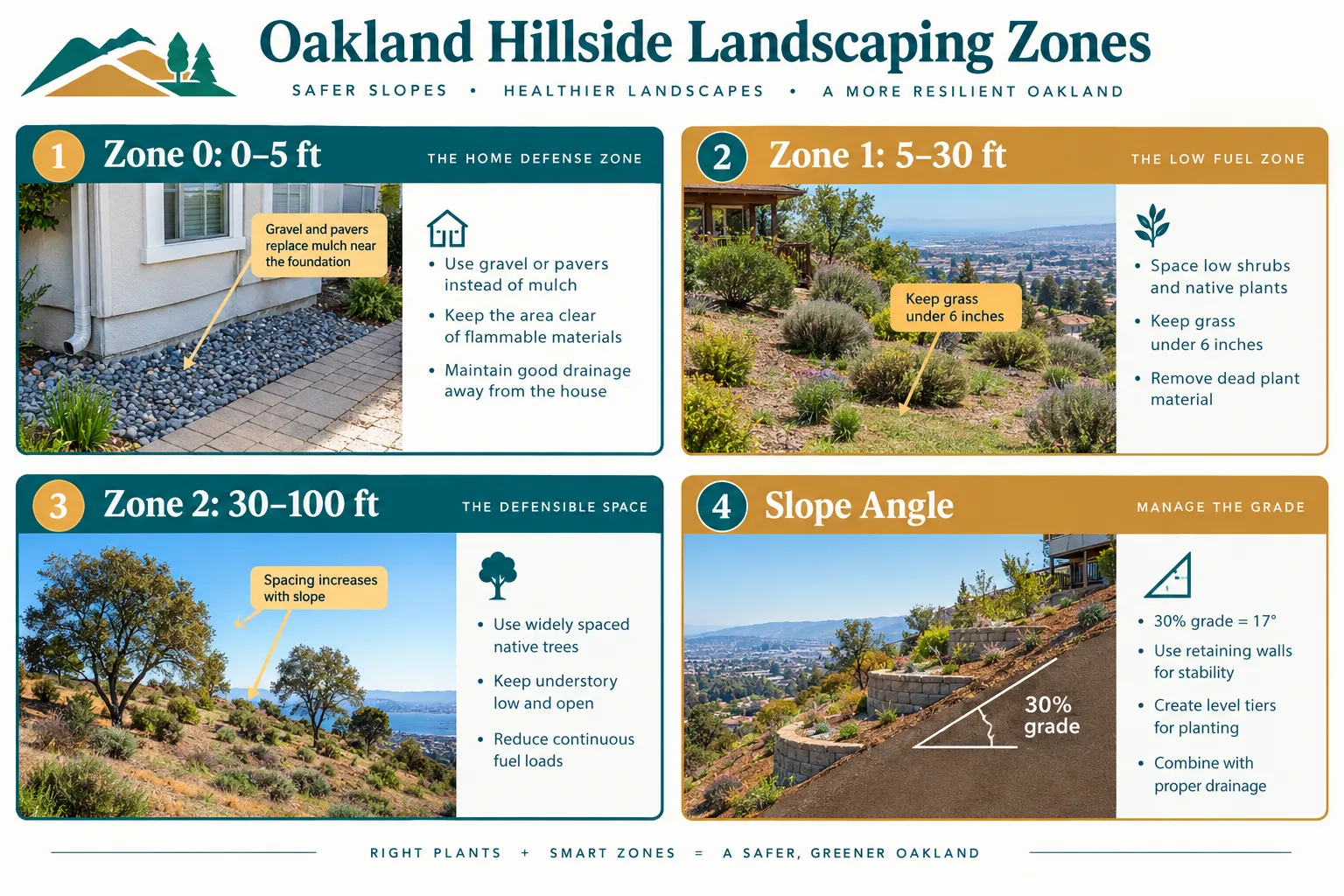
- Zone 0 (0 to 5 feet from your home) must use non-combustible surfaces like gravel, pavers, or concrete, not wood mulch
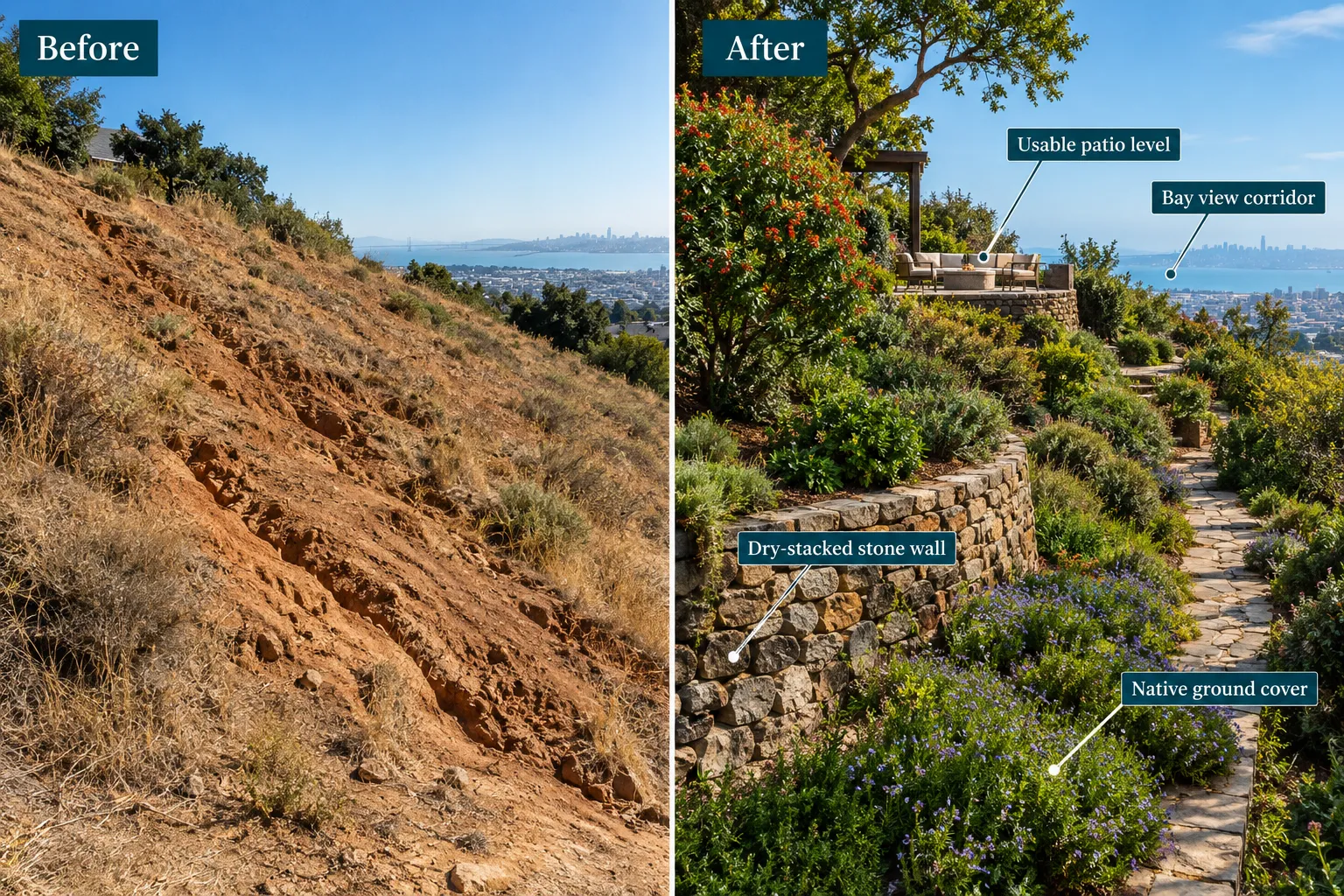
- Terracing with retaining walls is the most effective way to create usable flat space and control erosion on steep slopes
- California native plants, toyon, coffeeberry, manzanita, and blue-eyed grass, are the right foundation for Oakland hillside gardens
- Grading, retaining walls over 4 feet, and drainage work all require permits from the City of Oakland
- Preserving natural topography and minimizing grading is both a city planning requirement and the best way to protect bay views
- Hire a licensed C-27 (Landscaping) or C-29 (Masonry) contractor for retaining wall work; verify their license at the CSLB website
Table of Contents
- How to Landscape a Sloped Yard in Oakland
- How to Prevent Erosion on Steep Oakland Hills Properties
- Defensible Space Zones: What Oakland's Fire Rules Require
- Native Plants for Oakland Slopes and Bay View Properties
- Terracing vs. Retaining Walls for Oakland Slopes
- How Much Does Hillside Landscaping Cost in Oakland
- How to Maximize Bay Views With Landscaping
- Do You Need Permits for Landscaping on Slopes in Oakland
- Best Ground Cover for Oakland Hillside Yards
- How to Make a Steep Oakland Yard Usable for Entertaining
- Common Mistakes People Make Landscaping Slopes in Oakland
- Oakland Slope Landscaping Maintenance: What's Involved
- FAQ
How to Landscape a Sloped Yard in Oakland
Oakland landscaping on a slope starts with one question: how steep is it? Slopes under 15 percent can often be planted directly with deep-rooted natives and ground cover. Slopes between 15 and 30 percent usually need terracing or retaining walls. Anything steeper than 30 percent almost always requires a licensed contractor and a geotechnical assessment before any grading begins.
The City of Oakland's hillside design guidance stresses preserving natural topography and minimizing grading wherever possible. [6] That's not just good practice, it protects your bay view, reduces erosion risk, and keeps permit costs down.
Key steps for sloped yard work:
- Assess slope percentage before calling a contractor
- Get a soils or geotechnical report if the slope exceeds 20 percent
- Plan drainage first, water management drives every other decision
- Choose plants based on fire safety zones, not just looks
- Pull permits before breaking ground on walls or grading
How to Prevent Erosion on Steep Oakland Hills Properties
Erosion on Oakland hills happens fast. The clay-heavy soils common in the East Bay expand when wet and crack when dry, making bare slopes vulnerable after every rain. The best erosion control combines deep-rooted plants, physical barriers, and proper drainage.
Proven erosion control methods for Oakland slopes:
- Deep-rooted natives: Toyon (Heteromeles arbutifolia), coffeeberry (Frangula californica), and coyote brush (Baccharis pilularis) anchor soil with root systems that go 3 to 6 feet deep
- Jute netting or coir blankets: Biodegradable erosion control fabric holds soil while plants establish, typically the first 12 to 18 months after planting
- French drains and swales: Redirects water across the slope rather than straight down, reducing the velocity that causes rilling
- Retaining walls with weep holes: Prevents hydrostatic pressure buildup behind walls, which is the main cause of wall failure
- Terracing: Breaks a long slope into shorter, flatter sections that slow water movement
Oakland's Vegetation Management Plan identifies fire-risk reduction and erosion control as linked goals on hillside properties. [2] A bare slope is both an erosion risk and a fire risk, the two problems share the same solution: well-established native plantings.
Defensible Space Zones: What Oakland's Fire Rules Require
Every Oakland Hills property in the Wildland-Urban Interface Fire Area is subject to mandatory defensible space requirements and annual inspections. [1] This is not optional, and it directly shapes what you can plant and where.
Oakland's compliance standards define three zones: [3]
| Zone | Distance from Structure | Key Requirement |
|---|---|---|
| Zone 0 | 0 to 5 feet | Non-combustible surfaces only (gravel, pavers, concrete) |
| Zone 1 | 5 to 30 feet | Remove dead plants, keep grass under 6 inches, space shrubs |
| Zone 2 | 30 to 100 feet | Reduce fuel load; spacing requirements increase with slope |
The exact Zone 2 distance depends on your property's slope angle, fuel load, and fuel type. [7] CAL FIRE's defensible space guidance specifies shrub and tree spacing based explicitly on slope steepness, steeper slopes require wider spacing because fire travels faster uphill. [12, see source note]
Oakland's Home Hardening guidance reinforces Zone 0: replace any wood mulch within 5 feet of your home with gravel, pavers, or concrete. [8] This is one of the most common violations found during annual inspections.
The Oakland Fire Safe Council's firescaping program offers free site visits and guidance for homeowners navigating these requirements. [9]
Native Plants for Oakland Slopes and Bay View Properties
California native plants are the right choice for Oakland hillside gardens, not because they look good in magazines, but because they're adapted to the East Bay's dry summers, clay soils, and fire risk. Most require little to no irrigation once established.
Recommended natives for Oakland slopes:
- Toyon (Heteromeles arbutifolia): Evergreen shrub, 6 to 10 feet, deep roots, fire-resistant, supports birds
- Coffeeberry (Frangula californica): Drought-tolerant, 4 to 8 feet, excellent erosion control
- Manzanita (Arctostaphylos spp.): Low-growing varieties work well as ground cover; avoid planting in Zone 0
- Blue-eyed grass (Sisyrinchium bellum): Low, clumping perennial for slope edges and terraces
- Coyote brush (Baccharis pilularis): Fast-establishing, excellent for steep slopes, stays low
- California fescue (Festuca californica): Ornamental grass for slope stabilization
For bay view properties, keep taller plants (over 4 feet) positioned below the viewing line or to the sides of the view corridor. Low-growing natives like coyote brush and blue-eyed grass work well in the foreground without blocking sightlines.
Terracing vs. Retaining Walls for Oakland Slopes
Both terracing and retaining walls solve the same core problem, creating flat, stable ground on a slope, but they work differently and cost differently.
Retaining walls are single vertical structures that hold back soil. They work well for moderate slopes and defined grade changes. In Oakland, walls over 4 feet require a building permit and an engineered design. [6]
Terracing creates a series of stepped flat areas down a slope, often using shorter walls at each level. It distributes the load across multiple smaller walls rather than one large one, which reduces risk and often reduces cost per linear foot.
Choose retaining walls if: You have one defined grade change of 3 to 6 feet and need a clean edge.
Choose terracing if: You have a long continuous slope and want usable planting beds or entertaining space at multiple levels.
The S-11 combining zone (North Oakland Hill Specific Plan) requires designs to minimize grading and respect geotechnical constraints. [14, see source note] That means terracing with shorter walls is often the preferred approach from a planning standpoint.
How Much Does Hillside Landscaping Cost in Oakland
Oakland landscaping costs on slopes run significantly higher than flat-yard work. The added cost comes from equipment access, soil engineering, permit fees, and the labor intensity of working on a grade.
Rough cost ranges (estimates based on contractor market data, 2026):
- Basic erosion control planting (natives + jute netting): $8 to $15 per square foot
- Dry-stacked stone retaining wall: $35 to $65 per square foot of wall face
- Concrete or engineered retaining wall: $55 to $100+ per square foot
- Full terracing with walls and planting: $25,000 to $80,000+ depending on slope and access
- Geotechnical report: $1,500 to $4,000
- Oakland grading/retaining wall permit: $500 to $2,500+, depending on project scope
These are estimates. Your actual cost depends on slope steepness, soil conditions, equipment access, and contractor availability. Always get three written bids. Ask each contractor to itemize labor, materials, permits, and hauling separately.
How to Maximize Bay Views With Landscaping
Preserving or opening up bay views is one of the top reasons Oakland Hills homeowners invest in landscaping. The key is managing plant height and density in the view corridor while still meeting defensible space requirements.
Practical strategies:
- Use low-growing ground cover (under 18 inches) in the primary view corridor
- Position taller shrubs to the sides of the view line, not directly in front
- Avoid fast-growing trees like eucalyptus or Monterey pine in the view zone, they'll block the view within 5 to 10 years
- Use terracing to create a lower foreground planting level that frames rather than blocks the view
- Trim existing trees to raise the canopy rather than removing them entirely
Oakland's hillside planning guidance explicitly calls for protecting view corridors as part of site design. [6] If you're in the S-11 zone, your landscaping plan may need to demonstrate that it preserves existing view lines. [14, see source note]
Do You Need Permits for Landscaping on Slopes in Oakland
Yes, in many cases. Oakland requires permits for grading, retaining walls over 4 feet, and drainage work that affects adjacent properties.
When you need a permit:
- Retaining walls over 4 feet in height (measured from bottom of footing)
- Any grading that moves more than 50 cubic yards of soil
- Drainage systems that discharge to the street or neighboring property
- Work in a designated hillside or geologic hazard zone
When you typically don't need a permit:
- Planting or replanting with no grading
- Retaining walls under 4 feet with no surcharge (no structure above)
- Replacing existing irrigation systems in-kind
Contact Oakland's Planning and Building Department before starting any slope work. Unpermitted retaining walls are a common problem in the hills, they create liability and can complicate home sales.
How to Make a Steep Oakland Yard Usable for Entertaining
A steep Oakland yard can become a functional outdoor space with the right approach. The goal is to create at least one flat zone, even a small one, that works for seating, dining, or gathering.
Options for creating usable space:
- Cantilevered deck: Built over the slope rather than into it; avoids major grading; requires structural engineering
- Cut-and-fill terrace: Grade a flat pad into the slope; fill the downhill side with a retaining wall
- Multi-level terraces: Create two or three connected flat areas at different elevations, connected by steps
A 10-by-12-foot flat pad is enough for a small dining table and four chairs. That's achievable on most slopes with a single retaining wall and modest grading. For larger entertaining areas, budget for full terracing and expect a 6 to 12 week project timeline.
Common Mistakes People Make Landscaping Slopes in Oakland
The most expensive mistakes on Oakland hillside projects come from skipping steps early in the process.
- Skipping the geotechnical report: Clay soils in the Oakland Hills expand and shift. A soils report costs $1,500 to $4,000 and can prevent a $50,000 wall failure
- Planting the wrong species in Zone 0: Wood mulch and dense shrubs within 5 feet of the house are fire code violations [8]
- Building walls without permits: Unpermitted walls may need to be demolished and rebuilt at your expense
- Ignoring drainage: Water behind a retaining wall with no weep holes will eventually push the wall over
- Hiring a contractor without a C-27 or C-29 license: Verify at the California State License Board (cslb.ca.gov) before signing anything
Your yard deserves someone who knows what they're doing. Licensed, insured, and reviewed contractors are not hard to find, but you have to check.
Oakland Slope Landscaping Maintenance: What's Involved
Oakland hillside landscaping requires ongoing maintenance, especially for fire compliance. The Oakland Fire Department conducts annual inspections of all properties in the Wildland-Urban Interface Fire Area. [1]
Annual maintenance checklist:
- Trim grass and weeds in Zone 1 to under 6 inches before fire season (typically by May 1)
- Remove dead plant material from all zones
- Clear debris from gutters, downspouts, and Zone 0
- Check retaining walls for cracks, leaning, or soil movement
- Inspect drainage channels for blockage
- Reapply erosion control fabric in bare areas before the rainy season (October to November)
The Oakland Vegetation Management Plan, adopted in 2026, outlines a citywide strategy for fire-risk reduction that applies to all hillside properties. [2] Staying ahead of annual inspection requirements is far cheaper than receiving a notice of violation.
FAQ
Can I do Oakland hillside landscaping myself, or do I need to hire someone?
Basic planting and erosion control fabric installation are DIY-friendly. Retaining walls over 4 feet, grading, and drainage work require permits and, in most cases, a licensed contractor. Steep slopes over 30 percent should always involve a professional due to soil stability risks.
What plants are banned or discouraged in the Oakland Hills?
Highly flammable non-natives like eucalyptus, Monterey pine, pampas grass, and acacia are strongly discouraged in fire-risk zones. The Oakland Fire Safe Council's firescaping guidance lists specific species to avoid. [9]
How do I verify a landscaping contractor's license in California?
Go to cslb.ca.gov and search by company name or license number. Look for an active C-27 (Landscaping) license for planting and irrigation work, or C-29 (Masonry) for retaining walls. Always confirm the license is current and the contractor carries general liability and workers' compensation insurance.
What is Zone 0 and why does it matter for my Oakland yard?
Zone 0 is the 0 to 5 foot area immediately around your home. Oakland's Home Hardening guidance requires non-combustible surfaces in this zone, gravel, pavers, or concrete instead of wood mulch or dense plantings. [8] This is one of the most commonly cited violations during annual fire inspections.
How long does a hillside terracing project take in Oakland?
A basic single-wall terrace with planting typically takes 2 to 4 weeks. Full multi-level terracing projects with permits can take 2 to 4 months from permit approval to final planting. Permit review alone can add 4 to 8 weeks.
Do defensible space rules apply to my whole property or just near the house?
The rules apply from your structure outward. Zone 1 covers 5 to 30 feet from the structure. Zone 2 extends from 30 to 100 feet, with the exact distance depending on slope and fuel load. [3] If your property is smaller than 100 feet in any direction, the zone extends to your property line.
Conclusion
Oakland landscaping on hillside properties is more complex than most homeowners expect, but it's also one of the most rewarding investments you can make. The combination of fire safety, erosion control, native planting, and smart terracing creates a yard that's safer, lower-maintenance, and genuinely beautiful.
Start with the basics: know your slope percentage, understand which defensible space zone applies to each part of your yard, and pull permits before breaking ground. Then find a licensed contractor who has worked specifically on Oakland Hills properties. Ask to see past hillside projects. Ask about their permit process. Ask whether they carry the right license for retaining wall work.
Find the right landscaper for your yard. Local pros with local knowledge make the difference on a project this specific. The directory built for homeowners not advertisers, that's what LandscapeProsDirectory is here for. Real reviews from real homeowners, licensed insured and reviewed contractors, and cost guides that actually tell you what things cost.
No fluff. Just useful advice. Find your next landscaper here.
References
[1] English 2026 OFD Annual Inspection Notice - https://www.oaklandca.gov/files/assets/city/v/1/fire/documents/fire-code-amp-inspections/english-2026-ofd-annual-inspection-notice.pdf
[2] Oakland VMP Final Adopted - https://www.oaklandca.gov/files/assets/city/v/1/public-meetings/wildfire-prevention-commission/2026/oakland-vmp_final_adopted.pdf
[3] Compliance Standards for Vegetation Inspections - https://www.oaklandca.gov/Public-Safety-Streets/Fire/Wildfire-District-Inspections/Compliance-Standards-for-Vegetation-Inspections
[4] Oakland Legistar VMP Agenda Report - https://oakland.legistar.com/View.ashx?M=F&ID=15669900&GUID=3EBAA80D-6FD8-43BB-BE57-C09896D27393
[5] Oaklandside Property Wildfire Guide - https://oaklandside.org/oakland-wildfire-guide/property/
[6] Oakland Planning Staff Report (Oak Knoll) - https://www.oaklandca.gov/files/assets/city/v/1/planning-amp-building/documents/dp/oak-knoll/07-27-2016-staff-report.pdf
[7] Fire Season Notice - https://www.oaklandca.gov/files/assets/city/v/1/public-works/documents/sustainability/fire-season-notice.pdf
[8] Home Hardening - https://www.oaklandca.gov/Public-Safety-Streets/Fire/Wildfire-District-Inspections/Home-Hardening
[9] Oakland Fire Safe Council Programs - https://oaklandfiresafecouncil.org/programs/
[10] Wildfire Prevention Town Hall 2025 - https://www.oaklandca.gov/files/assets/city/v/2/fire/documents/oakland-vegetation/wildfire-prevention-town-hall-2025.pdf
<!DOCTYPE html>
<html lang="en">
<head>
<meta charset="UTF-8">
<meta name="viewport" content="width=device-width, initial-scale=1.0">
<title>Oakland Hillside Landscaping Cost Estimator</title>
<style>
  .lpd-wrap{font-family:system-ui,sans-serif;max-width:520px;margin:2rem auto;background:#f7f5f0;border:1px solid #d4c9b0;border-radius:8px;padding:1.25rem}
  .lpd-wrap h3{margin:0 0 .75rem;font-size:1.05rem;color:#2c4a2e}
  .lpd-row{margin:.5rem 0}
  .lpd-row label{display:block;font-size:.85rem;color:#444;margin-bottom:.2rem}
  .lpd-row select,.lpd-row input{width:100%;padding:.4rem .5rem;border:1px solid #bbb;border-radius:4px;font-size:.9rem;background:#fff;box-sizing:border-box}
  .lpd-btn{margin-top:.9rem;background:#2c6e3f;color:#fff;border:none;padding:.55rem 1.1rem;border-radius:5px;font-size:.95rem;cursor:pointer;width:100%}
  .lpd-btn:hover{background:#235530}
  .lpd-result{margin-top:.9rem;background:#fff;border:1px solid #b5d4bc;border-radius:5px;padding:.75rem;font-size:.9rem;color:#2c4a2e;display:none}
  .lpd-result strong{font-size:1rem}
  .lpd-note{font-size:.75rem;color:#777;margin-top:.5rem}
</style>
</head>
<body>
<div class="lpd-wrap">
  <h3>Oakland Hillside Landscaping Cost Estimator</h3>
  <div class="lpd-row">
    <label>Slope steepness</label>
    <select id="lpd-slope">
      <option value="low">Under 15% (gentle)</option>
      <option value="mid">15-30% (moderate)</option>
      <option value="steep">Over 30% (steep)</option>
    </select>
  </div>
  <div class="lpd-row">
    <label>Approximate slope area (sq ft)</label>
    <input type="number" id="lpd-sqft" placeholder="e.g. 1500" min="100" max="20000">
  </div>
  <div class="lpd-row">
    <label>Primary goal</label>
    <select id="lpd-goal">
      <option value="erosion">Erosion control + planting</option>
      <option value="wall">Retaining wall</option>
      <option value="terrace">Full terracing + entertaining space</option>
    </select>
  </div>
  <button class="lpd-btn" onclick="lpdCalc()">Estimate My Cost Range</button>
  <div class="lpd-result" id="lpd-result"></div>
</div>
<script>
function lpdCalc(){
  var slope=document.getElementById('lpd-slope').value;
  var sqft=parseFloat(document.getElementById('lpd-sqft').value)||0;
  var goal=document.getElementById('lpd-goal').value;
  if(sqft<100){alert('Please enter a valid area.');return;}
  var lo,hi,note='';
  if(goal==='erosion'){lo=8;hi=15;note='Includes natives, jute netting, basic drainage.';}
  else if(goal==='wall'){lo=35;hi=65;note='Dry-stacked stone. Engineered walls run $55,$100+/sq ft of wall face.';}
  else{lo=25;hi=50;note='Full terracing with walls, steps, and planting.';}
  if(slope==='mid'){lo=Math.round(lo*1.25);hi=Math.round(hi*1.3);}
  if(slope==='steep'){lo=Math.round(lo*1.6);hi=Math.round(hi*1.7);note+=slope==='steep'?' Geotech report ($1,500,$4,000) likely required.':'';}
  var total_lo=(lo*sqft).toLocaleString();
  var total_hi=(hi*sqft).toLocaleString();
  var el=document.getElementById('lpd-result');
  el.style.display='block';
  el.innerHTML='<strong>Estimated range: $'+total_lo+', $'+total_hi+'</strong><br><span class="lpd-note">'+note+' Estimates only. Get 3 written bids from licensed C-27/C-29 contractors.</span>';
}
</script>
</body>
</html>
Liked this guide? Follow us on Google Search
Related Directory Pages
Find a Landscaper Near You
Browse CA landscaping professionals on LandscapeProsDirectory.
Search Landscapers