
Reno Slope Stabilization: Costs for Terracing and Erosion
Reno slope stabilization and terracing costs for 2026. Guide to erosion control, gravity walls, and planting for steep High Sierra foothills. Compare local pros
Last updated: October 1, 2026
Quick Answer: Reno slope stabilization cost typically runs $3,000 to $65,000+ depending on slope steepness, wall height, method, and soil conditions. Terraced retaining walls on a mid-size Reno lot average $8,000 to $25,000 installed. Erosion control blankets and riprap are cheaper entry points at $1,500 to $8,000. Any wall over 3 feet in Washoe County requires a permit and often a licensed structural engineer.
Key Takeaways
- Reno slope stabilization cost ranges from roughly $3,000 for basic erosion blankets to $65,000+ for engineered terraced walls on steep lots
- Retaining walls in Reno average $25 to $75 per square foot installed, depending on material and wall height [3][6]
- Walls over 3 feet in Washoe County require a building permit; walls over 4 feet typically need a licensed structural engineer [1]
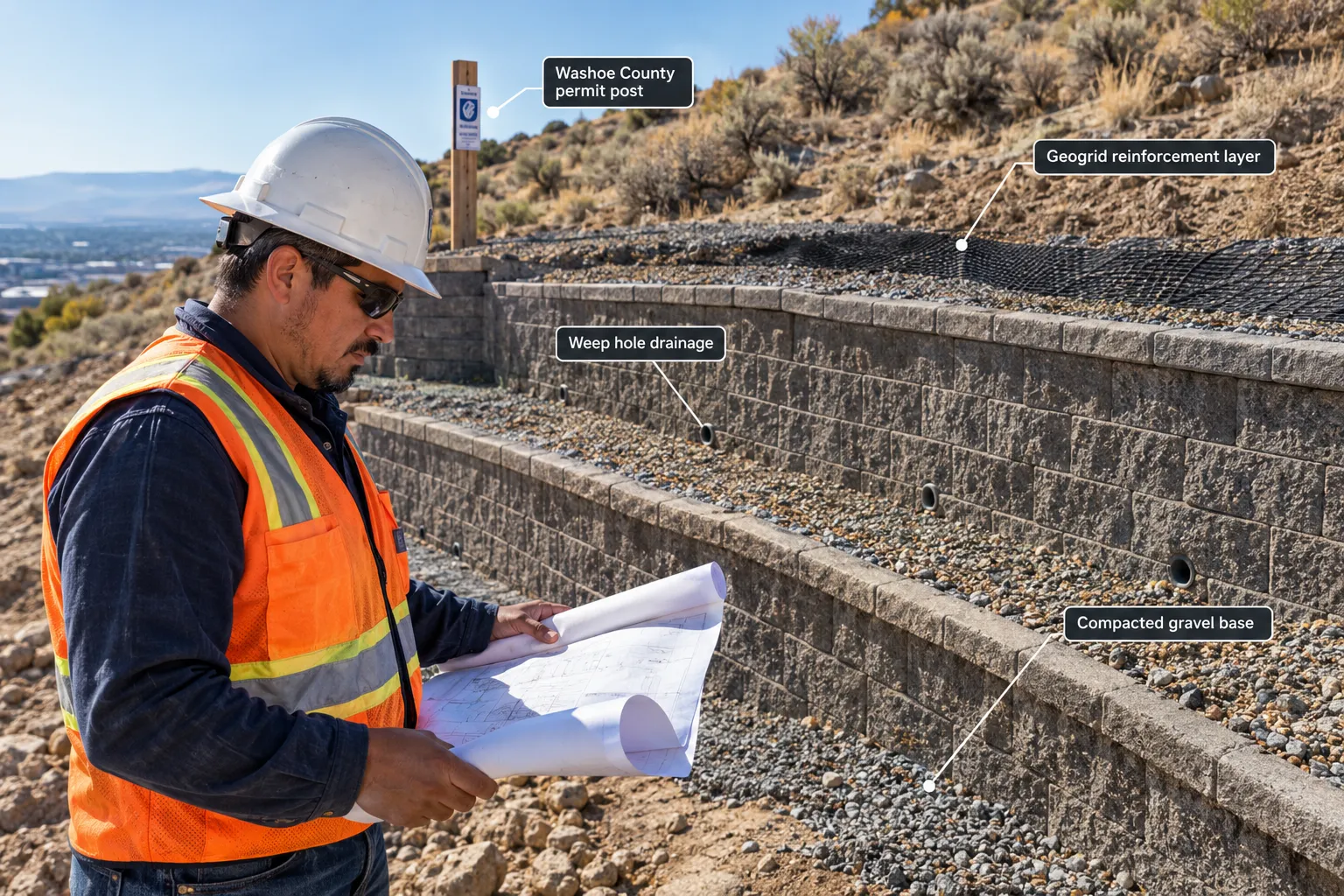
- Freeze-thaw cycles and Reno's clay-heavy soils make drainage detailing non-negotiable, weep holes and gravel backfill are not optional
- Terracing (multiple shorter walls) usually outperforms a single tall wall on slopes steeper than 3:1
- DIY is only realistic for walls under 2 feet and gentle slopes, anything steeper is a liability and permit issue
- Get at least three bids from licensed Nevada contractors; verify licenses at the Nevada State Contractors Board before signing anything
- Unpermitted slope work can trigger fines, forced removal, and title problems when you sell
Table of Contents
- What Is Slope Stabilization and Why Do You Need It?
- How Much Does Slope Stabilization Cost in Reno?
- Reno Slope Stabilization Cost Per Square Foot
- Cost of Terracing Steep Reno Lots
- Erosion Control Blankets and Riprap Pricing
- Slope Stabilization Methods Compared: Terracing vs. Retaining Walls
- What Factors Affect Slope Stabilization Pricing?
- Engineering and Permitting for Nevada Slopes
- Planting for Hillside Stabilization
- DIY vs. Hiring a Professional in Reno
- How Long Does Slope Stabilization Last?
- Slope Stabilization Maintenance Costs in Reno
- Common Mistakes People Make With Slope Stabilization
- How to Get Slope Stabilization Quotes in Reno
- FAQ
What Is Slope Stabilization and Why Do You Need It?
Slope stabilization is any method used to stop a hillside from moving, eroding, or failing. It includes retaining walls, terracing, erosion blankets, riprap, grading, and deep-rooted plantings. You need it when a slope is losing soil, creeping toward a structure, or washing out during Reno's monsoon rain events.
Reno sits at roughly 4,500 feet elevation. The combination of freeze-thaw winters, clay soils in many neighborhoods, and sudden summer downpours creates real erosion risk. Slopes steeper than 2:1 (two feet of horizontal run for every foot of rise) are especially vulnerable. Left alone, an unstable slope can undermine a fence, damage a foundation, or send a mudslide across a neighbor's property.
Your yard deserves someone who knows what they're doing, and slope work is one of the areas where a wrong call gets expensive fast.
How Much Does Slope Stabilization Cost in Reno?
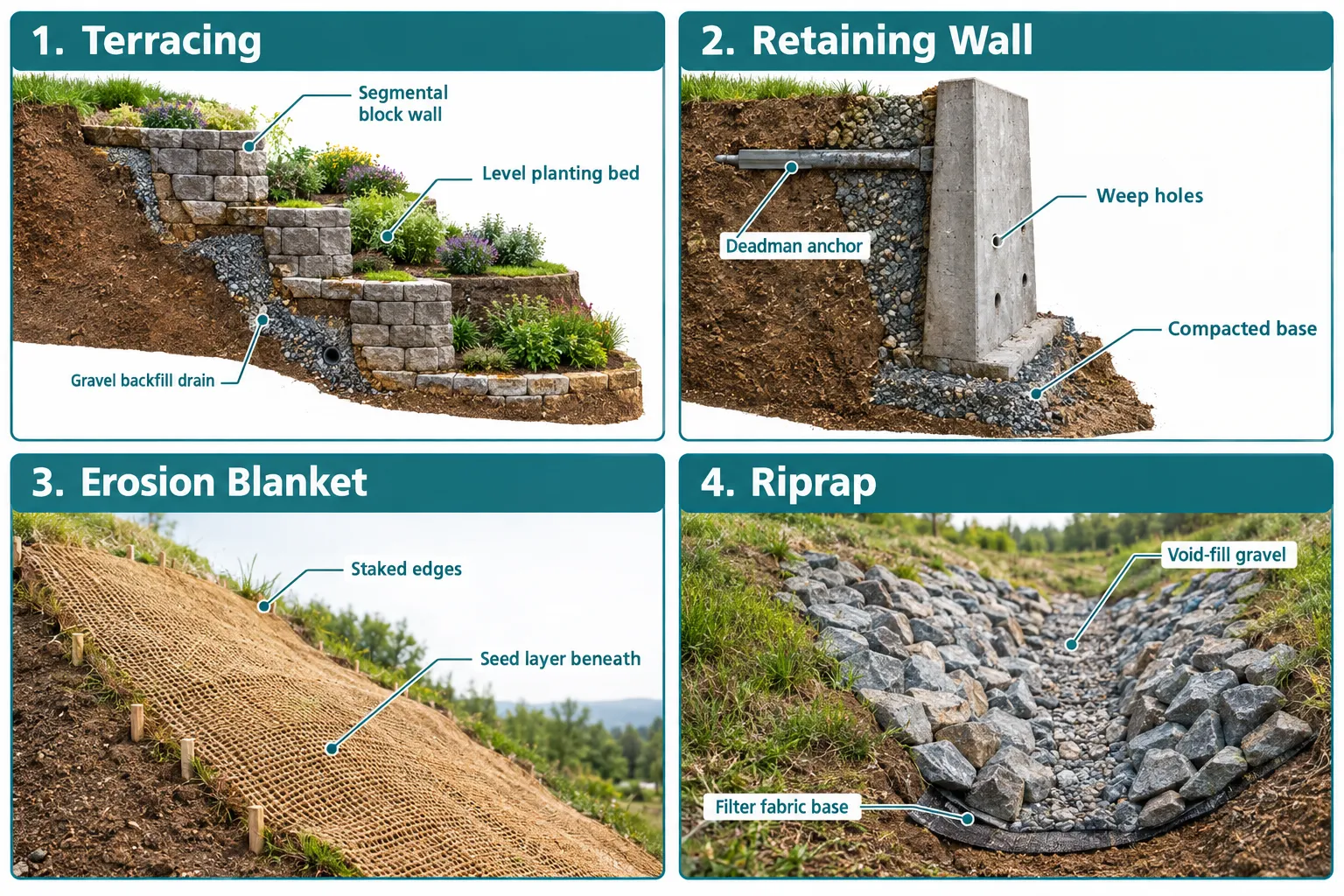
Reno slope stabilization cost depends heavily on the method chosen and the size of the slope. Basic erosion control (blankets, seed, staking) starts around $1,500 to $4,000 for a typical residential slope. A single segmental block retaining wall runs $4,000 to $18,000 for most residential projects. Full terracing with multiple tiers on a steep lot can reach $25,000 to $65,000 or more.
Here are ballpark ranges for common methods in 2026:
| Method | Typical Reno Cost Range | Best For |
|---|---|---|
| Erosion control blanket + seeding | $1,500, $4,500 | Gentle slopes, new construction |
| Riprap (rock lining) | $2,500, $8,000 | Drainage channels, moderate slopes |
| Single segmental block wall | $4,000, $18,000 | Slopes under 4 ft height change |
| Terraced multi-tier walls | $12,000, $65,000+ | Steep lots, height changes over 6 ft |
| Poured concrete wall | $8,000, $30,000+ | High-load or engineered sites |
| Grading + regrading only | $1,200, $6,000 | Pre-wall prep, minor slope correction |
These are installed costs including labor, materials, and basic drainage. Engineering and permit fees are separate. [3][6][7]
Reno Slope Stabilization Cost Per Square Foot
Per square foot, Reno retaining walls and slope work typically cost $25 to $75 for standard segmental block or timber, and $45 to $125 for poured concrete or engineered walls [6][10]. Erosion blankets run $1 to $3 per square foot for materials, plus $0.50 to $1.50 per square foot for labor and staking.
Keep in mind: square foot pricing for walls is measured as the face area of the wall, not the ground area of the slope. A 50-foot-long wall that stands 4 feet tall has 200 square feet of face area. At $40 per square foot, that wall costs $8,000 before drainage, backfill, and permits.
Grand Design Landscape, a Reno-area contractor, notes that retaining wall projects vary widely based on access, soil conditions, and drainage requirements [8].
Cost of Terracing Steep Reno Lots
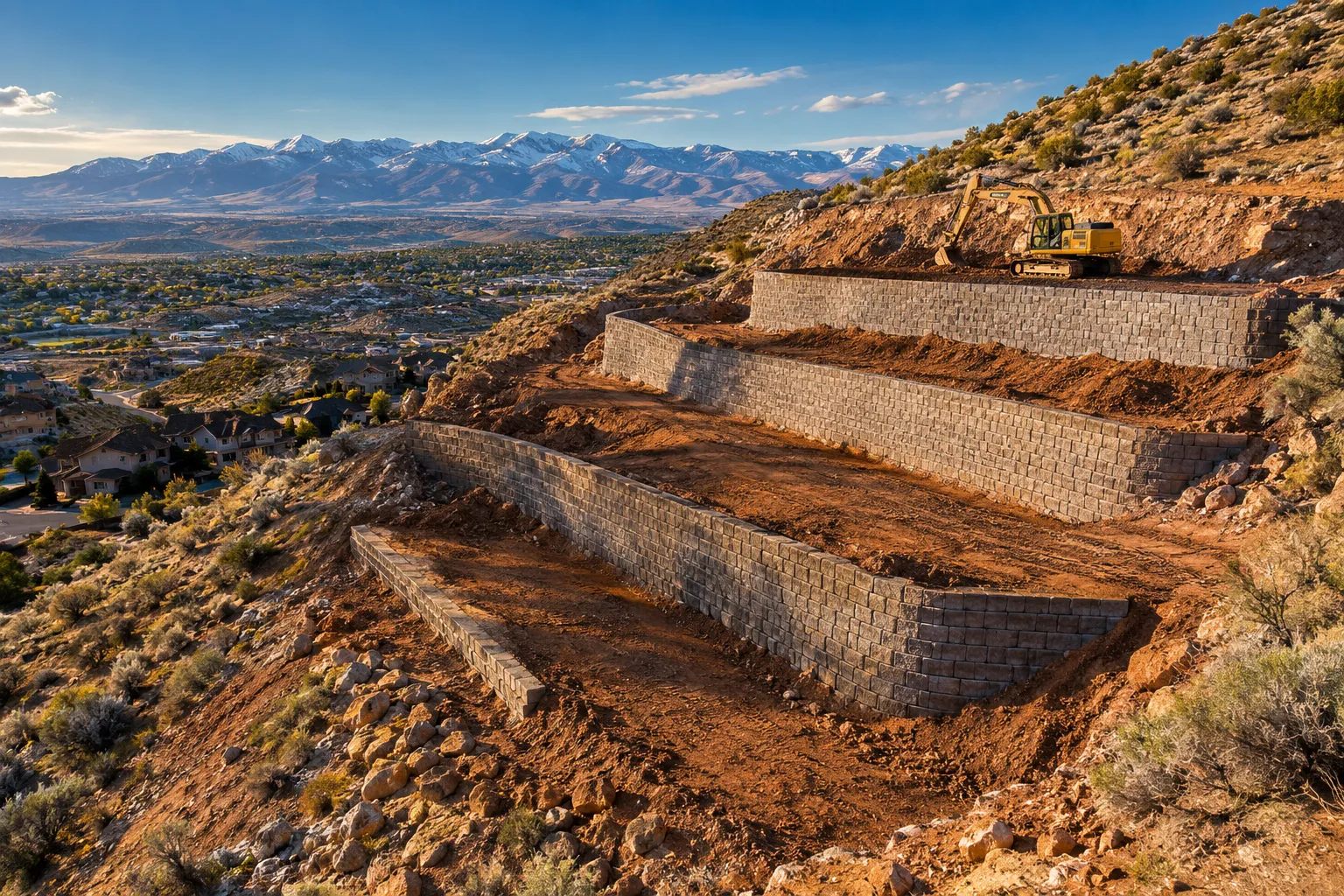
Terracing a steep Reno lot means building two or more shorter retaining walls in steps rather than one tall wall. This is almost always the right call on slopes with more than 5 to 6 feet of elevation change. Each tier typically holds 2 to 4 feet of height. The space between tiers becomes a usable planting bed or pathway.
A mid-size Reno hillside terrace project, say, a 60-foot-wide slope with 8 feet of total rise, might involve three tiers of segmental block wall. Expect:
- Wall materials: $6,000 to $14,000 depending on block type
- Labor: $4,000 to $10,000
- Grading and backfill: $1,500 to $4,000 [4]
- Drainage (gravel, pipe, weep holes): $1,000 to $3,500
- Engineering (if walls exceed 4 ft): $1,500 to $4,000 [1]
- Permits: $200 to $800 through Washoe County
Total for that project: roughly $14,000 to $35,000. Larger lots or steeper grades push costs higher. Reno Grading notes that landscape sloping and grading preparation is a key cost driver before any wall goes in [4].
Erosion Control Blankets and Riprap Pricing
Erosion control blankets and riprap are the two most common lower-cost options for Reno slopes that don't need full retaining walls. Erosion blankets (jute, coir, or synthetic mesh) hold soil while plants establish. Riprap uses angular rock to armor drainage channels and slope faces against water scour.
Erosion control blankets cost $1,500 to $4,500 installed for a typical 1,000 to 2,000 square foot residential slope. Jute is biodegradable and works well with seeding. Synthetic blankets last longer but cost more.
Riprap runs $2,500 to $8,000 for most residential drainage swales and slope faces. Rock size matters: D50 (median rock diameter) of 6 to 12 inches is typical for Reno residential drainage channels. Always install filter fabric beneath riprap or it will sink into the soil over time.
Neither method replaces a retaining wall on slopes steeper than 3:1. They work best as secondary protection or on slopes that are already close to stable.
Slope Stabilization Methods Compared: Terracing vs. Retaining Walls
Terracing and single retaining walls both hold soil, but they solve different problems. A single retaining wall works well when you have one defined grade change, like a flat yard dropping to a lower flat yard. Terracing works better when the entire slope needs to be tamed and you want usable space on the hillside.
Choose terracing if:
- Your slope rises more than 5 feet total
- You want planting beds or pathways between tiers
- You're on a slope steeper than 2.5:1
- A single wall would need to exceed 4 feet (triggering engineering requirements)
Choose a single retaining wall if:
- You have one clean grade change of 2 to 4 feet
- The slope behind the wall is already stable
- Budget is a priority and the site allows it
Poured concrete walls cost more upfront but last longer and handle higher loads. Segmental block (Allan Block, Versa-Lok) is the most common choice in Reno for residential work because it handles freeze-thaw movement better than solid poured walls without proper expansion joints [8].
What Factors Affect Slope Stabilization Pricing?
Several site-specific conditions drive Reno slope stabilization cost up or down. The biggest variables are slope steepness, wall height, soil type, drainage needs, and site access.
- Slope steepness: Steeper slopes need more engineering, more backfill, and sometimes soil nails or geogrid reinforcement
- Wall height: Every foot of additional height increases cost non-linearly, a 5-foot wall costs significantly more per square foot than a 3-foot wall
- Soil type: Reno's clay-heavy soils in areas like South Meadows and Spanish Springs expand when wet and shrink when dry, which stresses walls and requires better drainage detailing
- Drainage: Poor drainage is the number one cause of retaining wall failure in Reno. Gravel backfill, perforated pipe, and weep holes add cost but are not optional
- Access: Tight side yards or hillside lots with no truck access require hand-digging or small equipment, which raises labor costs
- Material choice: Segmental block, timber, poured concrete, and natural stone all have different price points and lifespans
Engineering and Permitting for Nevada Slopes
Any retaining wall over 3 feet in Washoe County requires a building permit. Walls over 4 feet, measured from the bottom of the footing to the top of the wall, typically require stamped drawings from a licensed structural or geotechnical engineer [1]. This is not optional, and skipping it is one of the most expensive mistakes a Reno homeowner can make.
Engineering fees for a residential retaining wall in Reno run $1,500 to $5,000 depending on wall complexity and whether a soils report is required. A geotechnical soils report, which tests bearing capacity and soil composition, adds another $1,000 to $3,000 but is often required for walls on steep or unstable ground.
Permit fees through Washoe County Building Department are relatively modest ($200 to $800 for most residential walls), but the review process takes time. Budget 3 to 6 weeks for permit approval before work can begin.
Warning: Unpermitted slope work can result in stop-work orders, fines, and mandatory removal of completed walls. It also creates title and disclosure issues when you sell the property. No fluff, just useful advice: pull the permit.
Planting for Hillside Stabilization
Deep-rooted native plants are one of the most cost-effective long-term slope stabilization tools available to Reno homeowners. Plants don't replace walls on steep slopes, but they dramatically reduce erosion between walls and on gentler grades.
Good choices for Reno hillsides include:
- Fourwing saltbush (Atriplex canescens), deep roots, drought-tolerant, handles Reno's alkaline soils
- Desert willow (Chilopsis linearis), fast-growing, excellent root mass for slope anchoring
- Apache plume (Fallugia paradoxa), native to the Great Basin, low water, spreads naturally
- Blue grama grass (Bouteloua gracilis), excellent for erosion control on moderate slopes
Hydroseeding a Reno hillside with a native seed mix runs $0.08 to $0.20 per square foot. A 2,000 square foot slope costs $160 to $400 in seed and mulch, plus $500 to $1,500 in labor. Add erosion blankets over the seed for the first season and you have a low-cost stabilization system that improves every year as roots deepen.
Planting alone won't hold a slope that's already failing. Pair it with walls or riprap first, then plant.
DIY vs. Hiring a Professional in Reno
DIY slope stabilization is realistic only for walls under 2 feet tall and gentle slopes. For anything taller or steeper, the combination of permit requirements, engineering needs, and physical risk makes professional installation the right call.
DIY makes sense if:
- The wall is under 2 feet and the slope is gentle (less than 4:1)
- You're installing erosion blankets or simple riprap on a low-risk slope
- You have experience with grading and drainage
Hire a pro if:
- Any wall will exceed 3 feet (permit required)
- The slope is steeper than 2:1
- There's a structure, fence, or neighbor's property downhill
- Soil is clay-heavy or shows signs of existing movement
Find the right landscaper for your yard by checking the Nevada State Contractors Board (nvcontractorsboard.com) before hiring. Look for a Class A or Class B general contractor, or a C-10 (masonry) or C-18 (landscaping) specialty license. Licensed, insured, and reviewed, that's the baseline. Know who you're letting into your yard.
How Long Does Slope Stabilization Last?
A properly built segmental block retaining wall in Reno lasts 25 to 50 years with adequate drainage and maintenance. Poured concrete walls can last 50+ years. Timber walls have the shortest lifespan at 10 to 20 years due to rot and freeze-thaw damage.
Erosion blankets are temporary (1 to 5 years) and are meant to hold soil while plants establish. Once native plants have rooted deeply, the blanket has done its job. Riprap lasts indefinitely if the filter fabric base is intact and the rocks aren't displaced by flooding.
The biggest factor in longevity is drainage. A well-drained wall outlasts a poorly drained wall by decades. Reno's freeze-thaw cycles push water into every crack and joint, drainage is the difference between a 30-year wall and a 10-year wall.
Slope Stabilization Maintenance Costs in Reno
Annual maintenance for a Reno retaining wall system is modest if the original installation was done correctly. Budget $200 to $600 per year for inspection, minor repairs, and drainage clearing.
Key maintenance tasks:
- Clear weep holes and drainage outlets every spring and fall, clogged drainage is the leading cause of wall failure
- Inspect for bulging or cracking after the first hard freeze each winter
- Repoint mortar joints on older masonry walls every 5 to 10 years
- Replant bare spots on hillside planting areas to prevent erosion from returning
- Check riprap after heavy rain events for displaced rock or exposed filter fabric
Major repairs, like rebuilding a section of failed wall, run $2,000 to $10,000 depending on extent. Catching a problem early (a slight lean, a weep hole that's stopped flowing) is far cheaper than waiting for a failure.
Common Mistakes People Make With Slope Stabilization
The most common mistake is skipping drainage. A beautiful wall with no weep holes or gravel backfill will fail within a few years in Reno's climate. The second most common mistake is building without a permit and then having to tear it out.
Other mistakes to avoid:
- Undersizing the wall: A 3-foot wall trying to hold a 6-foot slope will fail. Match the wall to the actual load
- Using the wrong block: Not all retaining wall block is rated for the same height. Check manufacturer specs
- Ignoring soil reports: Clay soils in Reno neighborhoods like Damonte Ranch and Double Diamond behave very differently from sandy soils. A soils report is worth the cost
- Hiring unlicensed contractors: Unlicensed work means no permit, no inspection, and no recourse if it fails. We verify so you don't have to, but you still need to check
- Building too close to the property line: Washoe County has setback rules for retaining walls. Check before you dig
How to Get Slope Stabilization Quotes in Reno
Getting accurate quotes for Reno slope stabilization cost requires giving contractors the same information so you can compare bids fairly. Cost guides that actually tell you what things cost start with knowing what to ask.
Steps to get useful quotes:
- Measure your slope: total length, approximate height change, and steepness
- Note what's downhill, a neighbor's fence, a structure, or open space changes the risk profile
- Ask each contractor to specify the wall material, drainage method, and whether engineering is included
- Request a line-item bid, not a single lump sum
- Verify the contractor's Nevada license at nvcontractorsboard.com before the site visit
- Ask if they pull permits, if a contractor suggests skipping permits, walk away
Get at least three bids. Local pros, local knowledge, a contractor who works regularly in your specific Reno neighborhood will know the soil conditions and local code quirks better than a general contractor from out of the area. Find your next landscaper here at LandscapeProsDirectory, where real reviews from real homeowners help you make a smarter hire.
FAQ
How much does a basic retaining wall cost in Reno?
A basic segmental block retaining wall in Reno costs $4,000 to $18,000 installed for most residential projects, depending on length, height, and drainage requirements. Per square foot of wall face, expect $25 to $75 for standard block. [3][6]
Do I need a permit for a retaining wall in Reno?
Yes. Washoe County requires a building permit for any retaining wall over 3 feet tall. Walls over 4 feet (measured from footing bottom to wall top) also require stamped drawings from a licensed engineer. Skipping permits can result in fines and forced removal. [1]
What is the cheapest way to stabilize a slope in Reno?
For gentle slopes, erosion control blankets with native seeding is the lowest-cost option at $1,500 to $4,500 installed. Riprap is slightly more at $2,500 to $8,000 but handles drainage channels better. Neither replaces a retaining wall on slopes steeper than 3:1.
How long does a retaining wall last in Reno's climate?
Segmental block walls last 25 to 50 years with proper drainage. Timber walls last 10 to 20 years. Poured concrete can last 50+ years. Reno's freeze-thaw cycles shorten wall life significantly when drainage is inadequate.
What questions should I ask a Reno slope stabilization contractor?
Ask: Are you licensed with the Nevada State Contractors Board? Do you pull permits? What drainage method will you use? Is engineering included or separate? Can you provide a line-item bid? What warranty do you offer on labor and materials? What to ask before you hire a landscaper matters as much as the price.
Can I DIY a retaining wall in Reno?
Only for walls under 2 feet on gentle slopes. Anything taller requires a permit and often an engineer. DIY walls without permits create legal and title problems. The physical and financial risk is not worth it for walls over 2 feet.
Conclusion
Reno slope stabilization cost is not one number, it's a range shaped by your slope's steepness, the method you choose, your soil conditions, and whether engineering and permits are required. For most Reno homeowners dealing with a real erosion problem or a steep hillside, the realistic budget is $8,000 to $35,000 for a properly engineered, permitted solution.
The steps that matter most: measure your slope before calling anyone, get three line-item bids from licensed Nevada contractors, verify every license at the Nevada State Contractors Board, and pull the permit. Skipping any of those steps costs more in the long run than doing them right the first time.
Your yard deserves someone who knows what they're doing. Find the right landscaper for your yard at LandscapeProsDirectory, licensed, insured, and reviewed by homeowners in your area. No fluff, just useful advice and local pros with local knowledge.
References
[1] Retaining Wall Structural Engineer - https://www.pe-se.com/blog/retaining-wall-structural-engineer
[2] Cost Of An Outdoor Living Space Reno Nv - https://www.granddesignlandscape.com/cost-of-an-outdoor-living-space-reno-nv/
[3] Retaining Walls Reno Costs - https://www.homeyou.com/nv/retaining-walls-reno-costs
[4] Get Landscape Sloping - https://renograding.com/get-landscape-sloping
[5] Pricing - https://www.granddesignlandscape.com/pricing/
[6] Reno Nv - https://getclearcost.com/cost-guides/retaining-wall/reno-nv
[7] Reno Nv Walls Costs Prices - https://walls.promatcher.com/cost/reno-nv-walls-costs-prices.aspx
[8] Retaining Wall Installation - https://www.granddesignlandscape.com/retaining-wall-installation/
[10] Reno Nv Retaining Wall Cost - https://www.homeblue.com/retaining-wall/reno-nv-retaining-wall-cost.htm
<!DOCTYPE html>
<html lang="en">
<head>
<meta charset="UTF-8">
<meta name="viewport" content="width=device-width, initial-scale=1.0">
<title>Reno Slope Stabilization Cost Estimator</title>
<style>
  .cg-calc{font-family:Arial,sans-serif;max-width:520px;margin:24px auto;background:#f7f9fb;border:1px solid #d0dce8;border-radius:8px;padding:20px}
  .cg-calc h3{margin:0 0 4px;font-size:1.1rem;color:#1a3a5c}
  .cg-calc p{margin:0 0 14px;font-size:.85rem;color:#555}
  .cg-calc label{display:block;font-size:.88rem;font-weight:600;color:#1a3a5c;margin-bottom:3px}
  .cg-calc select,.cg-calc input{width:100%;padding:7px 9px;border:1px solid #b0c4d8;border-radius:5px;font-size:.9rem;margin-bottom:12px;box-sizing:border-box}
  .cg-calc button{background:#1a6bbf;color:#fff;border:none;padding:10px 20px;border-radius:5px;font-size:.95rem;cursor:pointer;width:100%}
  .cg-calc button:hover{background:#155a9e}
  .cg-result{margin-top:14px;background:#e8f0fa;border-left:4px solid #1a6bbf;padding:12px 14px;border-radius:4px;display:none}
  .cg-result strong{color:#1a3a5c;font-size:1rem}
  .cg-result p{margin:4px 0 0;font-size:.82rem;color:#444}
</style>
</head>
<body>
<div class="cg-calc">
  <h3>Reno Slope Stabilization Cost Estimator</h3>
  <p>Get a rough budget range based on your slope and method. Estimates only, get 3 contractor bids for accuracy.</p>
  <label for="cg-method">Stabilization Method</label>
  <select id="cg-method">
    <option value="blanket">Erosion Control Blanket + Seeding</option>
    <option value="riprap">Riprap (Rock Lining)</option>
    <option value="single">Single Segmental Block Wall</option>
    <option value="terrace">Terraced Multi-Tier Walls</option>
    <option value="concrete">Poured Concrete Wall</option>
  </select>
  <label for="cg-sqft">Approximate Slope Area (sq ft)</label>
  <input type="number" id="cg-sqft" placeholder="e.g. 500" min="50" max="10000">
  <label for="cg-eng">Engineering Required?</label>
  <select id="cg-eng">
    <option value="no">No (wall under 4 ft)</option>
    <option value="yes">Yes (wall 4 ft or taller)</option>
  </select>
  <button onclick="cgCalc()">Estimate My Cost</button>
  <div class="cg-result" id="cg-result">
    <strong id="cg-range"></strong>
    <p id="cg-note"></p>
  </div>
</div>
<script>
function cgCalc(){
  var m=document.getElementById('cg-method').value;
  var s=parseFloat(document.getElementById('cg-sqft').value)||0;
  var eng=document.getElementById('cg-eng').value;
  if(s<50){alert('Please enter a slope area of at least 50 sq ft.');return;}
  var lo,hi,note;
  if(m==='blanket'){lo=1.5;hi=3.5;note='Jute or coir blanket with native seeding. Best for gentle slopes under 4:1.';}
  else if(m==='riprap'){lo=3;hi=6;note='Angular rock with filter fabric base. Best for drainage channels and moderate slopes.';}
  else if(m==='single'){lo=25;hi=60;note='Segmental block wall, per sq ft of wall face. Add drainage and backfill costs.';}
  else if(m==='terrace'){lo=35;hi=90;note='Multi-tier walls on steep lots. Includes grading prep and drainage.';}
  else{lo=45;hi=110;note='Poured concrete for high-load or engineered sites. Longest lifespan.';}
  var low=(lo*s).toFixed(0);
  var high=(hi*s).toFixed(0);
  if(eng==='yes'){low=Math.round(low*1+2000);high=Math.round(high*1+5000);}
  document.getElementById('cg-range').textContent='Estimated Range: $'+Number(low).toLocaleString()+', $'+Number(high).toLocaleString();
  document.getElementById('cg-note').textContent=note+(eng==='yes'?' Engineering fee added ($2,000,$5,000 estimate).':'');
  var r=document.getElementById('cg-result');r.style.display='block';
}
</script>
</body>
</html>
Liked this guide? Follow us on Google Search
Related Directory Pages
Find a Landscaper Near You
Browse NV landscaping professionals on LandscapeProsDirectory.
Search Landscapers