
Glendale Landscaping: Xeriscape Rebates & Desert Style
Glendale landscaping guide for 2026. Maximize your Glendale xeriscape rebate and design a beautiful West Valley yard with drought-hardy plants. Compare local pr
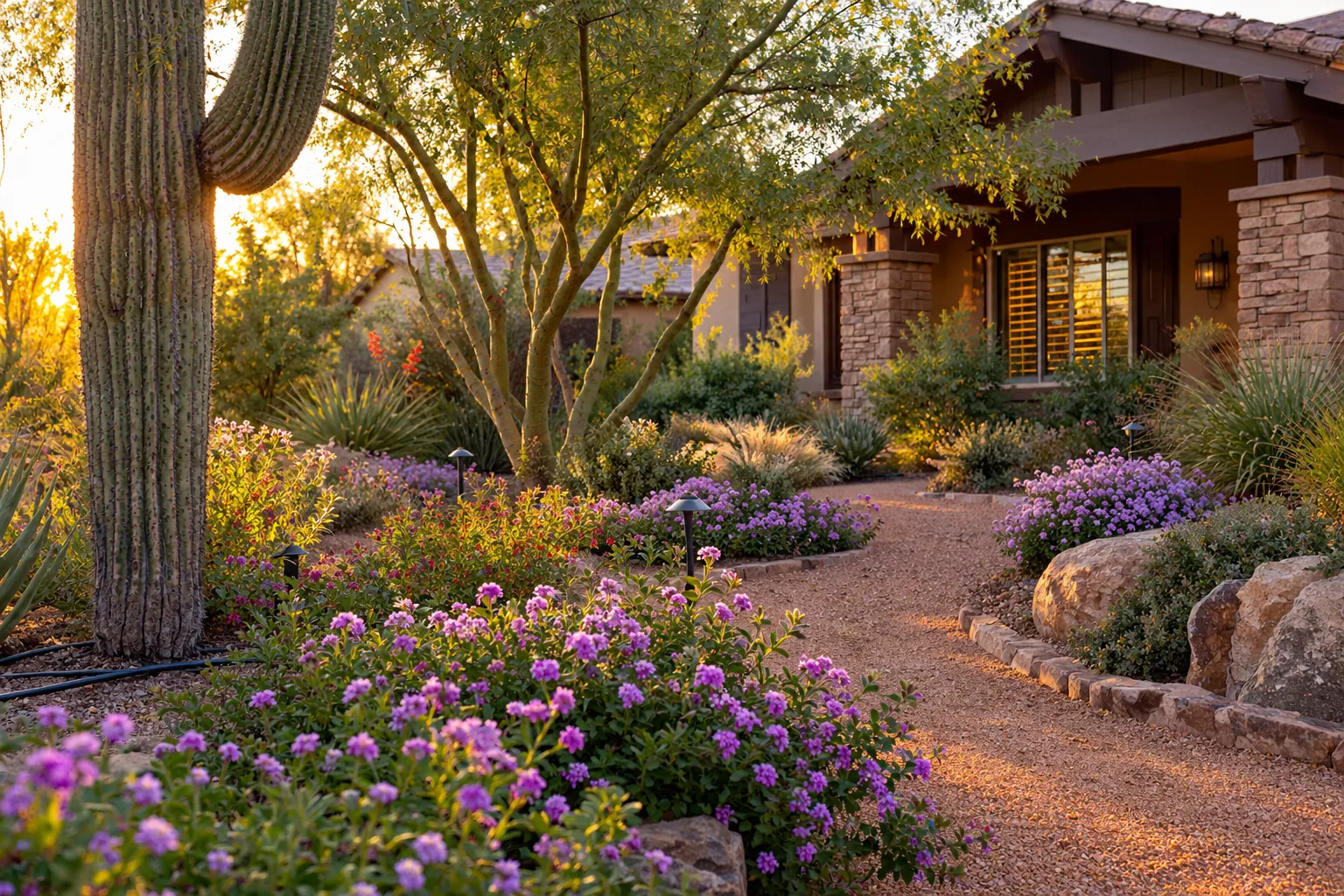
Last updated: October 1, 2026
Quick Answer: Glendale, Arizona homeowners can receive up to $3,000 in city rebates for converting grass to xeriscape, and up to $500 for new-home desert landscaping installations. To qualify, you must remove at least 500 square feet of grass, ensure more than 50% of your total yard is non-grass, and use low-water plants for at least 75% of new plantings. Applications must be submitted and approved before installation begins.
Key Takeaways
- Glendale's xeriscape rebate pays existing homeowners $1.00 per square foot of grass replaced, up to $3,000 for single-family homes
- New-home xeriscape qualifies for $0.50 per square foot, up to $500
- Artificial grass earns a separate rebate of $0.25 per square foot, up to $250
- You must remove a minimum of 500 square feet of grass to qualify for conversion rebates
- Pre-approval is required before any installation work starts, skipping this step is the most common reason for denial
- At least 75% of new trees and shrubs must be low-water-use species
- More than 50% of your combined front and back yard must be non-grass after conversion
- Commercial, HOA, and non-residential properties can receive up to $10,000 per xeriscape project, with a $50,000 annual cap per customer
- Bare soil and artificial turf alone do not qualify, the converted area must be actively landscaped
- Desert landscaping in Glendale typically establishes within one to three years with proper drip irrigation
Table of Contents
- What Is Xeriscaping and Why Does It Matter in Glendale?
- Claiming the Glendale Xeriscape Rebate
- How Much Can You Save With Glendale Water Rebates for Landscaping?
- Xeriscape vs. Traditional Landscaping: Cost Comparison
- Low-Maintenance Plants for Glendale
- What Plants Should You Avoid in Glendale Landscaping?
- Hardscaping for West Valley Heat
- Irrigation Efficiency in Glendale Yards
- Common Mistakes People Make With Desert Landscaping
- How Long Does It Take to Establish a Xeriscape Garden?
- Is Xeriscaping Worth It in Glendale?
- FAQ
What Is Xeriscaping and Why Does It Matter in Glendale?
Xeriscaping is a landscaping method that replaces water-intensive plants and grass with drought-tolerant species, gravel, and efficient irrigation. In Glendale, Arizona, where summer temperatures regularly exceed 110°F and drought conditions persist across the Colorado River Basin, xeriscaping is not just a trend, it's a practical response to a real water shortage.
Glendale sits in Maricopa County's West Valley, one of the fastest-growing regions in the country. The city draws water from the Colorado River and Salt River Project, both of which have faced sustained pressure from drought. Glendale's conservation and sustainable living team has expanded its water-efficiency rebate program as a direct response to these pressures, framing rebates as tools to help residents save water and money while stretching limited water resources [3].
Traditional Kentucky bluegrass or Bermuda lawns can use 50 to 80 gallons of water per square foot annually in Phoenix-area climates. A xeriscape yard, by contrast, can reduce outdoor water use by 50 to 75%, according to the EPA WaterSense program. That gap matters in a city where water bills spike sharply from May through September.
Claiming the Glendale Xeriscape Rebate
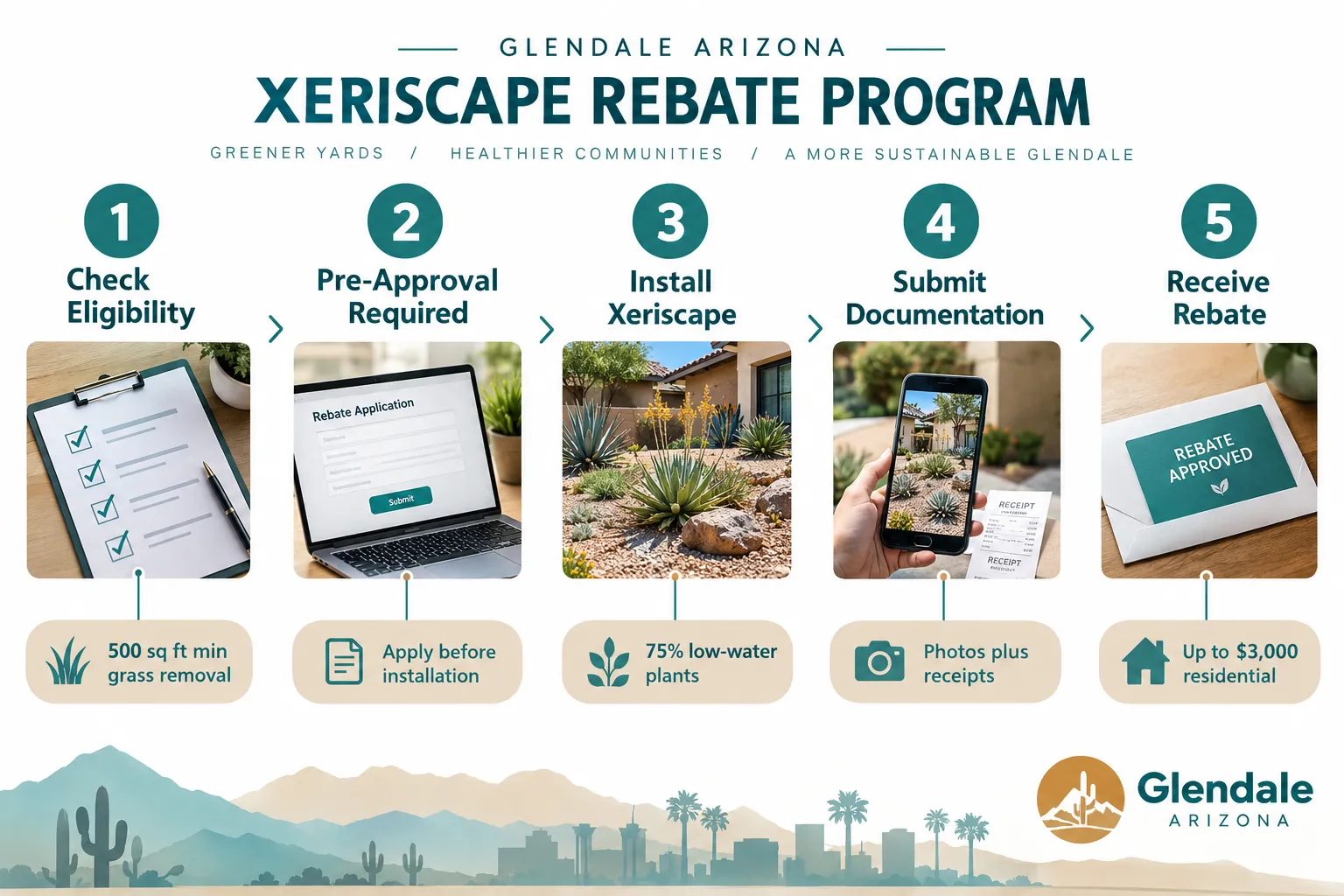
The Glendale xeriscape rebate program requires pre-approval before any installation work begins. Submitting your application after the work is done is the single most common reason claims are denied.
Here is the process, step by step:
- Confirm eligibility. You must be a Glendale water customer. The property must have at least 500 square feet of existing grass to qualify for the conversion rebate [9].
- Apply for pre-approval. Submit your application through Glendale's Water Conservation and Sustainable Living portal before hiring a contractor or buying materials [1][6].
- Get your design reviewed. Your plan must show that more than 50% of the total yard (front and back combined) will be non-grass after conversion, and that at least 75% of new trees and shrubs are low-water-use species [9].
- Complete the installation. Use a licensed contractor or do the work yourself. Keep all receipts and take dated before-and-after photos.
- Submit your rebate claim. Provide photos, receipts, and any required inspection documentation to Glendale Water Services [1][4].
- Receive your rebate. Approved claims are processed and paid after verification.
Who qualifies for Glendale landscaping rebates?
- Single-family residential homeowners who are Glendale water customers
- HOAs, commercial properties, and non-residential customers (higher caps apply, up to $10,000 per xeriscape project, with a $50,000 annual maximum per customer) [9]
- Both new-home installations and existing-home conversions qualify, at different rates [5]
Common denial reasons:
- Starting work before receiving pre-approval
- Converting less than 500 square feet of grass
- Using bare soil or artificial turf as the sole replacement (the area must be landscaped) [9]
- Failing to meet the 75% low-water-use plant requirement
- Missing required documentation (photos, receipts, contractor license info)
How Much Can You Save With Glendale Water Rebates for Landscaping?
The rebate amounts are straightforward. Existing homeowners replacing grass with xeriscape receive $1.00 per square foot, up to $3,000. New-home installations qualify for $0.50 per square foot, up to $500. Artificial grass earns a separate $0.25 per square foot, up to $250 [1][5][6].
These rebates were expanded effective July 1, 2025, as part of a broader conservation push tied to ongoing drought conditions [3][5].
On top of the rebate, a converted 1,500-square-foot front yard in Glendale can realistically cut outdoor water use by hundreds of dollars per year. Exact savings depend on your current irrigation habits, plant selection, and soil conditions, but the combination of upfront rebate plus long-term water savings makes the math favorable for most homeowners.
Xeriscape vs. Traditional Landscaping: Cost Comparison
Xeriscape typically costs more upfront than maintaining an existing lawn but less than installing a new traditional lawn from scratch. Here is a general comparison for a 1,000-square-foot Glendale yard (estimates only, get local quotes to verify):
| Item | Traditional Lawn | Xeriscape Conversion |
|---|---|---|
| Installation cost (est.) | $2,000, $5,000 | $3,000, $8,000 |
| Annual water cost (est.) | $600, $1,200 | $150, $400 |
| Glendale rebate available | None | Up to $3,000 |
| Maintenance (annual est.) | $800, $2,000 | $200, $600 |
These are estimates based on regional contractor pricing and typical Glendale water rates. Always get at least three written quotes from licensed contractors before committing.
Low-Maintenance Plants for Glendale
The best desert plants for Glendale yards are those native to the Sonoran Desert or adapted to USDA Hardiness Zone 9b to 10a. They need minimal supplemental water once established and can handle reflected heat from concrete and block walls.
Top plant picks for Glendale landscaping:
- Saguaro cactus (Carnegiea gigantea), iconic, slow-growing, zero supplemental water once established
- Blue agave (Agave tequilana), dramatic focal point, extremely drought-tolerant
- Desert willow (Chilopsis linearis), fast-growing shade tree, produces showy flowers
- Palo verde (Parkinsonia species), Glendale's most common shade tree, low water, provides filtered shade
- Red yucca (Hesperaloe parviflora), hummingbird magnet, blooms spring through fall
- Lantana (Lantana camara), low groundcover, thrives in full sun, minimal water
- Brittlebush (Encelia farinosa), native wildflower, yellow blooms in spring, handles extreme heat
- Bougainvillea, high-color vine or shrub, very low water once established, needs frost protection
All of these meet Glendale's low-water-use plant criteria for rebate qualification [9].
What Plants Should You Avoid in Glendale Landscaping?
Several popular plants sold at big-box stores in Arizona are poor choices for Glendale yards, either because they use too much water, cause allergy problems, or become invasive.
Avoid these in Glendale:
- Bermuda grass, the most common lawn grass in the Valley, but a significant water user and allergy trigger; Glendale's rebate program specifically targets its removal
- Olive trees (Olea europaea), banned or restricted in many Maricopa County cities due to severe pollen allergies; check current Glendale ordinances before planting
- Fountain grass (Pennisetum setaceum), listed as invasive in Arizona; spreads aggressively and increases wildfire risk
- Mulberry trees, high pollen producers, restricted in some Maricopa County jurisdictions
- Ice plant (Carpobrotus species), not suited to Glendale's alkaline soils; struggles and dies in summer heat
When in doubt, check with the Arizona Department of Agriculture's invasive species list or ask your contractor to verify before purchasing plants.
Hardscaping for West Valley Heat
Hardscaping in Glendale must account for extreme radiant heat. Concrete, dark pavers, and asphalt can reach 160°F in July, making material selection critical for both comfort and plant survival.
Best hardscaping materials for Glendale:
- Decomposed granite (DG), the most common ground cover in Glendale xeriscapes; affordable, permeable, and available in warm desert tones. Use a 3- to 4-inch depth over weed barrier fabric.
- Flagstone, natural Arizona flagstone (sandstone or quartzite) holds less heat than concrete pavers and blends with desert aesthetics
- Concrete pavers in light colors, tan, buff, or cream tones reflect more heat than gray or charcoal; choose textured surfaces to reduce glare
- River rock and boulders, adds visual weight and natural drainage; boulders provide afternoon shade for nearby plants
- Ramadas and shade structures, a covered patio or pergola with a shade sail can reduce surface temperatures in seating areas by 20 to 30 degrees
What to avoid in West Valley hardscaping:
- Dark-colored concrete or pavers in open sun areas
- Solid concrete coverage over large areas without expansion joints (Glendale's clay-heavy soils shift significantly with temperature swings)
- Rubber mulch, breaks down quickly in intense UV and can off-gas in extreme heat
A licensed contractor familiar with Glendale's soil profile, which includes expansive clay in many West Valley neighborhoods, will know to account for soil movement in any hardscape design. Your yard deserves someone who knows what they're doing, and that starts with knowing the local soil.
Irrigation Efficiency in Glendale Yards
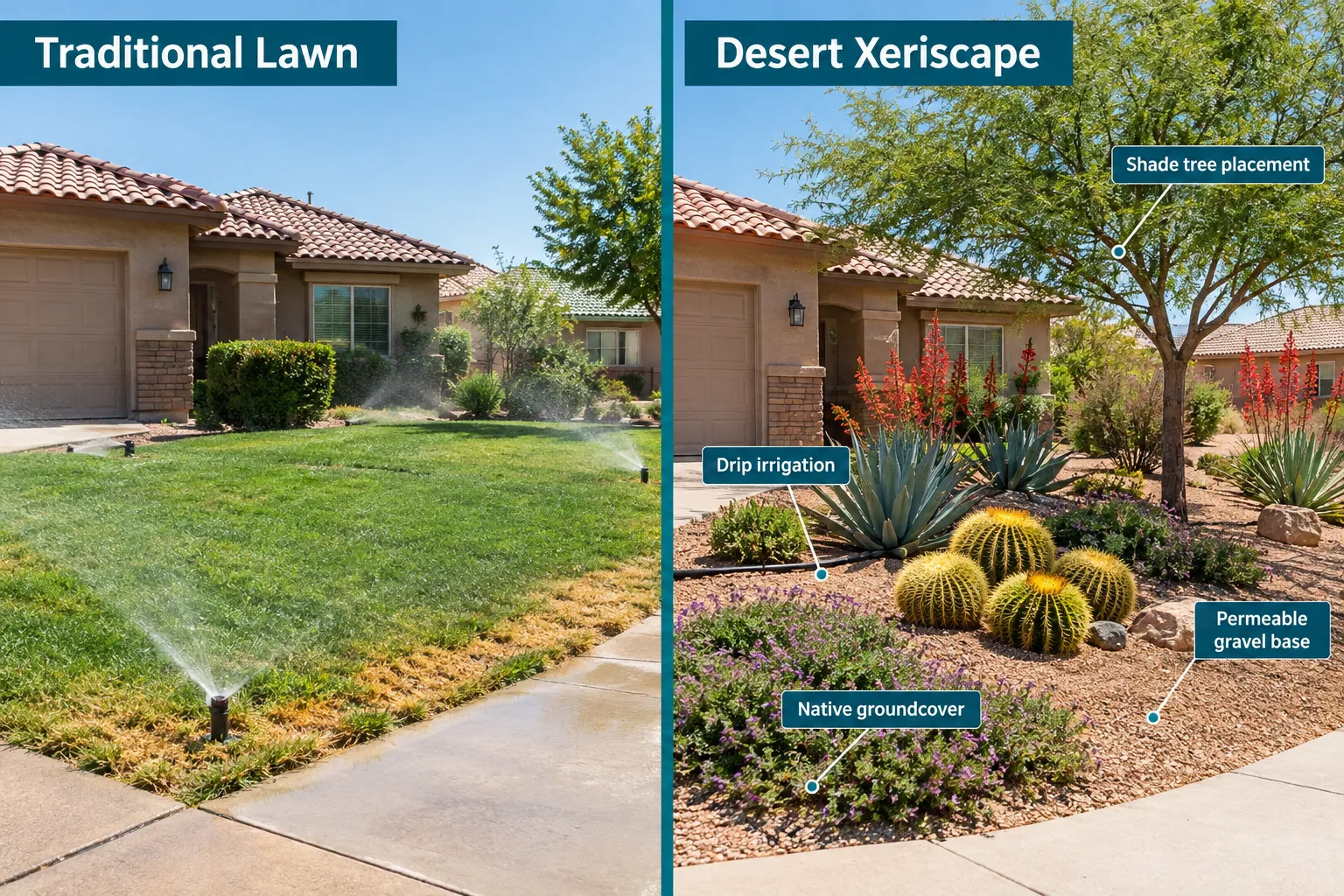
A well-designed drip irrigation system is the backbone of any successful Glendale xeriscape. Overhead sprinklers lose 30 to 50% of water to evaporation in summer heat; drip systems deliver water directly to root zones with far less waste.
Irrigation upgrades that matter in Glendale:
- Drip emitters, install at the base of each plant; adjust flow rates as plants establish
- Smart controllers, weather-based timers that adjust watering schedules based on local ET (evapotranspiration) rates; Glendale's rebate program also includes rebates for qualifying smart controllers [1][6]
- Soil moisture sensors, prevent overwatering, which is the leading cause of plant death in new xeriscapes
- Pressure regulators, Glendale's water pressure can run high in some neighborhoods; unregulated pressure blows out drip emitters
Watering schedule guidance for Glendale:
- Summer (May, September): water established desert plants once every 7 to 14 days, deep and slow
- Winter (November, February): most established desert plants need no supplemental irrigation
- New plantings: water every 2 to 3 days for the first month, then taper off over 6 to 12 months
Glendale's soils in the West Valley tend toward alkaline clay with caliche layers in some areas. Caliche, a hardened calcium carbonate layer, blocks drainage. If you hit caliche during installation, break through it or plant in raised mounds to prevent root rot.
Common Mistakes People Make With Desert Landscaping
The most common mistake is planting too close together. Desert plants look small in a nursery pot but can spread 6 to 10 feet at maturity. Crowding leads to competition for water and poor air circulation.
Other frequent errors in Glendale landscaping:
- Skipping pre-approval for the rebate, work done before approval is automatically disqualified [9]
- Using weed barrier fabric alone under DG, fabric degrades in UV and weeds push through within 2 to 3 years; use a quality commercial-grade barrier
- Overwatering new plants, more desert plants die from overwatering than drought in the first year
- Ignoring reflected heat from walls, west- and south-facing block walls in Glendale can kill even drought-tolerant plants placed too close; leave 18 to 24 inches of clearance
- Choosing plants only for looks, a plant that thrives in Tucson may struggle in Glendale's lower elevation and higher summer heat load
How Long Does It Take to Establish a Xeriscape Garden?
Most Glendale xeriscapes are fully established within one to three years. "Established" means the plants can survive on rainfall alone (or minimal supplemental irrigation) during the cooler months.
The timeline depends on plant type and installation season:
- Cacti and agaves: 6 to 12 months to root firmly; minimal water needed from the start
- Shrubs (lantana, brittlebush, red yucca): 1 to 2 years to reach mature size and water independence
- Trees (palo verde, desert willow): 2 to 3 years to establish a deep root system; may need monthly deep watering in summer for up to 5 years
Best time of year to install xeriscape in Glendale: October through March. Cooler soil temperatures reduce transplant stress, roots establish before summer heat arrives, and you avoid the brutal labor conditions of a Glendale July. Spring planting (February, April) is the second-best window.
Avoid planting in June or July unless you have a reliable drip system and can monitor plants closely through the monsoon season.
Is Xeriscaping Worth It in Glendale?
Yes, for most Glendale homeowners, xeriscaping delivers a clear return on investment. The combination of the city's rebate (up to $3,000 for existing homes), reduced water bills, and lower maintenance costs typically recoups the installation premium within three to five years [1][5].
Does Glendale offer a free landscape design consultation? The city's Water Conservation and Sustainable Living program offers resources and guidance for homeowners considering conversion, and some rebate-approved contractors offer free design consultations as part of their quote process [3][10]. Contact Glendale Water Services directly to ask about current offerings, as programs can change.
Can you do xeriscape on a small yard in Glendale? The rebate requires a minimum of 500 square feet of grass removal, but xeriscaping itself works on any yard size. Small yards often benefit most because every square foot of grass removed reduces both water use and maintenance time.
FAQ
Does Glendale require a licensed contractor to claim the xeriscape rebate?
Glendale does not mandate a licensed contractor for the rebate itself, but using one is strongly recommended. A licensed, insured contractor protects you if something goes wrong and can help ensure your installation meets the city's design criteria for approval [9].
Can I apply for the rebate if I already removed my grass?
No. Pre-approval must be obtained before installation begins. Work completed before approval is not eligible for rebates, regardless of how well the project meets other criteria [1][9].
What counts as a "low-water-use" plant for Glendale's rebate?
Glendale uses the Water Use Classification of Landscape Species (WUCOLS) list and similar regional resources to define low-water-use plants. Most Sonoran Desert natives and many Mediterranean-climate plants qualify. Ask your contractor to verify each species before purchasing [9].
How long does the rebate application process take?
Processing times vary. Allow two to four weeks for pre-approval review, and additional time after project completion for final inspection and payment. Contact Glendale Water Services for current processing timelines [1][6].
Is artificial turf a good replacement for grass in Glendale?
Artificial turf qualifies for a separate rebate of $0.25 per square foot, up to $250. However, it does not count as xeriscape for the higher rebate tier. Artificial turf also retains significant heat in Glendale summers, which can make outdoor spaces uncomfortable. Many homeowners combine artificial turf in small play areas with xeriscape plantings elsewhere [5][9].
What if my HOA restricts xeriscape in Glendale?
Arizona state law (ARS 33-1902) prohibits HOAs from banning xeriscape or low-water-use landscaping. If your HOA is resisting a conversion, cite this statute. HOAs may still regulate design aesthetics within reasonable limits, but they cannot prohibit desert-friendly landscaping outright.
Conclusion
Glendale landscaping is moving in one clear direction: less grass, more desert. The city's rebate program makes that transition financially practical, and the long-term water and maintenance savings make it smart. The key steps are simple, confirm eligibility, get pre-approval before you start, choose the right plants, and document everything.
Actionable next steps:
- Measure your current grass area. If it exceeds 500 square feet, you likely qualify for the conversion rebate.
- Visit Glendale's Water Conservation and Sustainable Living page to start your pre-approval application [3][6].
- Get at least three quotes from licensed, insured landscaping contractors who have completed xeriscape projects in the West Valley.
- Ask each contractor to show you their license number and proof of insurance before signing anything.
- Plan your installation for October through March for the best plant survival rates.
Find the right landscaper for your yard by using a directory that verifies licenses and shows real reviews from real homeowners. Know who you're letting into your yard before the first shovel hits the ground.
References
[1] Water Conservation Rebates - https://www.glendaleaz.gov/Community/City-Services/Water-Services/Water-Conservation-and-Sustainable-Living/Water-Conservation-Rebates
[3] Water Conservation And Sustainable Living - https://www.glendaleaz.gov/Community/City-Services/Water-Services/Water-Conservation-and-Sustainable-Living
[4] Glendale's Water Rebate Program - https://www.glendaleaz.gov/News/Whats-New/Glendales-Water-Rebate-Program
[5] Save Money And Conserve Water With Expanded Rebate Program In City Of Glendale 7-1-25 - https://www.glendaleaz.gov/files/assets/city/v/1/communications/documents/newsroom/press-releases/2025/save-money-and-conserve-water-with-expanded-rebate-program-in-city-of-glendale-7-1-25.pdf
[6] Water Conservation Rebates - https://www.glendaleaz.gov/Live/City-Services/Water-Services/Water-Conservation-and-Sustainable-Living/Water-Conservation-Rebates
[9] Rebate Terms And Conditions - https://www.glendaleaz.gov/files/assets/city/v/1/water/documents/water-services/water-conservation-and-sustainable-living/rebate-terms-and-conditions.pdf
[10] Water Conservation And Sustainable Living - https://www.glendaleaz.com/live/city_services/water_services/water_conservation_and_sustainable_living
<!DOCTYPE html>
<html lang="en">
<head>
<meta charset="UTF-8">
<meta name="viewport" content="width=device-width, initial-scale=1.0">
<title>Glendale Xeriscape Rebate Estimator</title>
<style>
.cg-wrap{font-family:Arial,sans-serif;max-width:480px;margin:2rem auto;background:#fdf8f2;border:1px solid #d9c9b0;border-radius:8px;padding:1.5rem}
.cg-wrap h2{font-size:1.1rem;color:#2d5a3d;margin:0 0 1rem}
.cg-label{display:block;font-size:.85rem;color:#444;margin:.75rem 0 .25rem}
.cg-input{width:100%;box-sizing:border-box;padding:.5rem;border:1px solid #c2a97a;border-radius:4px;font-size:.95rem}
.cg-select{width:100%;box-sizing:border-box;padding:.5rem;border:1px solid #c2a97a;border-radius:4px;font-size:.95rem;background:#fff}
.cg-btn{margin-top:1rem;width:100%;padding:.65rem;background:#2d5a3d;color:#fff;border:none;border-radius:4px;font-size:1rem;cursor:pointer}
.cg-btn:hover{background:#1e3f2b}
.cg-result{margin-top:1rem;background:#e8f4ec;border-radius:6px;padding:1rem;font-size:.9rem;color:#1e3f2b;display:none}
.cg-result strong{font-size:1.1rem}
.cg-note{font-size:.75rem;color:#777;margin-top:.75rem}
</style>
</head>
<body>
<div class="cg-wrap">
<h2>Glendale Xeriscape Rebate Estimator</h2>
<label class="cg-label" for="cg-type">Property type</label>
<select class="cg-select" id="cg-type">
<option value="existing">Existing home (grass conversion)</option>
<option value="new">New home installation</option>
<option value="turf">Artificial grass only</option>
</select>
<label class="cg-label" for="cg-sqft">Square feet of grass to replace</label>
<input class="cg-input" type="number" id="cg-sqft" placeholder="e.g. 1200" min="0">
<button class="cg-btn" onclick="cgCalc()">Estimate My Rebate</button>
<div class="cg-result" id="cg-result"></div>
<p class="cg-note">Estimates based on Glendale rebate rates effective July 1, 2025. Pre-approval required before installation. Verify current rates at glendaleaz.gov.</p>
</div>
<script>
function cgCalc(){
var t=document.getElementById('cg-type').value;
var s=parseFloat(document.getElementById('cg-sqft').value)||0;
var rate,cap,label;
if(t==='existing'){rate=1.00;cap=3000;label='Existing home conversion';}
else if(t==='new'){rate=0.50;cap=500;label='New home installation';}
else{rate=0.25;cap=250;label='Artificial grass';}
if(s<500&&t==='existing'){
document.getElementById('cg-result').style.display='block';
document.getElementById('cg-result').innerHTML='<strong>Not eligible.</strong> Existing-home conversion requires at least 500 sq ft of grass removal.';
return;
}
var est=Math.min(s*rate,cap);
document.getElementById('cg-result').style.display='block';
document.getElementById('cg-result').innerHTML='<strong>'+label+'</strong><br>'+s.toLocaleString()+' sq ft × $'+rate.toFixed(2)+'/sq ft<br><strong>Estimated rebate: $'+est.toLocaleString(undefined,{minimumFractionDigits:0,maximumFractionDigits:0})+'</strong> (max $'+cap.toLocaleString()+')';
}
</script>
</body>
</html>
Liked this guide? Follow us on Google Search
Related Directory Pages
Find a Landscaper Near You
Browse AZ landscaping professionals on LandscapeProsDirectory.
Search Landscapers