
Inland Empire Hardscape Costs: Heat-Hardy Pool Decks
Inland Empire pool hardscape costs for 2026. Compare pricing for heat-resistant pavers, travertine, and cooling deck coatings in Riverside and San Bernardino.
Last updated: October 1, 2026
Quick Answer: Pool hardscape in the Inland Empire typically costs between $8 and $30 per square foot installed, depending on material. Standard concrete is cheapest but cracks fastest in the region's extreme heat swings. Travertine, porcelain pavers, and cool-deck coatings cost more upfront but hold up far better in Riverside and San Bernardino County summers.
Key Takeaways
- Inland Empire pool hardscape cost ranges from roughly $8/sq ft for basic concrete to $30+/sq ft for premium travertine or porcelain pavers installed
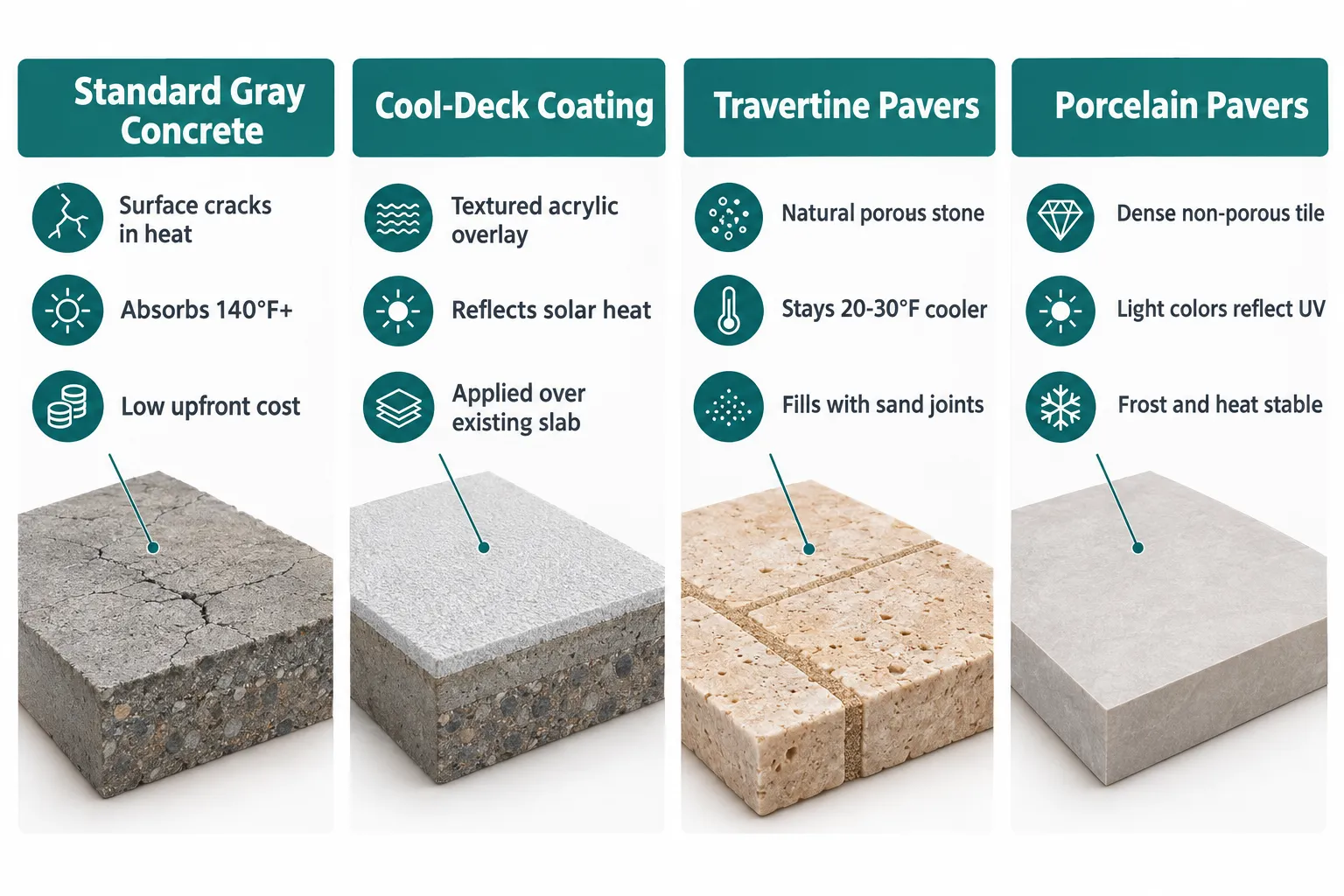
- Standard gray concrete can reach surface temperatures above 140°F in Inland Empire summers, light-colored and porous materials stay significantly cooler underfoot
- Cool-deck acrylic coatings ($3,$8/sq ft) are the most affordable heat-reduction upgrade for an existing slab
- Thermal expansion cracks in concrete are common in the Inland Empire because daily temperature swings can exceed 40°F in summer
- Travertine and porcelain pavers cost more ($15,$30/sq ft installed) but flex with heat better than poured concrete
- Riverside County labor rates for hardscape installation typically run $45,$85/hour depending on crew size and complexity
- Always verify a contractor's C-27 Landscaping or C-8 Concrete contractor license through the California Contractors State License Board (CSLB) before signing anything
- Resurfacing an existing deck costs 40-60% less than full removal and replacement
- Most quality pool deck installations in the Inland Empire carry a 1-5 year workmanship warranty, ask for it in writing
Table of Contents
- What Is Pool Hardscape and Why Does It Matter in the Inland Empire
- How Much Does Inland Empire Pool Hardscape Cost
- Pool Deck Materials Comparison: Concrete vs. Pavers vs. Travertine
- Best Heat-Resistant Pool Decking for the Inland Empire
- Why Is My Pool Deck Cracking in the Heat
- How to Keep Your Pool Deck Cool in Inland Empire Summers
- Pool Hardscape Maintenance Tips for a Desert Climate
- Who Actually Needs New Pool Hardscape (and Who Doesn't)
- Common Mistakes People Make With Pool Decks
- How Long Does Pool Hardscape Last in the Inland Empire
- Can You Install Pool Hardscape Yourself
- How to Find the Best Pool Hardscape Contractors in the Inland Empire
- FAQ
- References
What Is Pool Hardscape and Why Does It Matter in the Inland Empire
Pool hardscape is any hard, non-plant surface surrounding your pool, the deck you walk on, the coping stones at the pool edge, retaining walls, and patio extensions. In the Inland Empire, material choice isn't just about looks. It's a safety and durability decision.
Fontana, Riverside, San Bernardino, and Rancho Cucamonga regularly hit 105-115°F in July and August. A dark or dense concrete deck can surface-heat to 140°F or higher. That's a burn risk for bare feet and a stress load that shortens the life of any poured slab. Choosing the wrong material here means cracked decks, costly repairs, and a backyard nobody wants to use during the hottest months. [3]
How Much Does Inland Empire Pool Hardscape Cost
For most Inland Empire homeowners in 2026, a full pool deck installation runs between $8,000 and $35,000 for a typical 500-800 sq ft surround. Per-square-foot costs vary significantly by material and site conditions.
Here's a realistic breakdown by material tier:
| Material | Installed Cost (per sq ft) | Notes |
|---|---|---|
| Broom-finish concrete | $8,$12 | Cracks fastest in heat |
| Cool-deck / acrylic overlay | $3,$8 (over existing slab) | Best budget heat upgrade |
| Stamped concrete | $12,$18 | Better look, same crack risk |
| Concrete pavers | $14,$20 | More flexible than poured |
| Travertine pavers | $18,$28 | Top heat performance |
| Porcelain pavers | $20,$30 | Dense, durable, modern look |
These are estimates based on contractor pricing active in the Riverside, San Bernardino market in mid-2026. Final cost depends on site prep, demolition of existing deck, drainage work, and coping style. [4] [6]
A full project including demo, grading, material, and installation for a 600 sq ft deck in Riverside typically lands between $12,000 and $22,000 for mid-range materials. [8]
Pool Deck Materials Comparison: Concrete vs. Pavers vs. Travertine
Each material has a real trade-off between upfront cost and long-term performance in Inland Empire heat.
Poured concrete is the cheapest starting point, but it's the worst performer in extreme temperature swings. It absorbs heat, gets dangerously hot, and develops thermal expansion cracks within a few years without proper control joints.
Concrete pavers cost more but allow individual units to shift slightly with heat expansion. If one cracks, you replace that paver, not the whole deck. They also offer better drainage than a solid slab.
Travertine pavers are a natural limestone material that's porous enough to stay noticeably cooler than dense concrete. Many Inland Empire homeowners report travertine staying 20-30°F cooler than a standard gray slab in direct sun. The sand-set installation method also allows for heat movement. [4]
Porcelain pavers are dense and non-porous, which means they don't absorb water (good for pool areas) but can heat up more than travertine. Light-colored porcelain in larger formats has become popular in newer Rancho Cucamonga and Chino Hills builds. [9]
Cool-deck coatings (like Kool Deck by Mortex) are acrylic-based overlays applied over existing concrete. They use light color and texture to reflect solar radiation. They don't solve cracking in a failing slab, but they're the most cost-effective heat-reduction option for a structurally sound existing deck. [7]
Best Heat-Resistant Pool Decking for the Inland Empire
Travertine is the top-performing natural material for heat resistance in the Inland Empire. Porcelain in light colors is the top performer for low maintenance. Cool-deck coatings are the best value upgrade for existing slabs.
Choose travertine if you want the coolest natural surface and don't mind resealing every 2-3 years. Choose porcelain if you want near-zero maintenance and a modern look. Choose a cool-deck overlay if your existing slab is structurally sound and you need to cut surface temperatures without a full replacement.
Avoid dark-colored materials entirely. Dark gray, charcoal, or black pavers absorb significantly more solar radiation. In Redlands or Hemet where summer temps regularly exceed 110°F, dark decking becomes a genuine hazard. [7]
Why Is My Pool Deck Cracking in the Heat
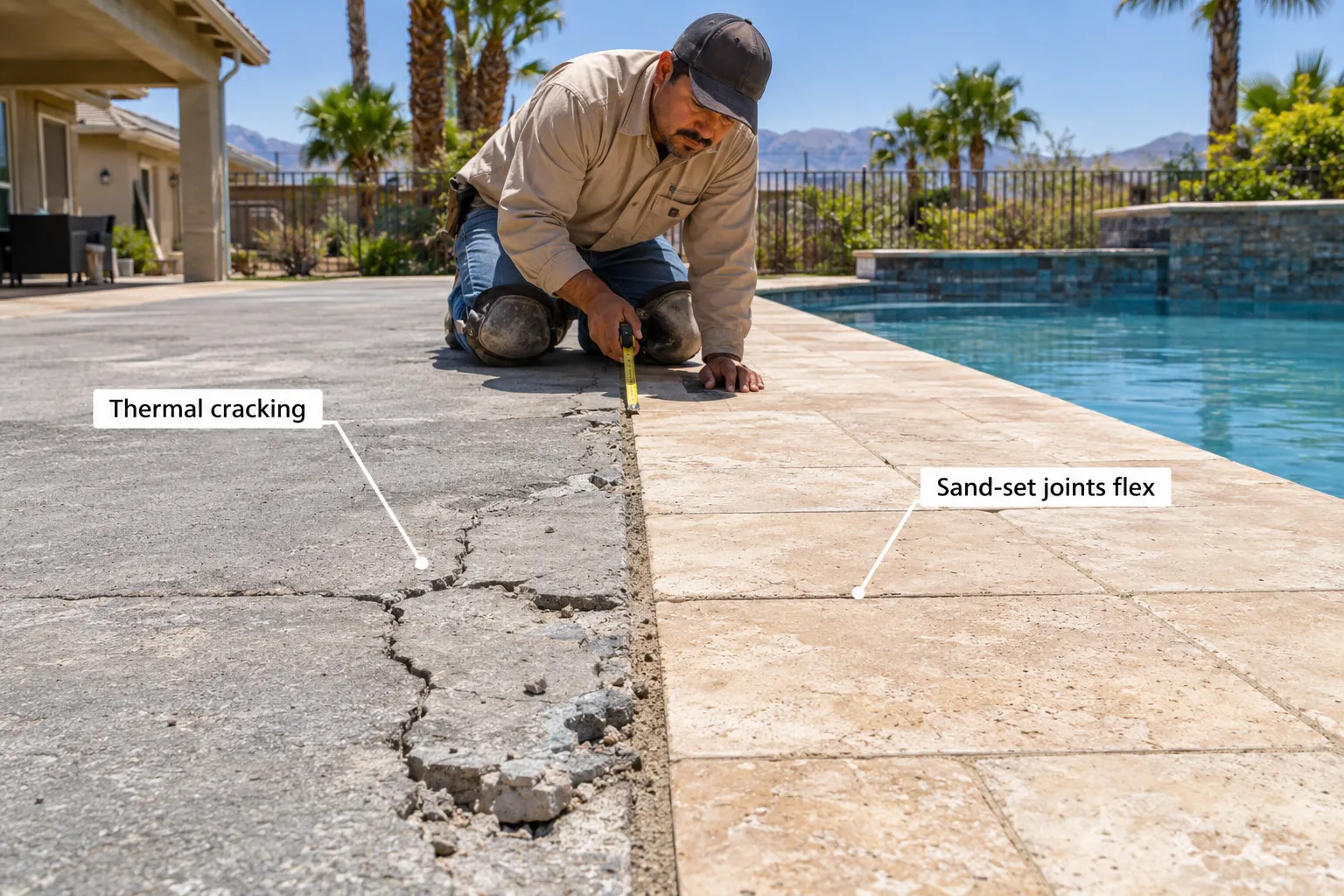
Cracking in Inland Empire pool decks is almost always caused by thermal expansion and contraction. Concrete expands in heat and contracts at night. In the Inland Empire, daily temperature swings of 35-45°F are common in summer, that's a lot of stress on a rigid slab.
Without adequate expansion joints, the slab has nowhere to move and cracks instead. Poor subgrade compaction and inadequate concrete thickness (less than 4 inches) make it worse. Tree roots near the deck are a secondary cause.
If your deck is cracking but structurally sound, a cool-deck resurfacing can hide and seal minor cracks while reducing future heat stress. If cracks are wide, deep, or heaving, full removal and replacement is the right call. [6] [7]
How to Keep Your Pool Deck Cool in Inland Empire Summers
The most effective strategies combine material choice, color, and shade.
- Use light colors. White, cream, buff, and light gray surfaces reflect more solar radiation than darker tones.
- Install a cool-deck coating. Acrylic overlays with textured finishes reduce surface temperatures measurably compared to smooth gray concrete. [7]
- Choose porous materials. Travertine and open-joint paver systems allow some evaporative cooling.
- Add shade structures. Pergolas, shade sails, or covered patios over part of the deck reduce direct sun exposure during peak hours (10am, 4pm).
- Orient the deck thoughtfully. West-facing decks get the worst afternoon sun in the Inland Empire. If you're designing from scratch, plan for shade on the west side.
Pool Hardscape Maintenance Tips for a Desert Climate
Inland Empire pool decks need more maintenance attention than decks in coastal California because of UV intensity, heat cycling, and occasional freeze-thaw events at higher elevations (Big Bear, Running Springs).
- Seal travertine pavers every 2-3 years to prevent staining and water intrusion
- Re-sand paver joints annually if you notice gaps, loose joints allow weeds and instability
- Inspect expansion joints each spring; replace cracked caulk before summer heat arrives
- Pressure wash the deck once a year but avoid high-pressure settings on travertine (use fan tip, not pinpoint)
- Check coping stones at the pool edge for shifting, a loose coping stone is a trip hazard and can allow water behind the pool shell [6]
Who Actually Needs New Pool Hardscape (and Who Doesn't)
You need new pool hardscape if: your current deck has wide structural cracks (wider than 1/4 inch), heaving sections, or is pulling away from the pool coping. Also if the surface is dangerously hot and your family avoids using the pool in summer.
You may not need full replacement if: your slab is structurally sound but looks worn or faded. A cool-deck overlay or concrete resurfacing can extend the life of a good slab for 8-12 years at 40-60% of replacement cost. [6]
If you just bought a home in Moreno Valley or Perris and the pool deck looks rough but is flat and solid, get a resurfacing quote before committing to full demo.
Common Mistakes People Make With Pool Decks
- Choosing material based on photos, not performance. Dark stamped concrete looks great in a showroom. It's miserable in a Fontana summer.
- Skipping the CSLB license check. California requires pool and hardscape contractors to hold a C-27 (Landscaping) or C-8 (Concrete) license. Unlicensed work voids homeowner's insurance claims and leaves you with no legal recourse. Verify at cslb.ca.gov before signing.
- Not getting three bids. Inland Empire hardscape pricing varies widely. One contractor may quote $14/sq ft for the same pavers another quotes at $22/sq ft.
- Ignoring drainage. A flat deck that pools water after rain will fail faster and create slip hazards. Proper slope (1/8 to 1/4 inch per foot away from the pool) is non-negotiable.
- Choosing the cheapest bid without checking references. Your yard deserves someone who knows what they're doing. Real reviews from real homeowners matter more than the lowest number on a quote sheet. [2] [5]
How Long Does Pool Hardscape Last in the Inland Empire
A well-installed travertine or porcelain paver deck in the Inland Empire should last 25-40 years with basic maintenance. Concrete pavers typically last 20-30 years. Poured concrete lasts 10-20 years before significant cracking in this climate. Cool-deck overlays last 8-15 years before needing recoating. [4] [7]
Longevity depends heavily on installation quality, specifically subgrade preparation, base depth, and joint spacing. A cheap install of expensive travertine will fail faster than a quality install of standard concrete pavers.
Can You Install Pool Hardscape Yourself
Simple paver projects are DIY-possible for a handy homeowner. A full pool deck is not. Pool deck work in California requires proper drainage planning, correct slope away from the pool shell, and in many cases a permit from your local building department.
Riverside County and San Bernardino County both require permits for hardscape projects over a certain square footage and value threshold. Unpermitted work can complicate home sales and insurance claims.
For anything beyond a small patio extension, hire a licensed contractor. Know who you're letting into your yard, and verify their license before work starts.
How to Find the Best Pool Hardscape Contractors in the Inland Empire
Start with the CSLB license lookup at cslb.ca.gov. Enter the contractor's name or license number and confirm their license is active, bonded, and has no disciplinary actions.
Then ask these questions before hiring:
- What license do you hold and what's your CSLB number?
- Do you carry general liability and workers' comp insurance?
- Can you provide three recent references in the Inland Empire?
- What base preparation method do you use under pavers?
- What warranty do you provide on labor and materials?
- Will this project require a permit, and who pulls it?
Local pros with local knowledge of Inland Empire soil conditions, heat patterns, and county permit requirements will outperform a general contractor who doesn't work this area regularly. [3] [8] [9]
LandscapeProsDirectory lists licensed, insured, and reviewed hardscape contractors in Riverside and San Bernardino counties. We verify so you don't have to. Find your next landscaper here.
FAQ
What is the cheapest heat-resistant pool deck option in the Inland Empire?
A cool-deck acrylic overlay over an existing concrete slab is the most affordable option, typically $3,$8 per square foot. It reduces surface temperature and refreshes the look without full demolition.
Do I need a permit to replace my pool deck in Riverside County?
In most cases, yes. Riverside County requires permits for hardscape work that involves structural changes or exceeds a certain project value. Always check with your local building department before work begins.
How do I verify a pool hardscape contractor's license in California?
Go to cslb.ca.gov and use the license lookup tool. Enter the contractor's name or license number to confirm their license type, status, and any complaints or disciplinary actions.
Is travertine worth the extra cost in the Inland Empire?
For most homeowners who use their pool regularly in summer, yes. Travertine's natural porosity and light color keep it significantly cooler underfoot than concrete. The higher upfront cost ($18,$28/sq ft installed) is often offset by fewer repairs and longer lifespan.
How long does a cool-deck coating last in Inland Empire heat?
Expect 8-15 years before recoating is needed. UV intensity and foot traffic are the main factors. Quality application and light colors extend the lifespan.
What causes pool deck coping to crack or shift?
Thermal expansion, poor base compaction, and water intrusion behind the pool shell are the most common causes in the Inland Empire. Inspect coping joints annually and reseal any gaps before summer.
Conclusion
The Inland Empire is one of the harshest climates in the Southwest for pool hardscape. Standard concrete fails faster here than almost anywhere else in California. But the right material, travertine, porcelain pavers, or a quality cool-deck coating, can give you a deck that stays walkable in July and lasts decades.
No fluff, just useful advice: get three bids, check every license on the CSLB website, ask about base preparation, and don't choose material based on photos alone. A 600 sq ft travertine deck installed by a licensed Riverside County contractor is a real investment. It's also the kind of upgrade that makes your backyard usable again during the hottest months of the year.
From basic lawn care to full backyard transformations, LandscapeProsDirectory connects Inland Empire homeowners with licensed, insured, and reviewed pros. Cost guides that actually tell you what things cost, and a directory built for homeowners, not advertisers.
Find the right landscaper for your yard today.
References
[1] Pool Deck Guide - https://poolchecker.com/pool-deck-guide/
[2] Landscaping Companies In Riverside Ca - https://threebestrated.com/landscaping-companies-in-riverside-ca
[3] poolbuilderfontana - https://www.poolbuilderfontana.com/
[4] Pool Decks - https://phenomenalpoolscapes.com/services/pool-decks
[5] Landscaping Hardscaping And Pavers - https://www.angi.com/companylist/us/ca/riverside/landscaping-hardscaping-and-pavers.htm
[6] ultimatepoolremodeling - https://ultimatepoolremodeling.com/
[7] Pool Decks - https://www.concretecoatingspecialists.com/pool-decks/
[8] alegriahardscapegroup - https://alegriahardscapegroup.com/
[9] greenwoodhardscape - https://greenwoodhardscape.com/
[10] Pools Remodeling - https://stepupbuilderinc.com/pools-remodeling/
Liked this guide? Follow us on Google Search
Related Directory Pages
Find a Landscaper Near You
Browse CA landscaping professionals on LandscapeProsDirectory.
Search Landscapers