
Nevada Hardscaping and Pool Permit Requirements Guide
Nevada landscaping permits for pools, hardscaping, and walls. Learn when you need a permit from Clark County or Washoe County for your project. Compare local pr
Last updated: October 1, 2026
Quick Answer: Most structural outdoor projects in Nevada, including pools, retaining walls over three feet, and graded drainage changes, require a permit before work begins. In Clark County, pool permits start around $500 and can exceed $1,500 depending on scope. Skipping permits risks stop-work orders, fines, and serious problems when you sell your home.
Key Takeaways
- Pools, spas, retaining walls over three feet, and structural patio covers all require permits in Clark County and most Nevada jurisdictions
- Pool permits in Clark County are processed through the Accela online portal and require plan review before any digging starts
- Inspections happen at multiple stages, not just at the end, so you cannot fill a pool until a final inspection is passed
- Unpermitted work can trigger fines, forced removal, and title issues at resale
- Clark County and the City of Las Vegas have separate permit offices; your address determines which one applies
- Washoe County (Reno/Sparks) follows different fee schedules and code timelines than Clark County
- HOA approval is separate from a government permit, you need both
- The Las Vegas Valley Water District caps pool and water-feature surface area for new residential builds
Table of Contents
- When Do You Need a Landscape Permit in Nevada?
- What Do You Need a Permit For in Nevada?
- Nevada Landscaping Permit Requirements by County
- How Much Does a Nevada Landscaping Permit Cost?
- How Long Does It Take to Get a Landscaping Permit in Nevada?
- Permitting for Retaining Walls and Grading in NV
- Difference Between Landscaping and Hardscaping Permits in Nevada
- Do I Need a Permit to Add Pavers or a Patio in Nevada?
- Nevada Pool Permit Requirements and Costs
- Las Vegas and Henderson Pool Safety Regulations
- Sequencing Inspections for a Smooth Approval
- What Happens If You Landscape Without a Permit in Nevada?
- Who Needs to Pull a Nevada Landscaping Permit?
- Nevada Landscaping Permit Common Mistakes to Avoid
- FAQ
When Do You Need a Landscape Permit in Nevada?
Any outdoor project that changes the structure, drainage, or safety of your property typically requires a Nevada landscaping permit. This includes pools, retaining walls, grading, and structural shade covers. Simple planting, sod installation, and drip irrigation usually do not.
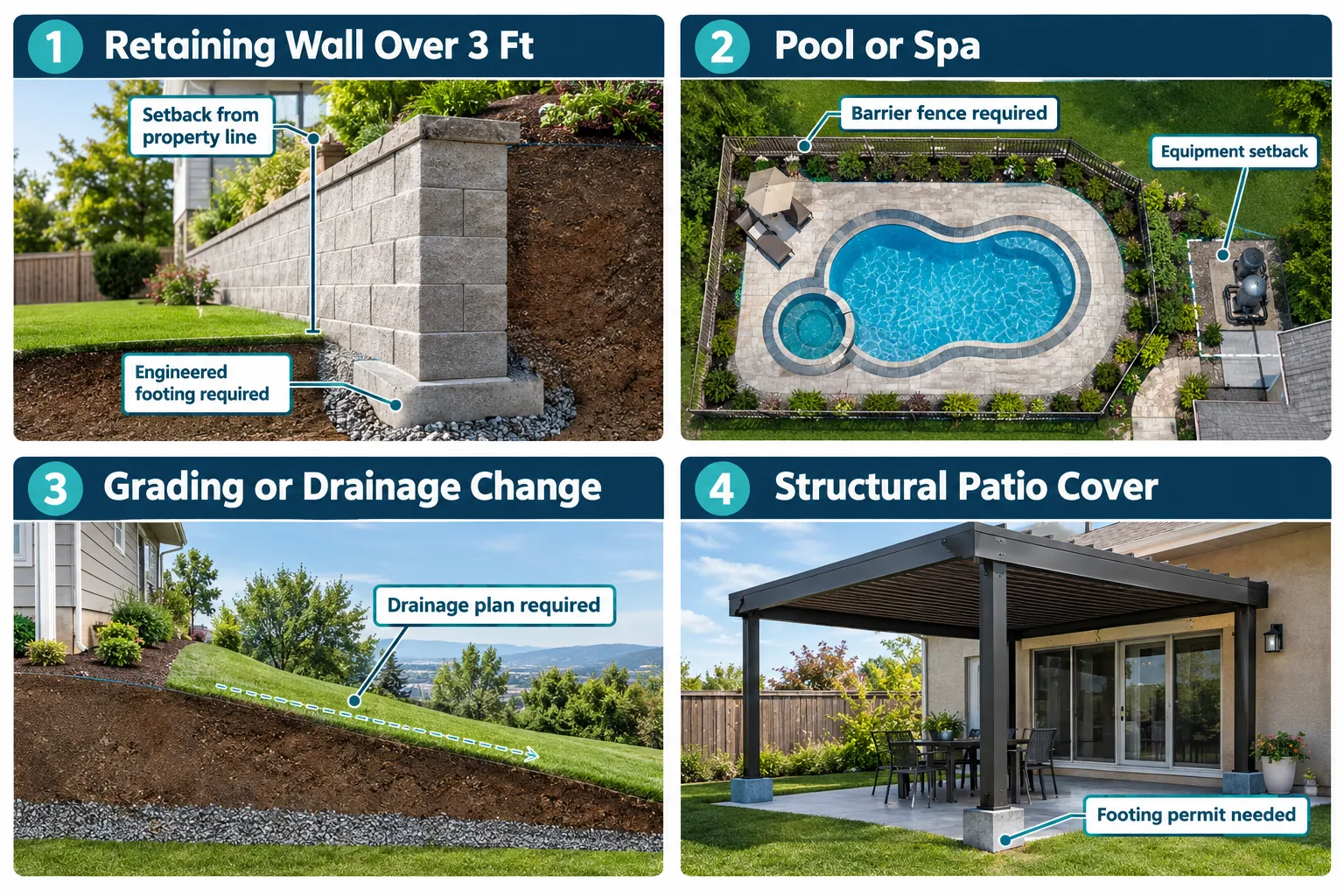
Here is a plain-language breakdown of what triggers a permit in most Nevada jurisdictions:
- Pools and spas (in-ground or above-ground over a certain size)
- Retaining walls over three feet in height measured from the bottom of the footing
- Grading or drainage changes that redirect water flow
- Structural patio covers and pergolas attached to the home
- Outdoor kitchens with gas lines or electrical connections
- Block walls and fences over six feet in most areas
The City of Las Vegas publishes a clear guide on when permits are required for residential work [8]. If you are unsure whether your project qualifies, call the building department before you dig, not after.
What Do You Need a Permit For in Nevada?
Structural changes to your yard require permits. Cosmetic or non-structural changes generally do not. The key question is whether the project involves footings, drainage, utilities, or a safety barrier.
Permit required:
- In-ground pools and spas
- Above-ground pools over 24 inches deep
- Retaining walls over 3 feet (Clark County) or as specified locally
- Attached or freestanding patio covers with footings
- Outdoor electrical, gas, or plumbing connections
- Grading that changes drainage patterns
Permit not typically required:
- Planting trees, shrubs, or ground cover
- Installing drip irrigation (no structural changes)
- Laying pavers on sand base at grade level (check locally)
- Portable or storable pools under 24 inches deep [3]
Nevada Landscaping Permit Requirements by County
Clark County and Washoe County are the two largest jurisdictions, and they operate independently. Your permit requirements depend on your specific address, not just the city name on your mail.
Clark County (Las Vegas metro): Unincorporated Clark County uses the Accela online portal for permit applications [9]. Projects within the City of Las Vegas, Henderson, North Las Vegas, or Boulder City fall under those cities' own building departments, even though they are physically inside Clark County [5]. Clark County adopted updated building and pool codes in 2024, including the 2024 International Swimming Pool and Spa Code (ISPSC) [1].
Washoe County (Reno/Sparks area): Washoe County has its own fee schedules and review timelines. Pool permit fees and retaining wall thresholds differ from Clark County. Always confirm with the Washoe County Building Department directly.
Key rule: If your address is in unincorporated Clark County, you apply through Clark County. If it is inside an incorporated city like Henderson or Las Vegas, you apply to that city's building department. Getting this wrong is one of the most common mistakes homeowners make.
How Much Does a Nevada Landscaping Permit Cost?
Permit fees in Nevada vary by project type, jurisdiction, and valuation. For Clark County, pool permits generally start around $500 and can reach $1,500 or more for larger or more complex installations [3]. Retaining wall and patio cover permits are typically lower, often in the $150 to $400 range depending on size and materials.
Fees are usually calculated as a percentage of the project's estimated construction value. A $40,000 pool project will carry a higher permit fee than a $12,000 one. Some jurisdictions also charge separate plan review fees on top of the base permit fee.
Cost factors that affect your permit fee:
- Project type (pool vs. wall vs. patio cover)
- Estimated construction value
- Whether plan review is required (most structural projects)
- Revision fees if plans are rejected and resubmitted
- Inspection fees (sometimes bundled, sometimes separate)
No fluff, just useful advice: always ask your contractor for a written breakdown of permit costs before signing a contract. Some contractors include permit fees in their quote; others bill them separately.
How Long Does It Take to Get a Landscaping Permit in Nevada?
Standard residential permits in Clark County can take two to six weeks for plan review, depending on current workload and project complexity. Pool permits with full structural drawings often take four to eight weeks. Rush review options exist in some jurisdictions for an additional fee.
Timeline factors:
- Complete vs. incomplete application (incomplete applications restart the clock)
- Whether third-party plan review is available
- Time of year (spring and summer see higher volume)
- Number of revision cycles required
A contractor who tells you permits will be approved in a week for a pool is either mistaken or cutting corners. Your yard deserves someone who knows what they're doing, and that includes realistic scheduling.
Permitting for Retaining Walls and Grading in NV
Retaining walls over three feet in Clark County require a building permit and, in most cases, engineered drawings [2]. Walls between three and four feet may require a soils report. Walls over four feet almost always require a licensed engineer's stamp.
Grading permits are separate from building permits. If your project moves significant soil, changes drainage patterns, or sits near a flood zone, a grading permit is required. Clark County updated its fence and block wall requirements in July 2026, tightening setback rules for walls near property lines.
What your retaining wall permit package typically needs:
- Site plan showing wall location and property lines
- Wall cross-section drawing with footing dimensions
- Engineer's stamp (for walls over a certain height)
- Soils report (site-dependent)
- Drainage plan showing how water is redirected
Common mistake: homeowners assume a low decorative wall does not need a permit. If it is retaining soil, even two feet of it, check with your local building department first.
Difference Between Landscaping and Hardscaping Permits in Nevada
Landscaping permits cover living elements and irrigation. Hardscaping permits cover structural, non-living features. In Nevada, most permit requirements apply to hardscaping, not soft landscaping.
Soft landscaping (planting, sod, basic irrigation) rarely needs a permit. Hardscaping (walls, pools, paved surfaces with footings, outdoor structures) almost always does when it meets size or structural thresholds.
The practical difference: you can plant a desert garden without a permit. You cannot build a six-foot block wall or a pool without one.
Do I Need a Permit to Add Pavers or a Patio in Nevada?
A simple paver patio laid on a sand base at existing grade generally does not require a permit in most Nevada jurisdictions. However, if the patio includes a structural cover, footings, drainage modifications, or is elevated above grade, a permit is likely required [8].
No permit typically needed:
- Ground-level pavers on compacted sand base
- Gravel or decomposed granite areas without structural edging
Permit likely needed:
- Attached patio cover or pergola with footings
- Raised deck or patio above grade
- Any patio connected to gas or electrical
When in doubt, a quick call to your local building department takes five minutes and can save you thousands in fines or forced removal later.
Nevada Pool Permit Requirements and Costs
In-ground pools and spas in Clark County require a building permit, plan review, and multiple inspections before the pool can be filled [3]. Above-ground pools over 24 inches deep also require a permit. Storable pools under that threshold are typically exempt.
The Las Vegas Valley Water District (LVVWD) now caps pool and water-feature surface area for new residential builds. This is a separate requirement from the building permit and affects project design before you submit plans.
What a Clark County pool permit application typically requires:
- Site plan with pool location, setbacks, and property lines
- Pool structural drawings (shell, steel, and equipment)
- Barrier/fence design meeting 2024 ISPSC requirements
- Gas and electrical plans
- Equipment setback compliance documentation
Clark County adopted the 2024 ISPSC, which includes updated barrier design standards and equipment setback requirements [1]. Applications are submitted through the Accela portal [9].
For public or commercial pools, the Nevada Division of Public and Behavioral Health (DPBH) issues separate state health permits in addition to local building permits [6][7].
Las Vegas and Henderson Pool Safety Regulations
Pool barrier requirements in Las Vegas and Henderson are governed by the 2024 ISPSC as adopted by Clark County. Every residential pool must be enclosed by a barrier that meets specific height, gate latch, and opening size requirements.
Key barrier requirements under the 2024 ISPSC:
- Minimum barrier height of 48 inches
- Gates must be self-closing and self-latching
- Latch must be on the pool side and at least 54 inches from the ground, or enclosed to prevent child access
- Openings in the barrier cannot allow a four-inch sphere to pass through
- Equipment setbacks from property lines apply to pumps, heaters, and filters
Henderson and the City of Las Vegas may have additional local amendments. Always confirm with the specific city's building department for your address.
Sequencing Inspections for a Smooth Approval
Nevada pool and hardscaping permits require inspections at multiple stages, not just a final walkthrough. Missing an inspection or covering work before it is inspected will result in a stop-work order and may require demolition of completed work.
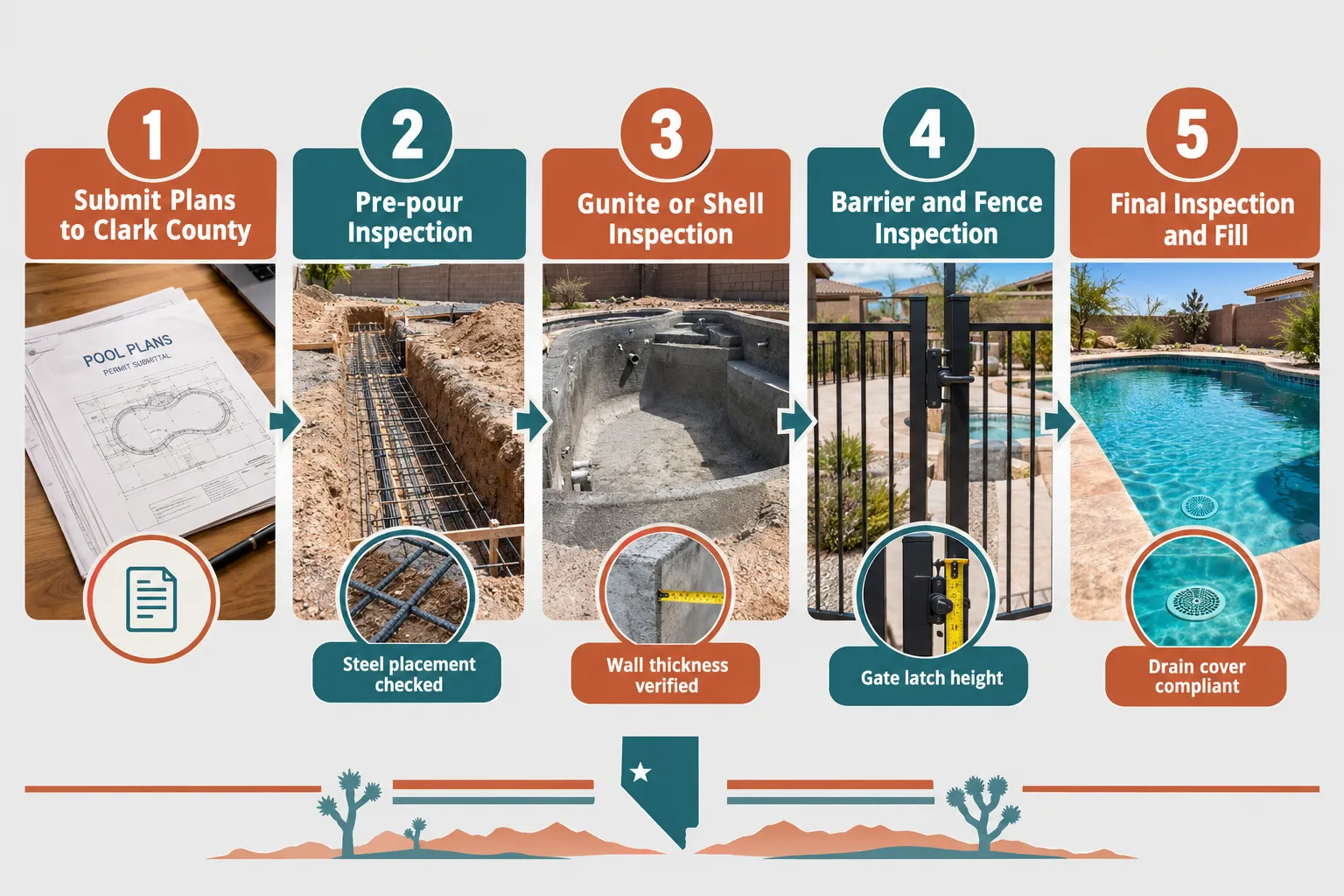
Typical inspection sequence for a residential pool in Clark County:
- Pre-pour / excavation inspection, Steel placement and footing dimensions are verified before any concrete is poured
- Gunite or shell inspection, Pool shell thickness and reinforcement are checked
- Plumbing rough-in inspection, Underground plumbing before backfill
- Electrical rough-in inspection, Bonding and wiring before covering
- Barrier inspection, Fence, gate, and latch compliance verified
- Equipment inspection, Pump, heater, and filter placement checked
- Final inspection, All systems complete; pool is approved for filling
You can track inspection status and schedule inspections through Clark County's Accela portal [9]. The pool cannot be filled and used until the final inspection is passed and approved.
For retaining walls, inspections typically occur at the footing stage and after block placement. Never backfill before the footing inspection is complete.
What Happens If You Landscape Without a Permit in Nevada?
Working without a required permit in Nevada can result in stop-work orders, fines, and mandatory removal of completed work. More importantly, unpermitted work creates serious problems when you sell your home.
Consequences of unpermitted work:
- Stop-work orders that halt all construction
- Fines from the local building department
- Requirement to demolish and redo work with proper permits
- Title and disclosure issues at resale
- Homeowner's insurance may deny claims related to unpermitted structures
- Lenders may refuse to finance a home with unpermitted additions
A homeowner in Henderson who built a pool without permits found out at closing that the buyer's lender required full permitting documentation. The sale was delayed four months and cost over $8,000 in retroactive permitting and repairs. Know who you're letting into your yard, and make sure they pull permits before they break ground.
Who Needs to Pull a Nevada Landscaping Permit?
In Nevada, the licensed contractor performing the work is typically responsible for pulling the permit. Homeowners can pull permits for their own primary residence in some cases, but this varies by project type and jurisdiction.
General rules:
- Licensed contractors must be registered with the Nevada State Contractors Board (NSCB) and should pull permits under their license
- Homeowners acting as their own general contractor can pull permits for their primary residence in many cases, but assume full liability for code compliance
- Subcontractors (electricians, plumbers) typically pull their own trade permits
Ask any contractor you hire: "Will you pull the permit, and can I see the permit number before work starts?" A contractor who resists this question is a red flag. Licensed, insured, and reviewed, that is the standard your yard deserves.
Nevada Landscaping Permit Common Mistakes to Avoid
Most permit problems are avoidable. These are the mistakes that cost homeowners the most time and money.
- Assuming your city and county are the same office. The City of Las Vegas and Clark County are separate permit authorities. Submitting to the wrong one delays your project.
- Starting work before permit approval. Even if you applied, work cannot begin until the permit is issued.
- Not scheduling inspections at each phase. Covering work before inspection requires demolition to expose it.
- Skipping the HOA submittal. HOA approval is separate from a government permit. You need both, and HOA review can take weeks.
- Underestimating construction value. Low-balling the project value to reduce fees can result in penalties and permit revocation.
- Forgetting the LVVWD water-feature cap. New pool designs must comply with Las Vegas Valley Water District surface area limits before plan submittal.
FAQ
Do I need a permit for a small backyard project in Nevada?
It depends on what the project involves. Planting, sod, and basic irrigation do not require permits. Any project involving footings, structural walls, pools, or drainage changes likely does. When in doubt, call your local building department before starting.
Can I do landscaping without a permit in Nevada?
Soft landscaping (planting, mulch, drip irrigation) generally does not require a permit. Structural hardscaping, pools, retaining walls over three feet, structural patio covers, requires a permit in most Nevada jurisdictions. Proceeding without a required permit risks fines and forced removal.
How do I apply for a landscaping permit in Nevada?
In unincorporated Clark County, applications are submitted through the Accela online portal [9]. Incorporated cities like Las Vegas and Henderson have their own portals. Washoe County has a separate system. You will need a site plan, project drawings, and in some cases an engineer's stamp.
What inspections are required for Nevada landscaping permits?
Inspections vary by project type. Pool projects require pre-pour, shell, rough-in (plumbing and electrical), barrier, equipment, and final inspections. Retaining walls require footing and placement inspections. No work can be covered before the relevant inspection is passed.
Does an HOA approval replace a government permit?
No. HOA approval and a government building permit are completely separate processes. You need both. HOA approval is a private agreement; a building permit is a legal requirement. Many projects stall because homeowners get one but forget the other.
Are public pool permit requirements different from residential in Nevada?
Yes. Public and commercial pools require a state health permit from the Nevada Division of Public and Behavioral Health (DPBH) in addition to local building permits [6][7]. Residential pools only require local permits.
How do I verify a contractor's license in Nevada?
Check the Nevada State Contractors Board (NSCB) website and search by license number or company name. A licensed contractor should provide their NSCB license number before you sign any contract. We verify so you don't have to, but always confirm directly with the board.
Conclusion
Nevada landscaping permits are not optional paperwork. They protect your investment, your family's safety, and your ability to sell your home without surprises. Whether you are adding a pool in Henderson, building a retaining wall in Reno, or installing a patio cover in unincorporated Clark County, the permit process is straightforward when you know the steps.
Your action plan:
- Confirm which building department covers your address (city vs. county)
- Determine whether your project triggers a permit using the thresholds above
- Ask any contractor you interview: "Will you pull the permit, and can I see it before work starts?"
- Check LVVWD water-feature caps if you are adding a pool or water feature
- Schedule all required inspections before covering any work
- Get HOA approval in writing before submitting to the building department
Find the right landscaper for your yard at LandscapeProsDirectory, local pros, local knowledge, real reviews from real homeowners. No fluff, just useful advice.
References
[1] Codes - https://www.clarkcountynv.gov/government/departments/building___fire_prevention/codes/
[2] Application Types - https://www.clarkcountynv.gov/government/departments/building___fire_prevention/plan_submittal/application-types
[3] Pool Permit - https://permitnotebook.com/nevada/clark-county/pool-permit/
[4] How Do I - https://www.clarkcountynv.gov/government/departments/building___fire_prevention/how-do-i
[5] Unincorporated Clark - https://permitbase.app/nevada/clark-county/unincorporated-clark/
[6] Permits (DPBH) - https://www.dpbh.nv.gov/regulatory/hcqc/environmental-health/public-bathing-places-pools-and-spas/permits/
[7] Permits (DPBH Environmental Health) - https://www.dpbh.nv.gov/regulatory/environmental-health/public-bathing-places-pools-and-spas/permits/
[8] When Do I Need A Permit - https://files.lasvegasnevada.gov/building-safety/Forms/General/WHEN-DO-I-NEED-A-PERMIT.pdf
[9] Accela Portal - https://aca-prod.accela.com/CLARKCO/Cap/CapHome.aspx?IsToShowInspection=yes&module=Building&TabName=Building
[10] Clark County NV Pool Rules - https://cityrulelookup.com/swimming-pools/pool-permits/clark-county-nv
<!DOCTYPE html>
<html lang="en">
<head>
<meta charset="UTF-8">
<meta name="viewport" content="width=device-width,initial-scale=1">
<title>Nevada Permit Checker</title>
<style>
.cg-wrap{font-family:Arial,sans-serif;max-width:520px;margin:24px auto;border:2px solid #0e7490;border-radius:10px;padding:20px;background:#f0f9ff}
.cg-wrap h3{margin:0 0 14px;color:#0e7490;font-size:1.1rem}
.cg-row{margin-bottom:12px}
.cg-row label{display:block;font-size:.9rem;font-weight:bold;color:#1e293b;margin-bottom:4px}
.cg-row select{width:100%;padding:7px;border:1px solid #cbd5e1;border-radius:6px;font-size:.9rem}
.cg-btn{background:#0e7490;color:#fff;border:none;padding:10px 22px;border-radius:6px;cursor:pointer;font-size:.95rem;margin-top:6px}
.cg-btn:hover{background:#0c6278}
.cg-result{margin-top:14px;padding:12px;border-radius:7px;font-size:.9rem;display:none}
.cg-yes{background:#fef3c7;border:1px solid #f59e0b;color:#92400e}
.cg-no{background:#dcfce7;border:1px solid #22c55e;color:#166534}
</style>
</head>
<body>
<div class="cg-wrap">
<h3>Nevada Permit Requirement Checker</h3>
<div class="cg-row">
<label>Project type</label>
<select id="cg-type">
<option value="">-- Select --</option>
<option value="pool">In-ground pool or spa</option>
<option value="abovepool">Above-ground pool</option>
<option value="wall">Retaining wall</option>
<option value="patio">Patio cover / pergola</option>
<option value="pavers">Ground-level pavers</option>
<option value="planting">Planting / irrigation</option>
</select>
</div>
<div class="cg-row" id="cg-extra-row" style="display:none">
<label id="cg-extra-label">Detail</label>
<select id="cg-extra">
<option value="yes">Yes</option>
<option value="no">No</option>
</select>
</div>
<button class="cg-btn" onclick="cgCheck()">Check Permit Need</button>
<div class="cg-result" id="cg-result"></div>
</div>
<script>
var cg={pool:{r:true,msg:"Permit required. In-ground pools need plan review, multiple inspections, and barrier compliance before filling."},abovepool:{check:true,label:"Is the pool over 24 inches deep?",yes:{r:true,msg:"Permit required. Above-ground pools over 24 inches deep require a Clark County permit."},no:{r:false,msg:"No permit typically required for storable pools under 24 inches deep."}},wall:{check:true,label:"Is the wall over 3 feet tall?",yes:{r:true,msg:"Permit required. Walls over 3 ft need plan review; over 4 ft usually need an engineer's stamp."},no:{r:false,msg:"Walls under 3 ft generally do not require a permit, but confirm with your local building department."}},patio:{check:true,label:"Does it have footings or attach to the house?",yes:{r:true,msg:"Permit required. Structural patio covers and attached pergolas need a building permit."},no:{r:false,msg:"Freestanding shade sails without footings typically do not require a permit."}},pavers:{r:false,msg:"No permit typically required for ground-level pavers on a sand base. If adding drainage changes, check locally."},planting:{r:false,msg:"No permit required for planting, sod, or basic drip irrigation."}};
function cgCheck(){var t=document.getElementById("cg-type").value,res=document.getElementById("cg-result"),ex=document.getElementById("cg-extra").value;if(!t){res.style.display="none";return;}var d=cg[t];if(d.check){var ans=d[ex];res.className="cg-result "+(ans.r?"cg-yes":"cg-no");res.innerHTML=ans.msg;}else{res.className="cg-result "+(d.r?"cg-yes":"cg-no");res.innerHTML=d.msg;}res.style.display="block";}
document.getElementById("cg-type").addEventListener("change",function(){var t=this.value,er=document.getElementById("cg-extra-row"),el=document.getElementById("cg-extra-label");document.getElementById("cg-result").style.display="none";if(cg[t]&&cg[t].check){el.textContent=cg[t].label;er.style.display="block";}else{er.style.display="none";}});
</script>
</div>
</body>
</html>
Liked this guide? Follow us on Google Search
Related Directory Pages
Find a Landscaper Near You
Browse NV landscaping professionals on LandscapeProsDirectory.
Search Landscapers