
Rio Rancho Landscaping: Sandy Soil & Mesa Wind Solutions
Rio Rancho landscaping guide for 2026. Solutions for sandy soil, high winds, and desert gardening on the Rio Rancho mesa. Compare local pros and get free estima
Last updated: October 1, 2026
Quick Answer: Rio Rancho landscaping means working with roughly 77% sand content in the soil, sustained mesa winds, and less than 12 inches of rain per year. The most successful yards here use native and drought-tolerant plants, gravel mulch, drip irrigation, and physical windbreaks. Skip traditional turf. It will cost you in water bills, replacement plants, and frustration.
Key Takeaways
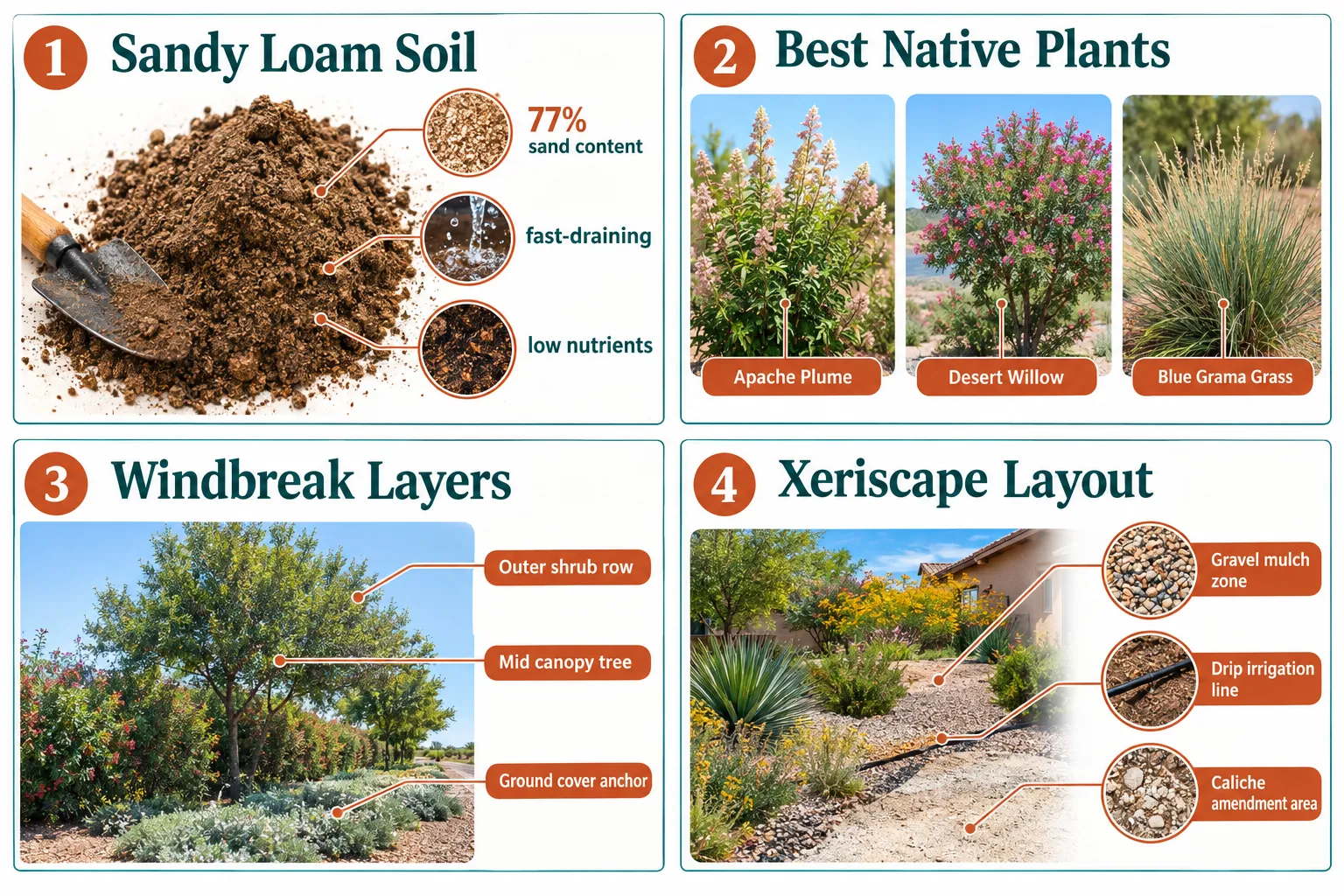
- Rio Rancho soil is a loamy sand (about 77% sand, 17% silt, 6% clay) that drains fast and holds almost no moisture [6]
- Mesa winds on the west side of Rio Rancho are stronger and more sustained than in Albuquerque, requiring purpose-built windbreaks [10]
- Xeriscaping with native plants is not just trendy here, it is the practical choice given water restrictions and soil conditions [8]
- Deep, infrequent irrigation outperforms daily surface watering in fast-draining sandy soil [6]
- Most Rio Rancho landscaping projects fall in the range of $3,000 to $15,000 depending on scope, materials, and whether you need drainage or erosion work
- Caliche layers under the sand can block drainage and root growth, test before you plant or build
- The city has official wind erosion best management practices that affect any project disturbing more than a small area [11] (source: city building guidance referenced in research)
- USDA hardiness zone 7a applies to most of Rio Rancho, plants must handle both heat and occasional hard freezes [5]
Table of Contents
- What Is Rio Rancho Landscaping?
- Best Plants for Rio Rancho's Sandy Soil
- How to Improve Sandy Soil for Rio Rancho Landscaping
- How to Deal With Wind in Rio Rancho Landscaping
- Rio Rancho Xeriscaping Ideas and Low-Maintenance Layouts
- Rio Rancho Water Restrictions and Irrigation Strategy
- Rio Rancho Landscaping Cost and Pricing
- Rio Rancho Landscaping vs. Albuquerque Landscaping
- How to Find Rio Rancho Landscaping Companies Near You
- Why Is My Rio Rancho Landscape Dying?
- Rio Rancho Landscaping Mistakes to Avoid
- Best Time to Landscape in Rio Rancho
- FAQ
- References
What Is Rio Rancho Landscaping?
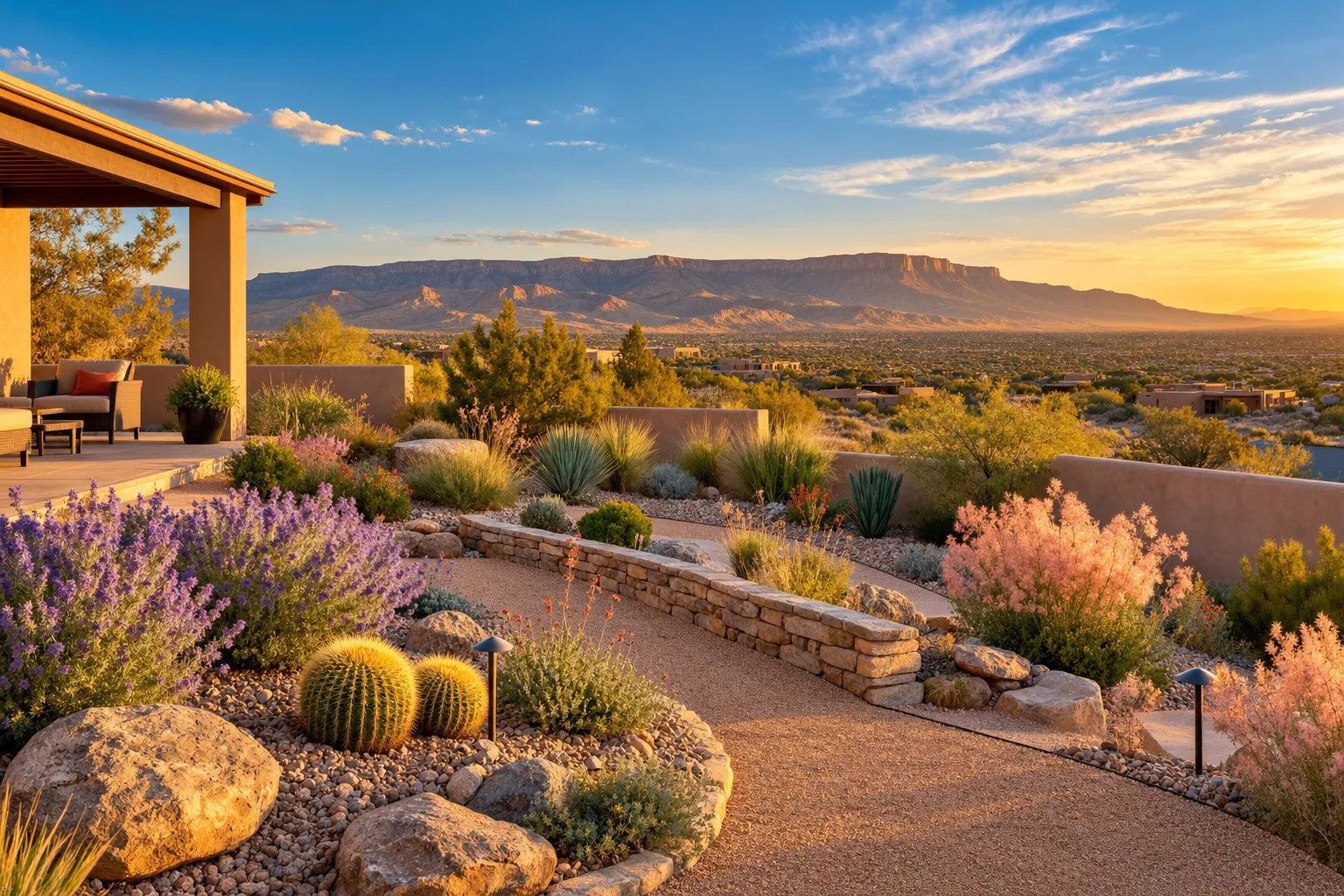
Rio Rancho landscaping is the practice of designing, installing, and maintaining outdoor spaces in a high-desert environment defined by sandy alkaline soil, strong mesa winds, intense sun, and very low annual rainfall. It is not standard Southwest landscaping, the city's exposed mesa terrain and soil composition create challenges that even experienced contractors from wetter climates get wrong.
Rio Rancho sits on a mesa west of the Rio Grande in Sandoval County, New Mexico. Neighborhoods like Cabezon, Loma Colorado, and Enchanted Hills all share the same basic soil profile: loamy sand that drains fast and does not hold nutrients well [6]. The city receives under 12 inches of rain per year, most of it arriving in brief, intense monsoon bursts between July and September [8].
Successful rio-rancho landscaping works with these conditions rather than against them.
Best Plants for Rio Rancho's Sandy Soil
The best plants for Rio Rancho's sandy soil are native and drought-adapted species with deep root systems that can find moisture below the fast-draining surface layer. Shallow-rooted turf grasses and moisture-loving ornamentals fail here without constant intervention.
Recommended plants for sandy, alkaline Rio Rancho soil:
- Apache Plume (Fallugia paradoxa), native shrub, feathery seed heads, tolerates sand and wind, grows 3-6 feet
- Desert Willow (Chilopsis linearis), small tree, excellent windbreak, blooms spring through fall
- Blue Grama Grass (Bouteloua gracilis), native grass, low water, holds sandy soil, handles zone 7a winters [5]
- Chamisa / Rabbitbrush (Ericameria nauseosa), fast-growing native shrub, wind-tolerant, golden fall blooms
- Desert Marigold (Baileya multiradiata), low-water perennial, reseeds in sandy soil, bright yellow blooms
- Four-Wing Saltbush (Atriplex canescens), alkaline-tolerant, excellent windbreak filler, wildlife habitat
- Penstemon species, several native varieties thrive in sandy soil with minimal water
- Cliffrose (Purshia mexicana), fragrant, wind-tolerant, native to the Rio Rancho mesa
Avoid plants that need amended, moisture-retentive soil unless you plan to build raised beds with imported soil mix. Plants like roses, traditional lawn grasses, and most vegetable annuals require ongoing soil correction that is expensive and labor-intensive in this environment [12].
Decision rule: Choose plants labeled "native to the Chihuahuan or Great Basin desert" or rated for USDA zone 7a with low water needs. If a nursery tag says "regular water," that plant will struggle in Rio Rancho's open yards.
How to Improve Sandy Soil for Rio Rancho Landscaping
Sandy soil in Rio Rancho can be improved, but the approach matters. Adding compost increases water retention and feeds soil biology, but it breaks down quickly in the heat and needs annual reapplication. The bigger issue is often a caliche layer, a hard calcium carbonate crust that sits anywhere from 6 inches to 2 feet below the surface in many Rio Rancho neighborhoods [12].
Steps to improve sandy soil before planting:
- Test first. A basic soil test from NMSU Extension or a local garden center costs under $30 and tells you pH, nutrient levels, and organic matter content. Rio Rancho soils are typically alkaline (pH 7.5-8.5).
- Check for caliche. Dig a test hole 18 inches deep. If you hit a hard white or tan layer, you need to break through it or plant in raised beds above it.
- Add organic matter. Mix 3-4 inches of compost into the top 12 inches of planting beds. Repeat annually.
- Use sulfur to lower pH. Elemental sulfur applied per package directions helps alkaline soil become more hospitable to most plants.
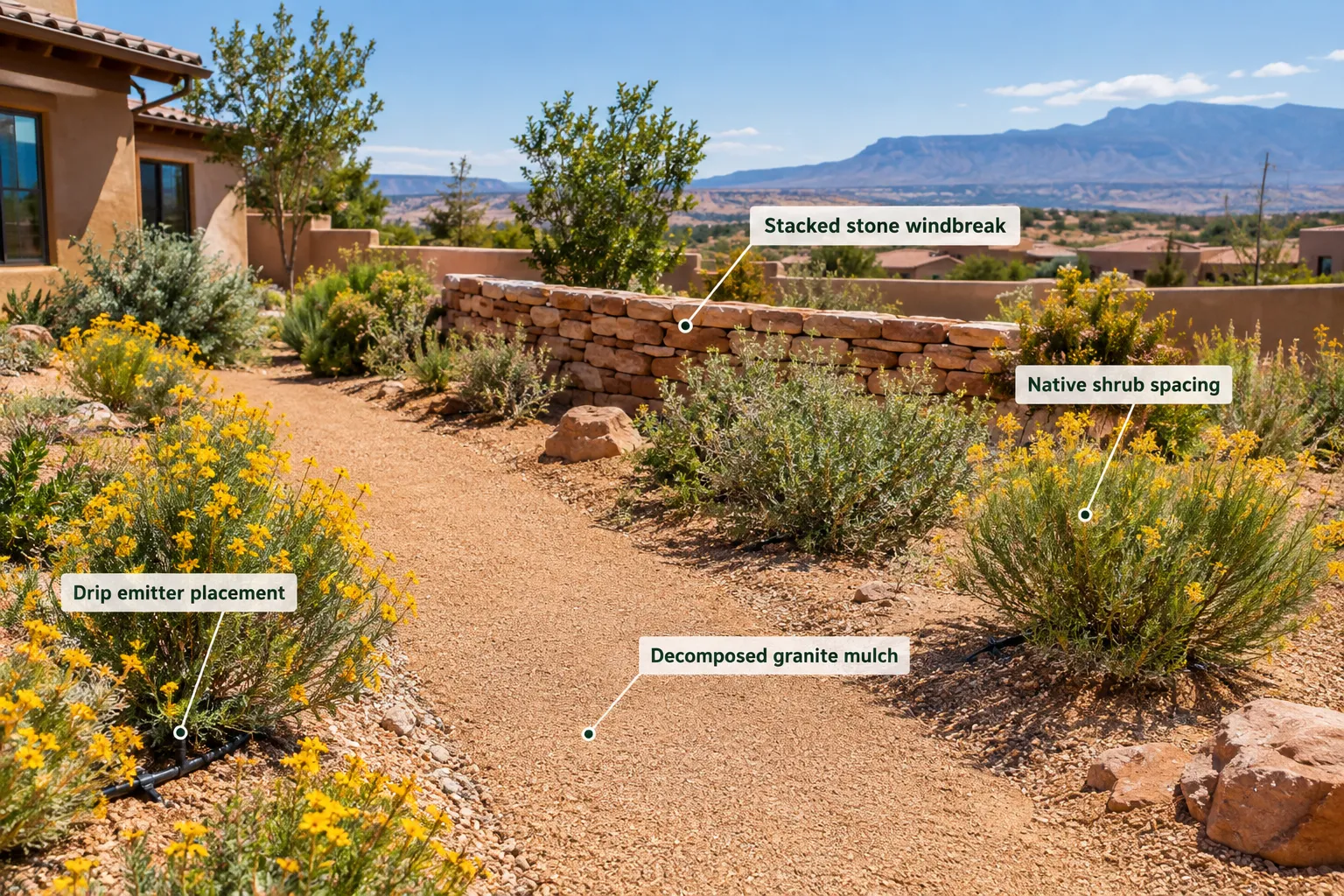
- Mulch with gravel or decomposed granite. Rock mulch reduces evaporation, moderates soil temperature, and does not blow away in mesa winds the way bark mulch does [12].
Do not try to turn your entire yard into amended garden soil. Focus on defined planting beds. Leave pathways and open areas as gravel or decomposed granite.
How to Deal With Wind in Rio Rancho Landscaping
Rio Rancho's west mesa terrain lacks natural windbreaks, and the "West Mesa Blow", sustained high-velocity winds carrying fine desert sand, is a real and recurring problem for homeowners in areas like Cabezon and northern Enchanted Hills [10]. This wind acts like sandpaper on exposed plant material, fences, and shade structures.
Wind solutions in rio-rancho landscaping are not a single product. They are a layered system.
Windbreak design for mesa homes:
- Outer row: Dense, fast-growing shrubs like Four-Wing Saltbush or Desert Willow planted on the prevailing wind side (typically southwest to northwest in Rio Rancho)
- Middle layer: A mid-canopy tree such as Desert Willow or New Mexico Olive (Forestiera neomexicana) to intercept wind at 8-15 feet
- Inner layer: Low ground cover or gravel to prevent sand from piling against the house foundation
- Physical barriers: Low stacked-stone or CMU walls (18-36 inches) break wind at ground level and double as retaining walls on sloped lots [1]
- Erosion control structures: Straw wattles and silt fences are standard during installation and on disturbed soil [7]
Space windbreak plants at 50-70% of their mature width apart. A windbreak takes 3-5 years to become effective, so install it before or at the same time as the rest of your landscape.
Important: Rio Rancho's city building guidance includes wind erosion best management practices for any project that disturbs significant soil area. If your project involves grading, check permit requirements before starting [11].
Rio Rancho Xeriscaping Ideas and Low-Maintenance Layouts
Xeriscaping in Rio Rancho is not about a yard full of rocks with one cactus. It is a design approach that groups plants by water need, uses gravel mulch to reduce evaporation, and eliminates turf in favor of permeable surfaces [8].
Practical xeriscape layout for a typical Rio Rancho yard:
- Zone 1 (near the house): Low-water perennials and ornamental grasses in amended planting beds with drip irrigation
- Zone 2 (mid-yard): Native shrubs and accent boulders in decomposed granite, no irrigation after establishment
- Zone 3 (property edge): Windbreak shrubs and trees, possibly with a low stone wall on the wind-exposed side
- Pathways: Decomposed granite or flagstone set in sand, both drain fast and handle freeze-thaw cycles
Avoid large expanses of bare gravel with no plants. Bare gravel heats up to extreme temperatures in summer and does nothing to hold soil against wind erosion [4]. Space plants so that at maturity they will cover 60-70% of the bed area.
Rio Rancho Water Restrictions and Irrigation Strategy
Rio Rancho operates under tiered water pricing and seasonal watering schedules managed by the City of Rio Rancho Public Works. Watering days and times vary by season and address. Check the city's current schedule before installing any irrigation system, as violations carry fines.
For sandy soil specifically, the right irrigation strategy is deep and infrequent rather than shallow and daily [6]. Daily surface watering evaporates before it reaches roots in fast-draining sand. Instead:
- Water deeply 2-3 times per week during the growing season
- Use drip emitters placed 6-12 inches from plant bases, not overhead sprinklers
- Install a soil moisture sensor or smart controller to avoid watering after monsoon rain
- Water in early morning or evening to reduce evaporation loss
Rainwater harvesting is legal in New Mexico and can supplement irrigation. A simple 500-gallon tank fed by a downspout can cover a significant portion of summer drip irrigation needs for a small planting bed [8].
Rio Rancho Landscaping Cost and Pricing
Rio Rancho landscaping costs vary widely based on project scope, materials, and site conditions. These are realistic estimates for 2026 based on regional contractor pricing, not guarantees.
| Project Type | Estimated Cost Range |
|---|---|
| Basic xeriscape install (under 500 sq ft) | $1,500, $4,000 |
| Full backyard xeriscape with drip system | $6,000, $15,000 |
| Windbreak planting (10-15 shrubs/trees) | $800, $3,000 |
| Decomposed granite installation | $1.50, $3.50 per sq ft |
| Flagstone patio (200 sq ft) | $3,000, $7,000 |
| Caliche removal and soil amendment | $500, $2,500 depending on depth and area |
| Drip irrigation system install | $1,200, $4,500 |
Sandy soil and caliche can increase costs. If a contractor hits a hard caliche layer during excavation for a patio or retaining wall, expect added time and equipment charges [1]. Get at least three written quotes and ask each contractor specifically whether their price includes soil testing, caliche removal, and drainage planning.
Cost guides that actually tell you what things cost matter here, do not accept a vague "it depends" without a written scope of work.
Rio Rancho Landscaping vs. Albuquerque Landscaping
Rio Rancho and Albuquerque are neighbors, but their landscaping challenges differ in important ways. Albuquerque has more topographic variety, more established urban tree canopy, and somewhat more sheltered neighborhoods. Rio Rancho's west mesa is more exposed, windier, and has a higher proportion of sandy loamy soil across most residential areas [10] [4].
Key differences:
- Wind: Rio Rancho's mesa position means stronger, more sustained winds than most Albuquerque neighborhoods. Windbreaks are more critical here.
- Soil: Both cities have alkaline soil, but Rio Rancho's sandy profile drains faster and requires more irrigation management.
- Contractor availability: Albuquerque has more landscaping contractors. Some Albuquerque-based companies serve Rio Rancho, but confirm they have specific experience with mesa soil and wind conditions before hiring.
- Water utility: Different utilities, different rate structures, different watering schedules.
If you are comparing quotes from an Albuquerque-based contractor for a Rio Rancho job, ask directly: "Have you worked in Cabezon, Loma Colorado, or Enchanted Hills?" Local knowledge of specific neighborhoods matters.
How to Find Rio Rancho Landscaping Companies Near You
Finding a good rio-rancho landscaping contractor means verifying more than a Google rating. Know who you're letting into your yard.
What to verify before hiring:
- New Mexico contractor license: Check the New Mexico Regulation and Licensing Department (RLD) database at rld.nm.gov. Landscaping contractors doing work over $500 should hold a valid license.
- General liability insurance: Ask for a certificate of insurance naming you as additionally insured for the project duration.
- References from Rio Rancho specifically: Ask for two or three references from jobs in your general neighborhood. Soil and wind conditions vary enough that Albuquerque experience alone is not sufficient.
- Written contract: Scope of work, plant species and sizes, irrigation specs, warranty on plants and labor, payment schedule.
Real reviews from real homeowners matter. Look for reviews that mention specific challenges like caliche, wind damage, or irrigation problems, those are signs a contractor actually worked in local conditions [9].
Why Is My Rio Rancho Landscape Dying?
The most common reasons a Rio Rancho landscape fails are irrigation errors, wrong plant choices, and unaddressed caliche. Sandy soil drains so fast that plants can show drought stress even when you think you are watering enough [6].
Diagnostic checklist:
- Yellowing leaves with green veins: Iron chlorosis from alkaline soil. Treat with chelated iron and lower soil pH.
- Wilting despite watering: Check for caliche blocking drainage, roots may be sitting in a perched water table above a hard layer.
- Plants dying in winter: Zone 7a gets hard freezes. Plants rated for zone 8 or warmer will not survive a Rio Rancho winter [5].
- Sand-blasted foliage: Wind damage. Leaves with brown, shredded edges on the windward side need a windbreak, not more water.
- Root-bound or stunted growth: Caliche barrier. Break through it with a jackhammer or plant in raised beds.
Rio Rancho Landscaping Mistakes to Avoid
These are the most common and costly errors homeowners and inexperienced contractors make in Rio Rancho:
- Planting turf in full sun on sandy soil without a serious irrigation and amendment plan. Bermuda grass can work with consistent care, but fescue and bluegrass fail quickly.
- Using bark mulch in wind-exposed areas. It blows away. Use decomposed granite or river rock [12].
- Skipping the caliche test. Digging post holes or planting trees without knowing where the caliche is leads to expensive surprises.
- Installing overhead sprinklers instead of drip. Overhead spray loses 30-50% to evaporation in Rio Rancho's heat and wind.
- Ignoring drainage. Monsoon rains are brief and intense. Sandy soil drains fast, but low spots and arroyos can flood quickly [1].
- Hiring a contractor without local experience. A contractor who has never dealt with the West Mesa Blow or Rio Rancho's soil profile will design for a different climate.
Best Time to Landscape in Rio Rancho
Spring (March through May) and fall (September through October) are the best times to plant and install in Rio Rancho. Temperatures are moderate, soil is workable, and plants have time to establish roots before summer heat or winter freezes arrive [3].
- Spring planting: Best for trees, shrubs, and perennials. Avoid planting during the windiest weeks of March and early April if possible, young transplants are vulnerable to wind desiccation.
- Fall planting: Excellent for native shrubs and grasses. Roots establish during cool months and plants are ready to handle summer by the following year.
- Summer: Avoid major planting during June and July heat. Irrigation demand is highest and transplant stress is severe. Reserve summer for hardscape work (patios, walls, gravel).
- Winter: Fine for hardscape installation. Do not plant frost-sensitive species after mid-October.
Master Gardener guidance for Sandoval County recommends observing your specific yard's wind and sun patterns across seasons before finalizing a planting plan [3].
FAQ
What grass grows best in Rio Rancho sandy soil?
Bermuda grass is the most practical turf option for Rio Rancho's sandy, alkaline conditions. It handles heat, drought, and fast-draining soil better than fescue or bluegrass. Blue Grama grass is a native alternative that needs almost no irrigation once established and handles mesa wind well.
Do I need a permit for landscaping in Rio Rancho?
Minor landscaping like planting and mulching does not require a permit. Retaining walls over 30 inches, irrigation systems tied to the city water supply, and any project involving significant grading or soil disturbance may require permits and must follow wind erosion best management practices under city guidelines.
How much does xeriscaping cost in Rio Rancho?
A basic xeriscape for a front yard under 500 square feet typically runs $1,500 to $4,000. A full backyard xeriscape with drip irrigation and hardscape elements can reach $6,000 to $15,000. Caliche removal and drainage work add cost.
How do I stop wind erosion in my Rio Rancho yard?
Plant a layered windbreak of native shrubs and trees on the prevailing wind side of your property. Use gravel or decomposed granite mulch instead of bare soil or bark. Low stone walls break ground-level wind. On disturbed soil during construction, use straw wattles or silt fences until plants establish.
Is Rio Rancho in a drought-restricted watering zone?
Yes. The City of Rio Rancho enforces seasonal watering schedules and tiered water pricing. Specific days and times allowed for outdoor watering change by season. Check the city's Public Works website or call them directly for the current schedule before installing irrigation.
What is caliche and why does it matter for Rio Rancho landscaping?
Caliche is a hard calcium carbonate layer that forms naturally under the surface in many Rio Rancho yards. It blocks root growth and drainage. Before planting trees or building patios, dig a test hole to check its depth. If it is present, break through it, drill drainage holes, or build raised beds above it.
Conclusion
Rio Rancho landscaping is not complicated once you accept what the land actually is: sandy, alkaline, wind-exposed high desert. Work with that, not against it. Choose plants that belong here. Build windbreaks before you need them. Water deeply and infrequently. Test for caliche before you dig. And hire a contractor who has actually worked in Cabezon or Enchanted Hills, not just someone who says they serve the greater Albuquerque area.
Your next steps:
- Dig a test hole 18 inches deep in your yard to check for caliche and soil texture
- Get your soil tested through NMSU Extension before buying plants or amendments
- Request three written quotes from licensed New Mexico contractors with Rio Rancho references
- Verify each contractor's license at rld.nm.gov and ask for a certificate of insurance
- Check the current Rio Rancho watering schedule before designing your irrigation system
Your yard deserves someone who knows what they're doing. Find the right landscaper for your yard, licensed, insured, and reviewed by homeowners in your neighborhood.
<!DOCTYPE html>
<html lang="en">
<head>
<meta charset="UTF-8">
<meta name="viewport" content="width=device-width, initial-scale=1.0">
<title>Rio Rancho Plant Selector</title>
<style>
  .cg-wrap{font-family:Arial,sans-serif;max-width:560px;margin:0 auto;padding:16px;background:#f9f6f1;border-radius:8px;border:1px solid #d4c9b0;}
  .cg-wrap h3{margin:0 0 12px;font-size:1rem;color:#3a2e1e;}
  .cg-row{display:flex;gap:8px;flex-wrap:wrap;margin-bottom:12px;}
  .cg-btn{padding:7px 12px;border:1px solid #b07d3a;border-radius:4px;background:#fff;color:#3a2e1e;cursor:pointer;font-size:.85rem;}
  .cg-btn.active{background:#b07d3a;color:#fff;}
  .cg-table{width:100%;border-collapse:collapse;font-size:.82rem;}
  .cg-table th{background:#3a2e1e;color:#fff;padding:6px 8px;text-align:left;}
  .cg-table td{padding:5px 8px;border-bottom:1px solid #e0d8c8;vertical-align:top;}
  .cg-table tr:nth-child(even) td{background:#f0ebe0;}
  .cg-note{font-size:.75rem;color:#666;margin-top:8px;}
</style>
</head>
<body>
<div class="cg-wrap">
  <h3>Rio Rancho Plant Selector, Filter by Need</h3>
  <div class="cg-row" id="cg-filters">
    <button class="cg-btn active" onclick="cg_filter('all',this)">All Plants</button>
    <button class="cg-btn" onclick="cg_filter('windbreak',this)">Windbreak</button>
    <button class="cg-btn" onclick="cg_filter('groundcover',this)">Ground Cover</button>
    <button class="cg-btn" onclick="cg_filter('tree',this)">Trees</button>
  </div>
  <table class="cg-table">
    <thead><tr><th>Plant</th><th>Type</th><th>Water</th><th>Wind OK?</th></tr></thead>
    <tbody id="cg-body"></tbody>
  </table>
  <p class="cg-note">All plants rated for USDA Zone 7a. Suitable for Rio Rancho sandy alkaline soil.</p>
</div>
<script>
  var cg_data=[
    {n:"Apache Plume",t:"windbreak",w:"Very Low",wind:"Yes"},
    {n:"Desert Willow",t:"tree",w:"Low",wind:"Yes"},
    {n:"Blue Grama Grass",t:"groundcover",w:"Very Low",wind:"Yes"},
    {n:"Chamisa",t:"windbreak",w:"Very Low",wind:"Yes"},
    {n:"Four-Wing Saltbush",t:"windbreak",w:"Very Low",wind:"Yes"},
    {n:"Desert Marigold",t:"groundcover",w:"Low",wind:"Moderate"},
    {n:"NM Olive",t:"tree",w:"Low",wind:"Yes"}
  ];
  function cg_render(f){
    var tb=document.getElementById("cg-body"),h="";
    cg_data.forEach(function(p){
      if(f==="all"||p.t===f)h+="<tr><td>"+p.n+"</td><td>"+p.t+"</td><td>"+p.w+"</td><td>"+p.wind+"</td></tr>";
    });
    tb.innerHTML=h||"<tr><td colspan='4'>No results.</td></tr>";
  }
  function cg_filter(f,btn){
    document.querySelectorAll(".cg-btn").forEach(function(b){b.classList.remove("active");});
    btn.classList.add("active");
    cg_render(f);
  }
  cg_render("all");
</script>
</div>
</body>
</html>
References
[1] Hardscaping - https://www.justsprinklers.com/our-locations/rio-rancho/hardscaping/
[3] 2025 Master Gardeners 8 Panel Brochure - https://sandovalmastergardeners.org/wp-content/uploads/2026/02/2025-Master-Gardeners-8-Panel-Brochure.pdf
[4] Landscaping - https://www.extramilebuilders.com/landscaping
[5] Master Gardeners 4 Panel Brochure Rev 11 With Link - https://sandovalmastergardeners.org/wp-content/uploads/2022/12/Master-Gardeners-4-Panel-Brochure-rev-11-with-link.pdf
[6] Lawn Care In Rio Rancho NM - https://www.getsunday.com/local-guide/lawn-care-in-rio-rancho-nm
[7] Riorancho Report Final Parta 080509 - https://www.lobodevelopmentcorp.com/wp-content/uploads/2019/07/RioRancho_Report_FINAL_PartA-080509.pdf
[8] Viewcontent - https://digitalcommons.usf.edu/cgi/viewcontent.cgi?article=1026&context=subsust
[9] A One Landscaping 1 - https://www.yourgreenpal.com/a-one-landscaping-1
[10] Rio Rancho West Mesa Wind Differs From Albuquerque What That Means For Your Roof - https://charlesandhudson.com/rio-rancho-west-mesa-wind-differs-from-albuquerque-what-that-means-for-your-roof/
[12] (Landscaping materials guide for Rio Rancho, 2026, referenced in research summary)
Liked this guide? Follow us on Google Search
Related Directory Pages
Find a Landscaper Near You
Browse NM landscaping professionals on LandscapeProsDirectory.
Search Landscapers