
Utah Tree Care: Pruning, Pests & Alkaline Soil Solutions
Expert Utah tree care guide covering alkaline soil solutions, emerald ash borer prevention, proper pruning timing, and finding licensed tree services in Salt La
Utah's alkaline soil kills more trees than homeowners realize. With soil pH levels often reaching 8.5 or higher across Salt Lake City, Provo, and Park City, many popular tree species simply can't survive. Add emerald ash borer threats, late spring frosts, and heavy snow loads, and Utah tree care becomes a specialized skill. Your yard deserves someone who knows what they're doing when it comes to these unique challenges.
Finding the right Utah tree service means understanding what makes tree care different in the Intermountain West. Local pros with local knowledge can save you thousands in replacement costs by choosing the right species and providing proper care from day one.
Key Takeaways
- Utah's alkaline soil (pH 7.5-8.5) requires specific tree species like honey locust, Austrian pine, and Gambel oak
- Emerald ash borer prevention requires professional treatment every 2-3 years for ash trees
- Deep watering techniques are essential for developing strong root systems in Utah's dry climate
- Proper pruning timing prevents frost damage and snow load issues
- Licensed Utah tree services must hold DOPL certification for commercial work
Table of Contents
- Understanding Utah's Alkaline Soil Challenge
- Best Trees for Utah's High pH Soil
- Emerald Ash Borer Prevention and Treatment
- Proper Watering Techniques for Utah Trees
- Pruning Timing and Snow Load Prevention
- Finding Licensed Utah Tree Service Professionals
- FAQ
Understanding Utah's Alkaline Soil Challenge
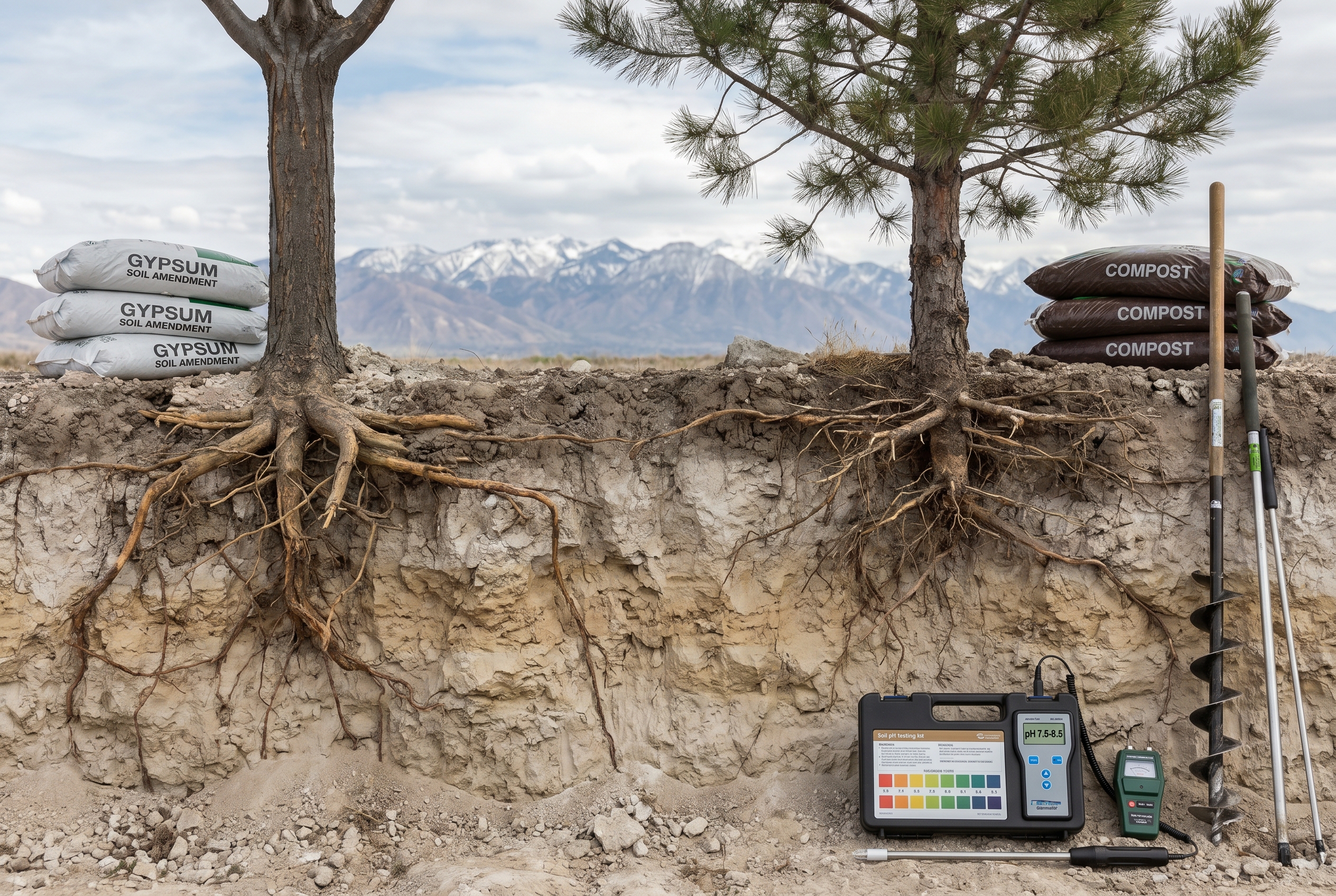
Utah landscaping directory's soil presents unique challenges that many homeowners don't discover until their trees start declining. The state's geological history created naturally alkaline conditions with pH levels between 7.5 and 8.5 across most residential areas.
Why Alkaline Soil Matters for Trees
High pH soil locks up essential nutrients like iron, manganese, and zinc. Trees can't absorb these nutrients even when they're present in the soil. This leads to chlorosis - yellowing leaves that indicate nutrient deficiency.
Salt Lake City's east bench areas often have pH levels exceeding 8.0. Provo's newer developments frequently test at 8.2 or higher. Even Park City's mountain soils lean alkaline due to limestone deposits.
Soil Testing Before Planting
Professional Utah tree service companies always test soil pH before recommending species. Home test kits work, but professional testing reveals nutrient levels and soil structure problems that affect long-term tree health.
Cost guides that actually tell you what things cost: soil testing runs $75-150 through most Utah tree services. This small investment prevents costly tree replacement later.
Best Trees for Utah's High pH Soil
Choosing alkaline-tolerant species makes the difference between thriving trees and constant replacement costs. These trees naturally handle Utah's soil conditions without extensive amendments.
Top Alkaline-Tolerant Trees for Utah
Honey Locust (Gleditsia triacanthos)
- Thrives in pH up to 8.5
- Drought tolerant once established
- Filtered shade perfect for Utah lawns
- Minimal pest problems
Austrian Pine (Pinus nigra)
- Handles alkaline soil and wind exposure
- Evergreen screening for privacy
- Salt tolerant for roadside planting
- Grows 40-60 feet at maturity
Gambel Oak (Quercus gambelii)
- Native to Utah's foothills
- Excellent fall color
- Wildlife habitat value
- Deep taproot system
London Plane Tree (Platanus × acerifolia)
- Urban pollution tolerant
- Fast growth rate
- Distinctive bark pattern
- Handles compacted soil
Trees to Avoid in Alkaline Soil
Many popular species struggle in Utah's conditions:
- Pin Oak (develops severe chlorosis)
- Sweet Gum (nutrient deficiency issues)
- Dogwood (requires acidic conditions)
- Most fruit trees without rootstock selection
Emerald Ash Borer Prevention and Treatment
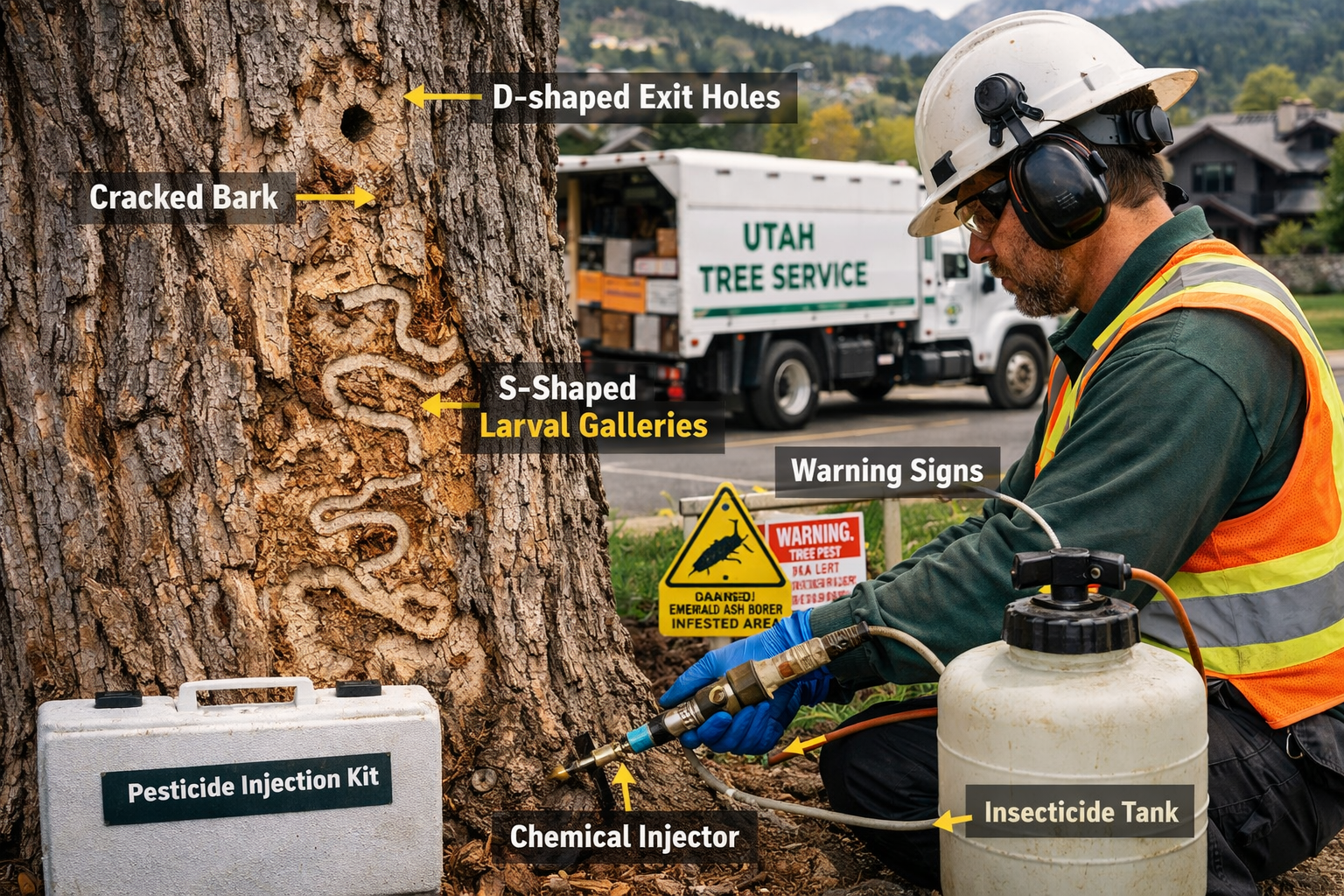
Emerald ash borer (EAB) reached Utah in 2018 and continues spreading across the Wasatch Front. This invasive beetle kills ash trees within 2-4 years of infestation.
Identifying Ash Trees on Your Property
Ash trees have:
- Compound leaves with 5-9 leaflets
- Opposite branching pattern
- Diamond-shaped bark ridges on mature trees
- Clusters of winged seeds (samaras)
Prevention Treatment Options
Professional Utah tree service companies offer several EAB prevention methods:
Emamectin Benzoate Injections
- Applied every 2-3 years
- 95% effective when applied before infestation
- Cost: $8-15 per inch of trunk diameter
Imidacloprid Soil Treatment
- Annual application required
- Lower cost but less effective
- Best for smaller trees under 15 inches
Signs of EAB Infestation
Watch for these warning signs:
- D-shaped exit holes in bark
- Serpentine galleries under bark
- Canopy thinning starting at the top
- Epicormic sprouting from trunk
When to Remove vs. Treat
Trees with more than 50% canopy loss rarely recover even with treatment. Licensed tree services can assess whether treatment makes financial sense or removal is necessary.
Proper Watering Techniques for Utah Trees
Utah's semi-arid climate requires specific watering strategies to develop deep, drought-resistant root systems. Most homeowners water too frequently and too shallow.
Deep Watering Principles
Trees need water penetration to 18-24 inches deep. This encourages roots to grow down rather than staying near the surface where they're vulnerable to heat and drought.
Watering Schedule by Season
Spring (March-May)
- Water every 7-10 days
- Apply 1-2 inches per session
- Focus on newly planted trees
Summer (June-August)
- Established trees: every 10-14 days
- Young trees: every 5-7 days
- Water early morning to reduce evaporation
Fall (September-November)
- Reduce frequency but maintain deep watering
- Continue until soil freezes
- Critical for winter survival
Winter Watering
Utah's dry winters require occasional watering during warm spells. Evergreens especially need winter moisture.
Mulching for Moisture Retention
Apply 2-4 inches of organic mulch around trees:
- Keep mulch 6 inches from trunk
- Extend to drip line when possible
- Reduces watering needs by 30-40%
Pruning Timing and Snow Load Prevention
Utah's climate creates specific pruning challenges. Late spring frosts can damage fresh cuts, while heavy snow loads break improperly pruned branches.
Optimal Pruning Windows
Dormant Season (December-February)
- Best time for structural pruning
- Reduces disease transmission
- Trees heal faster when growth resumes
Late Spring Considerations
Avoid pruning from March through May in areas prone to late frost. Park City and higher elevations face frost risk through June.
Snow Load Prevention Techniques
Utah tree service professionals use specific techniques to prevent snow damage:
Crown Thinning
- Reduces wind resistance
- Allows snow to fall through canopy
- Maintains tree structure
Proper Branch Selection
- Remove branches with narrow crotch angles
- Keep branches with wide, strong attachments
- Eliminate crossing or rubbing branches
Species-Specific Considerations
Evergreens
- Light pruning only
- Remove damaged branches immediately
- Avoid topping or excessive thinning
Deciduous Trees
- Structural pruning during dormancy
- Remove water sprouts and suckers
- Maintain central leader when appropriate
Finding Licensed Utah Tree Service Professionals
Utah requires specific licensing for commercial tree services. Know who you're letting into your yard by verifying credentials before hiring.
DOPL Licensing Requirements
The Utah Division of Occupational and Professional Licensing (DOPL) requires:
- Contractor license for tree removal
- Pesticide applicator license for treatments
- Workers' compensation insurance
- General liability coverage
What to Ask Before You hire a landscaper
Essential Questions:
- "What's your DOPL license number?"
- "Do you carry workers' compensation?"
- "Can you provide local references?"
- "What's included in your estimate?"
Red Flags to Avoid
- Door-to-door solicitation
- Requests for full payment upfront
- No written estimates
- Unusually low bids
- No local address or references
Verification Steps
We verify so you don't have to - but you can also check:
- DOPL license status online
- Better Business Bureau ratings
- Google reviews and local references
- Insurance certificates
Cost Expectations for Utah Tree Services
Tree Removal
- Small trees (under 25 feet): $300-800
- Medium trees (25-50 feet): $800-1,500
- Large trees (over 50 feet): $1,500-3,000+
Pruning Services
- Young trees: $150-400
- Mature trees: $400-1,000
- Hazardous pruning: $500-1,500+
Treatment Applications
- EAB prevention: $8-15 per inch diameter
- Deep root fertilization: $200-500
- Disease treatment: varies by condition
Real reviews from real homeowners show that investing in proper tree care costs less than replacement. A mature tree adds $1,000-10,000 to property value depending on species and location.
FAQ
How often should I water newly planted trees in Utah?
Water newly planted trees every 3-5 days for the first month, then gradually extend to weekly deep watering. Apply water slowly to penetrate 12-18 inches deep rather than frequent shallow watering.
When is the best time to plant trees in Utah?
Plant trees in early fall (September-October) or early spring (March-April). Fall planting allows root establishment before winter, while spring planting provides a full growing season to establish.
Do I need a permit to remove trees on my property in Utah?
Most Utah cities don't require permits for tree removal on private property, but some municipalities have restrictions for large or heritage trees. Check with your local city planning department before removal.
How can I tell if my tree has emerald ash borer?
Look for D-shaped exit holes in the bark, serpentine galleries under loose bark, canopy thinning from the top down, and unusual sprouting from the trunk. Professional inspection is recommended for accurate diagnosis.
What's the difference between certified arborists and tree services?
Certified arborists have passed International Society of Arboriculture exams and maintain continuing education. Tree services may employ certified arborists but aren't required to. Always ask about certifications when hiring.
Should I fertilize trees in Utah's alkaline soil?
Standard fertilizers often don't help in alkaline soil due to nutrient lockup. Professional soil testing determines if specialized fertilizers or soil amendments are needed. Iron chelate treatments often help more than general fertilizers.
Conclusion
Utah landscaping directory tree care requires understanding the state's unique challenges - from alkaline soil that locks up nutrients to emerald ash borer threats and heavy snow loads. Success starts with choosing appropriate species like honey locust, Austrian pine, and Gambel oak that naturally thrive in high pH conditions.
Professional Utah tree service providers bring local knowledge that saves money long-term. They understand proper watering techniques for the semi-arid climate, optimal pruning timing to prevent frost damage, and effective pest management strategies.
From basic lawn care to full backyard transformations, licensed professionals make the difference between thriving landscapes and costly replacements. Verify DOPL licensing, check local references, and invest in proper care from the start.
Find your next landscaper here by researching credentials, comparing detailed estimates, and choosing professionals who understand Utah's specific growing conditions. Your trees - and your property value - will benefit from expert care tailored to the Intermountain West.
Liked this guide? Follow us on Google Search
Related Directory Pages
- Browse Utah Landscaping Pros
- Park City Landscaping Services
- Browse Tree Services Services in Utah
- Also Read: Tree Care Guide for Arizona Homeowners
- Also Read: California Tree Care: Pruning, Removal & Fire Safety
- Also Read: Tree Services in Las Vegas: Care for Desert-Adapted Trees
- Also Read: Tree Care in New Mexico: Pruning, Pests & Piñon Health
- Search Utah Landscapers
Find a Landscaper Near You
Browse UT landscaping professionals on LandscapeProsDirectory.
Search Landscapers