
West Valley City Landscaping: Wasatch Front Tips
West Valley City landscaping guide for 2026. Explore water-wise Localscapes, lawn care, and winter prep for Utah's second-largest city. Compare local pros and g
Last updated: October 1, 2026
Quick Answer: West Valley City landscaping is governed by specific city ordinances that require front yards to have at least 25% live plant coverage, one tree, and an underground irrigation system designed for water efficiency. [1][3] In 2026, most landscaping projects in West Valley City range from about $320 for basic work to over $20,000 for full hardscape redesigns, with a median cost of around $6,200 for a complete landscape overhaul. [9] The Wasatch Front climate, hard freezes, alkaline soil, and drought pressure, means the smartest approach combines the Utah Localscapes five-zone method with native plants, drip irrigation, and minimal turf.
Key Takeaways
- West Valley City ordinance requires at least 25% of the front yard to be covered by live plants, one tree minimum, and a permitted underground irrigation system. [1][3]
- Lawn cannot exceed 35% of front and side yards in the Residential Sustainability Zone, and no lawn is allowed in park strips or areas narrower than 8 feet. [10]
- The Utah Localscapes method divides your yard into five zones based on water need, dramatically cutting outdoor water use while keeping the yard attractive year-round.
- Typical 2026 costs: $289 for mulching, $2,237 for sod, $2,759 for a sprinkler system, $3,077 for general landscaping, and $20,600 for hardscaping. [4]
- Landscape plans must be prepared by a licensed Utah landscape architect or a Utah Nursery and Landscape Association certified designer. [8]
- Irrigation systems must be installed by certified irrigation contractors and must include an EPA WaterSense smart controller in the Residential Sustainability Zone. [8][14]
- Alkaline Wasatch Front soil (pH 7.5 to 8.5 is common) requires amendment before most plants will thrive, elemental sulfur and compost are the standard fix.
- West Valley City actively enforces landscaping standards; yards out of compliance are referred to Code Enforcement. [7]
Table of Contents
- What Is Landscaping and Why Does It Matter in West Valley City
- Localscapes Principles for WVC Homes
- Managing Alkaline Soil in West Valley
- Best Time to Landscape in West Valley City
- How Much Does West Valley City Landscaping Cost in 2026
- Native Plants and Xeriscaping for West Valley City Water Conservation
- How Often Should You Water Your Landscape in West Valley City
- Winterizing Your Utah Landscape
- WVC Water Conservation Incentives and Ordinance Rules
- Professional Landscaping Services vs. DIY on the Wasatch Front
- West Valley City Landscaping vs. Salt Lake City Landscaping
- Common Landscaping Mistakes to Avoid on the Wasatch Front
- FAQ
- References
What Is Landscaping and Why Does It Matter in West Valley City
West Valley City landscaping is not optional, it is a code requirement. The city mandates that all residential front yards be landscaped, maintained, and irrigated with a permanent underground system. [1][3] Neglecting your yard is not just an aesthetic choice; it can result in a Code Enforcement notice. [7]
Beyond compliance, a well-designed yard reduces your water bill, increases property value, and handles the Wasatch Front's climate extremes better than a lawn-only approach. The city's own Water Element signals that regulations will tighten further, so designing for water efficiency now protects your investment long-term. [13]
Why this matters for homeowners:
- Front yards must have at least one tree and 25% live plant coverage. [1]
- Sod is not required, the city explicitly supports non-turf, water-wise designs. [6]
- Yards that fall out of compliance are reported to Code Enforcement. [7]
Localscapes Principles for WVC Homes
The Utah Localscapes method is the most practical framework for West Valley City yards. It divides your property into five zones based on water demand, so every square foot earns its water budget.
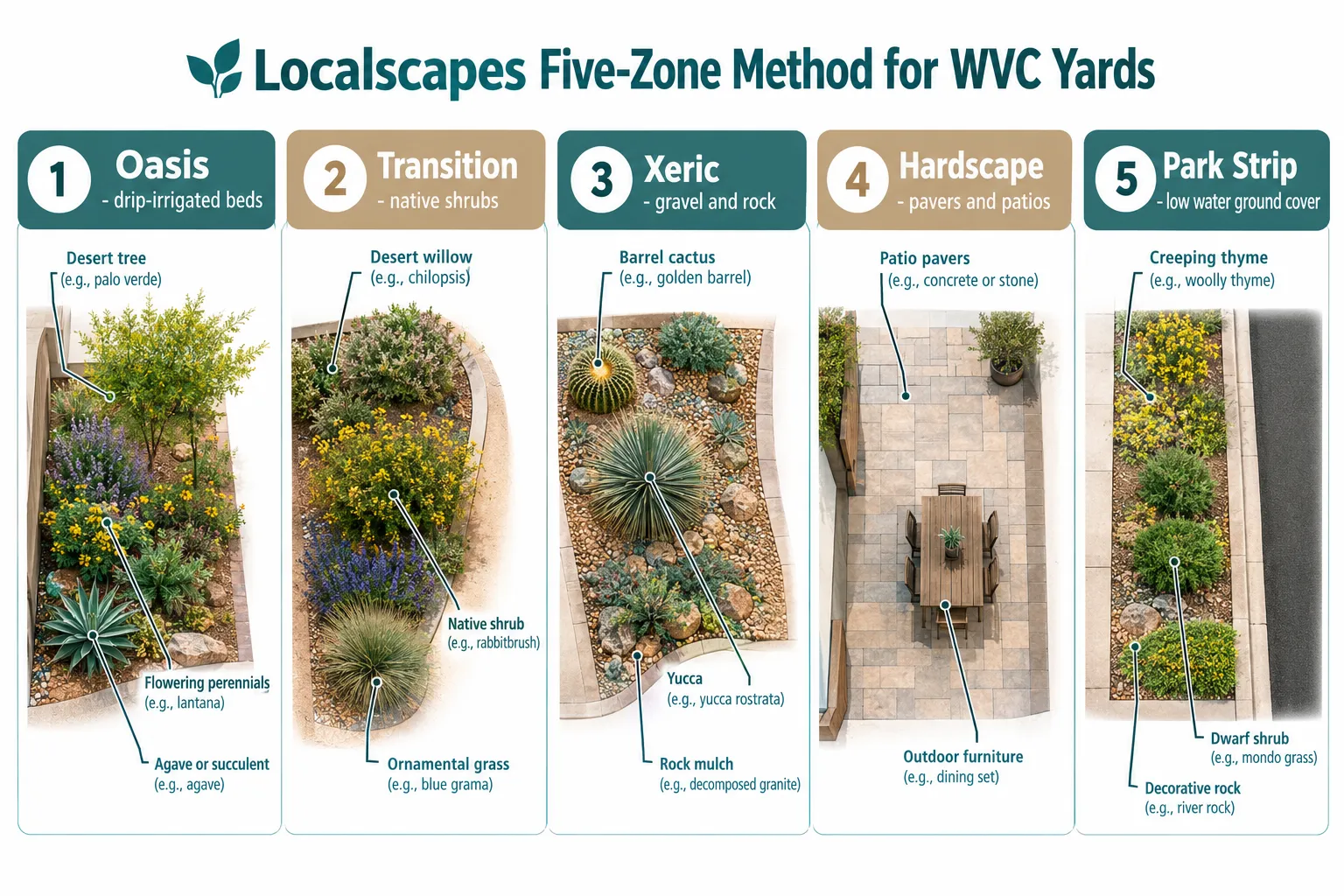
The five Localscapes zones applied to a WVC lot:
- Oasis Zone, Right outside a door or window. Small, high-visibility area. Use drip-irrigated perennials, container plants, or a small raised bed. This is your one spot where a little extra water is justified.
- Transition Zone, The middle ground. Native shrubs, ornamental grasses, and low-water perennials. Drip irrigation only. Think Utah serviceberry, Apache plume, or blue grama grass.
- Xeric Zone, The bulk of most WVC yards. Gravel mulch, boulders, drought-tolerant plants. Little to no irrigation once established. This zone handles the Wasatch Front's dry summers without complaint.
- Hardscape Zone, Patios, pathways, and driveways. No irrigation needed. Hardscaping averages about $20,600 in West Valley City for a full installation. [4]
- Park Strip Zone, The strip between the sidewalk and street. West Valley City requires this area to be either landscaped or concreted; concrete requires a Public Works permit. [1] No lawn is allowed here under the Residential Sustainability Zone rules. [10]
"Your yard deserves someone who knows what they're doing, and the Localscapes method gives both you and your contractor a shared language before a single shovel hits the ground."
The Localscapes approach aligns directly with WVC ordinance requirements: it naturally limits lawn to well under 35% of the yard, uses drip irrigation in non-lawn areas, and emphasizes live plant coverage. [10][8]
Managing Alkaline Soil in West Valley
Most West Valley City soil runs alkaline, with pH levels commonly between 7.5 and 8.5. At that pH, plants cannot absorb iron, manganese, or zinc properly, which causes yellowing leaves even when fertilizer is applied.
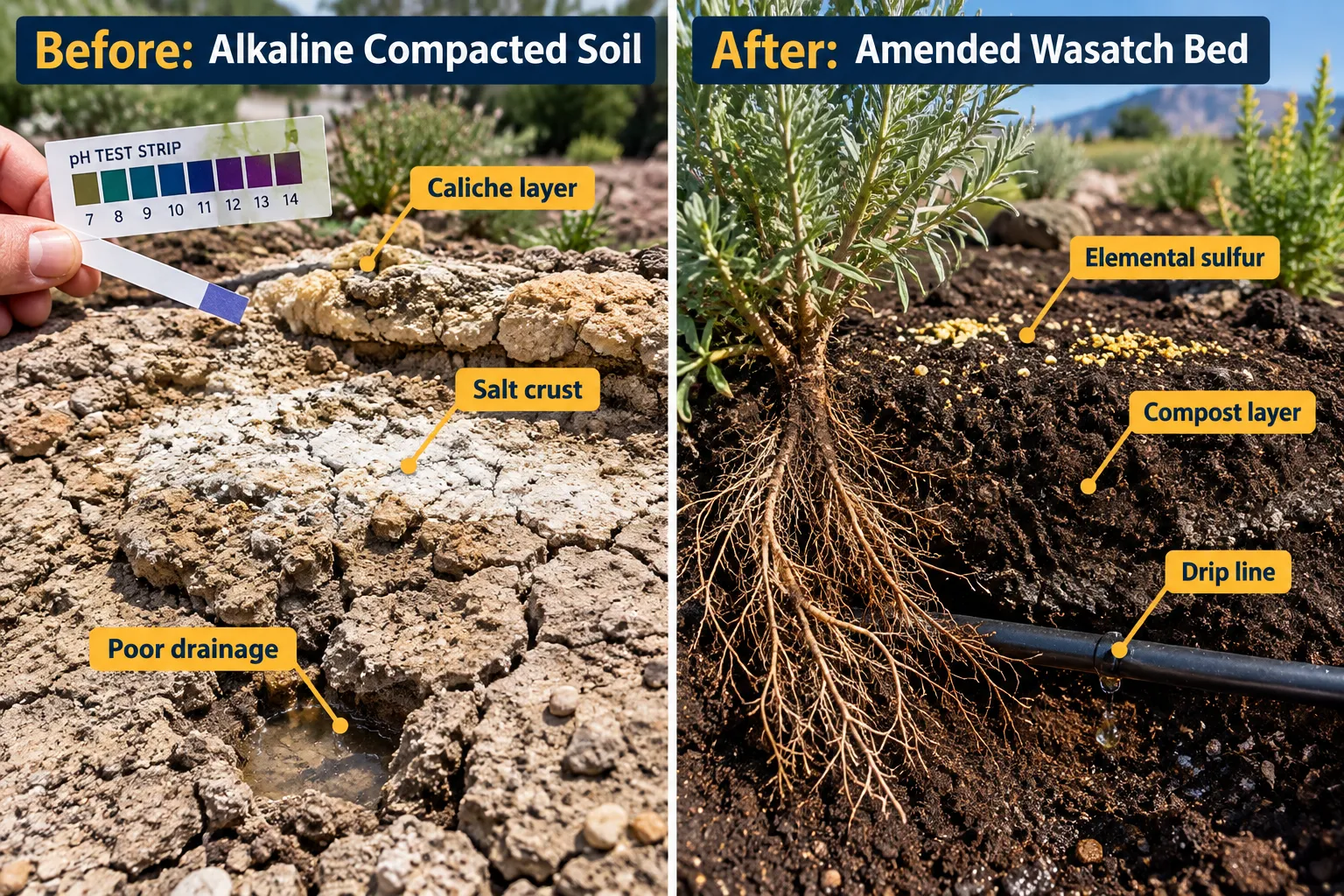
How to fix alkaline Wasatch soil:
- Test first. A basic soil test from the Utah State University Extension costs under $20 and tells you your exact pH, organic matter level, and nutrient profile. Do not guess.
- Add elemental sulfur. This is the standard amendment for lowering pH in Utah. Apply according to test results. It works slowly, allow 6 to 12 months for full effect.
- Incorporate compost. At least 3 to 4 inches worked into the top 12 inches of soil. Compost improves drainage, adds organic matter, and buffers pH swings.
- Watch for caliche. A hard layer of calcium carbonate sits beneath many WVC yards. If water pools after rain, you may need to break through it with a tile spade or hire a contractor to trench it out.
- Choose pH-tolerant plants. If amendment is not practical for your budget, choose plants that tolerate alkaline conditions: native rabbitbrush, four-wing saltbush, and most ornamental grasses handle high pH without complaint.
Skipping soil prep is the single most common reason new plantings fail on the Wasatch Front. Fix the soil once and plants perform for decades.
Best Time to Landscape in West Valley City
Spring is the peak season for west-valley-city landscaping projects, and the data backs that up. Demand peaks in May (index 99) and April (93), with a secondary peak in June (82). [4] Booking a contractor in March or early April gives you the best selection and sometimes better pricing before the rush.
Seasonal planting guide for WVC:
| Season | Best Tasks |
|---|---|
| March - April | Soil amendment, tree planting, hardscape installation |
| May - June | Sod, perennials, shrub installation, irrigation startup |
| July - August | Avoid new planting if possible; heat stress is high |
| September - October | Excellent for native plants and trees; soil is warm |
| November | Final mulching, irrigation winterization |
| December - February | Planning, contractor interviews, permit applications |
Fall planting (September through October) is underused in West Valley City. Soil is still warm, air temperatures are cooler, and plants establish roots before winter without the heat stress of summer.
How Much Does West Valley City Landscaping Cost in 2026
Most west-valley-city landscaping jobs range from $320 to $20,000 depending on scope, with a median full redesign cost of about $6,200. [9][12] These are real numbers from local marketplace data, not national averages.
2026 cost benchmarks for West Valley City: [4][9]
- Mulching: approximately $289
- Sod installation: approximately $2,237
- Sprinkler system installation: approximately $2,759
- General landscaping project: approximately $3,077
- Artificial turf installation: approximately $4,326 (note: a no-fee permit is required before installation) [1]
- Full landscape redesign (median): approximately $6,200
- Hardscaping (patios, walls, pavers): approximately $20,600
- Recurring monthly maintenance (median): approximately $185 per month [9]
What changes the price:
- Lot size and slope (slopes over 25% prohibit lawn; drip irrigation is required on slopes over 33%) [8][10]
- Soil condition (caliche removal adds cost)
- Permit requirements (artificial turf, park strip concrete, irrigation systems)
- Whether you need a licensed landscape architect to prepare the plan [8]
Choose a full-service contractor if your project involves hardscape, irrigation system design, or grading. For basic mulching, seasonal cleanup, or plant installation, a smaller crew often costs less and works just as well.
Native Plants and Xeriscaping for West Valley City Water Conservation
Xeriscaping means designing a landscape that needs little to no supplemental water once established. For West Valley City, it is not a trend, it is increasingly the law. [10][13]
Best native and low-water plants for WVC yards:
- Big sagebrush (Artemisia tridentata), iconic Wasatch Front shrub, extremely drought-tolerant
- Apache plume (Fallugia paradoxa), white flowers, feathery seed heads, handles alkaline soil
- Blue grama grass (Bouteloua gracilis), native grass, low water, stays green in summer
- Utah serviceberry (Amelanchier utahensis), small tree or large shrub, edible berries, good fall color
- Rabbitbrush (Ericameria nauseosa), yellow fall blooms, very drought-tolerant, attracts pollinators
- Penstemon (various species), tubular flowers, native to Utah, minimal water after establishment
Lawn limits to know: In the Residential Sustainability Zone, lawn cannot exceed 35% of front and side yards in a "moderate" water-use landscape, and drops to 20% in a "high" water-use landscape. [10] No lawn is allowed in park strips or areas narrower than 8 feet. [10]
Grouping plants with similar water needs, a practice called hydrozoning, is required in WVC's Water-Efficient Landscape Worksheets and reduces both water waste and maintenance time. [8]
How Often Should You Water Your Landscape in West Valley City
Watering frequency depends on plant type, season, and irrigation method. The city's guidelines are specific: spray or stream sprinklers must run between 9 p.m. and 8 a.m. to reduce evaporation losses, and early-morning irrigation is preferred for turf and groundcover. [8]
General watering guidelines for WVC:
- Established native plants: Once every 10 to 14 days in summer, none needed in winter
- New plantings (first season): Two to three times per week until roots establish
- Lawn (if any): Deep, infrequent watering, about 1 inch per week in summer, less in spring and fall
- Drip-irrigated beds: Run drip systems longer but less frequently than sprinklers; 30 to 60 minutes, two to three times per week in peak summer
Drip irrigation is required in all non-lawn areas in the Residential Sustainability Zone. [8] Overhead sprinklers are restricted to lawn areas only. [8] An EPA WaterSense smart controller is also required in that zone, which automatically adjusts run times based on weather data. [14]
Winterizing Your Utah Landscape
West Valley City sits at roughly 4,300 feet elevation. Hard freezes arrive by late October and can drop to single digits in January. Proper winterization protects your irrigation investment and keeps plants alive through freeze-thaw cycles.
Winterization checklist for WVC homeowners:
- Blow out irrigation lines by mid-October. Compressed air clears standing water from pipes and prevents cracking. Most irrigation contractors charge $50 to $100 for this service.
- Mulch perennial beds to 3 to 4 inches. Insulates roots against freeze-thaw heaving. Use wood chip mulch, not rock, around plants.
- Wrap young trees. Tree wrap on the trunk prevents sunscald, which is common on the Wasatch Front where sunny winter days cause bark to expand and then refreeze at night.
- Cut back ornamental grasses in late fall or early spring. Either works; leaving them through winter adds visual interest and provides wildlife cover.
- Do not prune spring-blooming shrubs in fall. You will cut off next year's flower buds. Wait until after bloom.
- Leave perennial seed heads standing. Birds feed on them through winter, and the structure adds interest to an otherwise bare yard.
Freeze-thaw cycles also heave pavers and flagstone. Check hardscape edges each spring and reset any lifted pieces before they become a trip hazard.
WVC Water Conservation Incentives and Ordinance Rules
West Valley City actively supports water-wise landscaping through both ordinance requirements and conservation resources. Understanding the rules before you start saves time and avoids Code Enforcement contact. [7]
Key rules every WVC homeowner needs to know:
- Front yards must be landscaped with at least 25% live plant coverage and one tree minimum. [1]
- An underground irrigation system is required in all landscaped areas and must be designed for water efficiency. [3]
- Artificial turf requires a no-fee permit before installation. [1]
- Park strip concrete requires a Public Works permit. [1]
- Landscape plans for new installations must be prepared by a licensed Utah landscape architect or a Utah Nursery and Landscape Association certified designer. [8]
- Irrigation systems must be installed by certified irrigation contractors. [8]
Water conservation resources:
- The Magna Water District (which serves the same corridor) promotes efficient sprinkler systems, drought-tolerant plants, and low-use fixtures. [2]
- West Valley City's Water-Efficient Landscape Worksheets provide detailed design and irrigation standards for both homeowners and contractors. [8]
- The city's Water page confirms that sod is not required, supporting non-turf designs. [6]
Prediction (clearly labeled): Based on the city's Water Element calling for "additional regulations for water-wise designs" and the regional trend toward tighter turf limits, it is likely that West Valley City will further reduce lawn percentage caps and expand mandatory drip irrigation requirements in coming years. [13] Homeowners planning long-term projects should design for smaller turf areas now to avoid costly retrofits later.
Professional Landscaping Services vs. DIY on the Wasatch Front
For most WVC homeowners, the honest answer is: do both. DIY works well for planting, mulching, and basic maintenance. Hire a pro for irrigation system design, hardscape, grading, and anything that requires a permit or a licensed designer. [8]
When to hire a professional:
- Irrigation system installation (must be a certified contractor) [8]
- Landscape plan preparation (must be a licensed landscape architect or certified designer) [8]
- Hardscape installation (patios, retaining walls, drainage)
- Caliche removal or significant grading
- Artificial turf installation (permit required) [1]
When DIY makes sense:
- Planting native shrubs and perennials
- Mulching and top-dressing beds
- Seasonal cleanup and pruning
- Basic lawn care and overseeding
What to ask before hiring a landscaper:
- Are you licensed in Utah and insured?
- Is your irrigation installer certified?
- Can you prepare or review a Water-Efficient Landscape Worksheet?
- Do you have experience with Wasatch Front soil conditions?
- Can you provide references from West Valley City or nearby neighborhoods?
Know who you're letting into your yard. Licensed, insured, and reviewed contractors protect you if something goes wrong.
West Valley City Landscaping vs. Salt Lake City Landscaping Differences
West Valley City and Salt Lake City share the same Wasatch Front climate, but their landscaping rules differ in meaningful ways. WVC has specific ordinance language about park strips, artificial turf permits, and the Residential Sustainability Zone that SLC homeowners do not face in the same form. [1][10]
Key differences:
- WVC explicitly prohibits lawn in park strips and areas narrower than 8 feet under the Residential Sustainability Zone. [10] SLC has its own water-wise ordinances but with different thresholds.
- WVC requires landscape plans to be prepared by a licensed Utah landscape architect or certified designer. [8] Requirements vary by project scope in SLC.
- Both cities sit at similar elevations with similar freeze-thaw cycles, alkaline soil, and drought pressure, so plant selection and soil management strategies transfer directly between them.
- WVC's enforcement mechanism routes non-compliant yards directly to Code Enforcement. [7] SLC uses a similar process but through different city departments.
If you own property in both cities or are comparing neighborhoods, the plant palette and soil strategies are nearly identical. The permit and ordinance details are where you need to check each city's specific rules.
Common Landscaping Mistakes to Avoid on the Wasatch Front
These are the errors that cost Wasatch Front homeowners the most time and money. Most are avoidable with a little planning.
- Skipping soil amendment. Planting directly into alkaline, compacted WVC clay without testing and amending is the fastest way to kill expensive plants.
- Overwatering new plantings. Native plants need regular water in their first season but drown with too much. Match irrigation to plant type.
- Ignoring park strip rules. Installing lawn in the park strip violates WVC ordinance in the Residential Sustainability Zone. [10] Use gravel, low ground cover, or concrete (with a permit). [1]
- Skipping the artificial turf permit. Installing synthetic turf without the required no-fee permit can result in a Code Enforcement notice. [1]
- Pruning at the wrong time. Pruning spring bloomers in fall removes next year's flowers. Pruning in late summer can stimulate tender growth that freezes.
- Planting too close to the house. Plants that touch the foundation trap moisture and create pest entry points. Keep shrubs at least 18 to 24 inches from the foundation.
- Hiring an unlicensed contractor for irrigation. WVC requires certified irrigation installers. An unlicensed install can void your permit and create liability. [8]
- Ignoring the freeze-thaw cycle. Pavers, pipes, and young trees all need preparation before the first hard freeze. Skipping winterization costs more in spring repairs than it saves in fall labor.
FAQ
Q: Does West Valley City require a permit for landscaping?
A: A no-fee permit is required before installing artificial turf. Concrete in the park strip requires a Public Works permit. Irrigation systems and landscape plans for new installations also require certified professionals. Basic planting and mulching generally do not require a permit. [1][8]
Q: Can I replace my front lawn with gravel in West Valley City?
A: Yes. The city does not require sod or grass in front yards. [6] You can use gravel, ground cover, shrubs, and hardscape as long as at least 25% of the front yard is covered by live plants and you include at least one tree. [1]
Q: How do I find a licensed landscaper in West Valley City?
A: Ask for their Utah contractor license number and verify it with the Utah Division of Occupational and Professional Licensing (DOPL). For irrigation work, confirm they are a certified irrigation contractor. For landscape plans, confirm they are a licensed Utah landscape architect or Utah Nursery and Landscape Association certified designer. [8] Local pros with local knowledge make a real difference on Wasatch Front projects.
Q: What is the cheapest way to improve my WVC yard on a small budget?
A: Mulching is the highest-impact, lowest-cost improvement at around $289 for a typical project. [4] It suppresses weeds, retains moisture, and makes beds look finished immediately. Pair it with a few native shrubs planted in fall (when they establish easily) and you have a solid foundation without a large upfront cost.
Q: When should I winterize my irrigation system in West Valley City?
A: Blow out irrigation lines by mid-October before the first hard freeze. At WVC's elevation, hard freezes can arrive as early as late October. Most local irrigation contractors charge $50 to $100 for a blowout service.
Q: Will West Valley City landscaping rules get stricter in the future?
A: It is likely. The city's Water Element explicitly calls for evaluating ordinances to require additional water-wise design regulations in new development. [13] Regional trends on the Wasatch Front also point toward tighter lawn percentage caps and broader drip irrigation mandates. Designing for minimal turf now is the safest long-term approach.
Conclusion
West Valley City landscaping in 2026 sits at the intersection of city ordinance, water scarcity, and a genuinely challenging climate. The rules are real, the costs are concrete, and the Wasatch Front's alkaline soil and hard winters do not forgive shortcuts.
Actionable next steps:
- Check your front yard against the 25% live plant coverage and one-tree minimum requirement before doing anything else. [1]
- Get a soil test from USU Extension before buying plants or hiring anyone.
- Use the Localscapes five-zone method to map your yard and identify where lawn is actually needed versus where gravel, native plants, or hardscape serve you better.
- If your project involves irrigation, hardscape, or a new landscape plan, hire a certified contractor and a licensed designer, it is required, and it protects you. [8]
- Book your contractor in March or early April for the best availability before the May demand peak. [4]
Find the right landscaper for your yard. Real reviews from real homeowners, licensed insured and reviewed, that is what LandscapeProsDirectory is built for. No fluff, just useful advice and local pros with local knowledge.
References
[1] Residential Landscaping - https://www.wvc-ut.gov/1947/Residential-Landscaping
[2] Magna Water District 2021 - https://conservewater.utah.gov/wp-content/uploads/SubmittedWaterPlans/Magna-Water-District-2021.pdf
[3] wvc-ut.gov - https://www.wvc-ut.gov/ArchiveCenter/ViewFile/Item/3466
[4] West Valley City Ut Landscaping - https://www.lawnstarter.com/west-valley-city-ut-landscaping
[5] West Valley City Ut - https://www.yourgreenpal.com/landscaping/west-valley-city-ut
[6] Water - https://www.wvc-ut.gov/1902/Water
[7] Landscaping And Water Conservation - https://www.wvc-ut.gov/1956/Landscaping-and-Water-Conservation
[8] Water Efficient Landscape Worksheets Pdf - https://www.wvc-ut.gov/DocumentCenter/View/743/Water-Efficient-Landscape-Worksheets-PDF
[9] Landscaping - https://serviceagent.ai/directory/utah/west-valley-city/landscaping/
[10] utah.gov - https://www.utah.gov/pmn/files/1296179.pdf
<!DOCTYPE html>
<html lang="en">
<head>
<meta charset="UTF-8">
<meta name="viewport" content="width=device-width, initial-scale=1.0">
<title>WVC Landscaping Budget Estimator</title>
<style>
  .cg-wrap{font-family:sans-serif;max-width:520px;margin:2rem auto;background:#f7f4ef;border-radius:10px;padding:1.5rem;box-sizing:border-box}
  .cg-wrap h2{font-size:1.1rem;color:#1a3a2a;margin:0 0 .5rem}
  .cg-wrap p{font-size:.85rem;color:#444;margin:0 0 1rem}
  .cg-row{margin:.6rem 0}
  .cg-row label{display:block;font-size:.85rem;color:#1a3a2a;margin-bottom:.25rem;font-weight:600}
  .cg-row select,.cg-row input{width:100%;padding:.45rem .6rem;border:1px solid #b5c9b5;border-radius:6px;font-size:.9rem;background:#fff;box-sizing:border-box}
  .cg-btn{display:block;width:100%;padding:.65rem;background:#2d6a4f;color:#fff;border:none;border-radius:7px;font-size:1rem;cursor:pointer;margin-top:1rem}
  .cg-result{margin-top:1rem;background:#fff;border-left:4px solid #2d6a4f;padding:.8rem 1rem;border-radius:0 7px 7px 0;font-size:.9rem;color:#1a3a2a;display:none}
  .cg-result strong{font-size:1.05rem}
</style>
</head>
<body>
<div class="cg-wrap">
  <h2>WVC Landscaping Budget Estimator</h2>
  <p>Get a rough 2026 cost range for your West Valley City project based on local data.</p>
  <div class="cg-row">
    <label for="cg-type">Project type</label>
    <select id="cg-type">
      <option value="mulch">Mulching</option>
      <option value="sod">Sod installation</option>
      <option value="sprinkler">Sprinkler system</option>
      <option value="general">General landscaping</option>
      <option value="turf">Artificial turf</option>
      <option value="hardscape">Hardscaping (patio/pavers)</option>
      <option value="maintain">Monthly maintenance</option>
    </select>
  </div>
  <div class="cg-row">
    <label for="cg-size">Yard size</label>
    <select id="cg-size">
      <option value="small">Small (under 1,000 sq ft)</option>
      <option value="medium" selected>Medium (1,000-3,000 sq ft)</option>
      <option value="large">Large (over 3,000 sq ft)</option>
    </select>
  </div>
  <button class="cg-btn" onclick="cgEstimate()">Estimate my cost</button>
  <div class="cg-result" id="cg-result"></div>
</div>
<script>
  var cgData={mulch:{small:[150,250],medium:[250,400],large:[400,650]},sod:{small:[800,1400],medium:[1800,2800],large:[3000,5500]},sprinkler:{small:[1200,1800],medium:[2200,3200],large:[3500,5500]},general:{small:[500,1500],medium:[2500,4000],large:[4500,8000]},turf:{small:[1500,2500],medium:[3500,5500],large:[6000,10000]},hardscape:{small:[4000,8000],medium:[10000,18000],large:[18000,28000]},maintain:{small:[100,150],medium:[160,220],large:[220,320]}};
  var cgNote={mulch:"",sod:"",sprinkler:"Certified installer required.",general:"Plan prep needs licensed designer.",turf:"No-fee city permit required before install.",hardscape:"Public Works permit may apply.",maintain:"Per month, recurring."};
  function cgEstimate(){
    var t=document.getElementById("cg-type").value;
    var s=document.getElementById("cg-size").value;
    var r=cgData[t][s];
    var n=cgNote[t];
    var el=document.getElementById("cg-result");
    el.style.display="block";
    el.innerHTML="<strong>Estimated range: $"+r[0].toLocaleString()+", $"+r[1].toLocaleString()+"</strong>"+(n?"<br><span style='font-size:.8rem;color:#555'>"+n+"</span>":"")+"<br><span style='font-size:.75rem;color:#888'>Based on 2026 West Valley City marketplace data. Actual quotes vary.</span>";
  }
</script>
</body>
</html>
Liked this guide? Follow us on Google Search
Related Directory Pages
Find a Landscaper Near You
Browse UT landscaping professionals on LandscapeProsDirectory.
Search Landscapers