
Best Drought-Tolerant Plants for Nevada Landscapes
Discover 20+ drought tolerant plants perfect for Nevada landscapes. From Texas sage to desert marigold, find water-wise plants for Las Vegas and Reno yards.
Nevada homeowners face a harsh reality: the state receives less than 10 inches of annual rainfall in most areas. Yet creating a beautiful landscape doesn't mean surrendering to brown lawns and barren yards. The right drought tolerant plants Nevada can transform your property into a stunning, water-wise oasis that thrives in the Silver State's challenging climate.
Your yard deserves someone who knows what they're doing when it comes to desert landscaping. Whether you're in Las Vegas dealing with Mojave Desert conditions or Reno facing high desert challenges, choosing plants adapted to Nevada's unique climate zones makes the difference between landscape success and costly failures.
Key Takeaways
- Nevada's two main climate zones require different plant selections: Mojave Desert (Las Vegas area) and high desert (Reno area)
- Native and adapted plants use 50-80% less water than traditional landscaping
- Proper plant placement and soil preparation are crucial for drought-tolerant success
- Many drought-tolerant plants offer year-round color and interest
- Professional installation ensures proper establishment and long-term success
Table of Contents
- Understanding Nevada's Climate Zones
- Top Drought-Tolerant Shrubs for Nevada
- Best Perennials and Wildflowers
- Ornamental Grasses That Thrive
- Cacti and Succulents for Nevada Gardens
- Trees for Water-Wise Landscapes
- Planting and Care Tips
- FAQ
Understanding Nevada's Climate Zones
Nevada splits into two distinct climate regions that determine which drought tolerant plants Nevada homeowners should choose. The Mojave Desert zone covers southern Nevada including Las Vegas landscaping services, Henderson, and Boulder City. This area sees extreme summer heat, mild winters, and receives 4-6 inches of annual rainfall.
The high desert zone encompasses northern Nevada including Reno, Carson City, and Elko. These areas experience cold winters with snow, hot summers, and slightly more precipitation at 7-12 inches annually. Understanding your zone helps you select plants that will actually survive and thrive.
Mojave Desert Zone (USDA Zones 8b-10a):
- Summer highs: 100-115°F
- Winter lows: 25-35°F
- Growing season: March through November
High Desert Zone (USDA Zones 6a-8a):
- Summer highs: 85-95°F
- Winter lows: -10 to 15°F
- Growing season: May through September
Top Drought-Tolerant Shrubs for Nevada
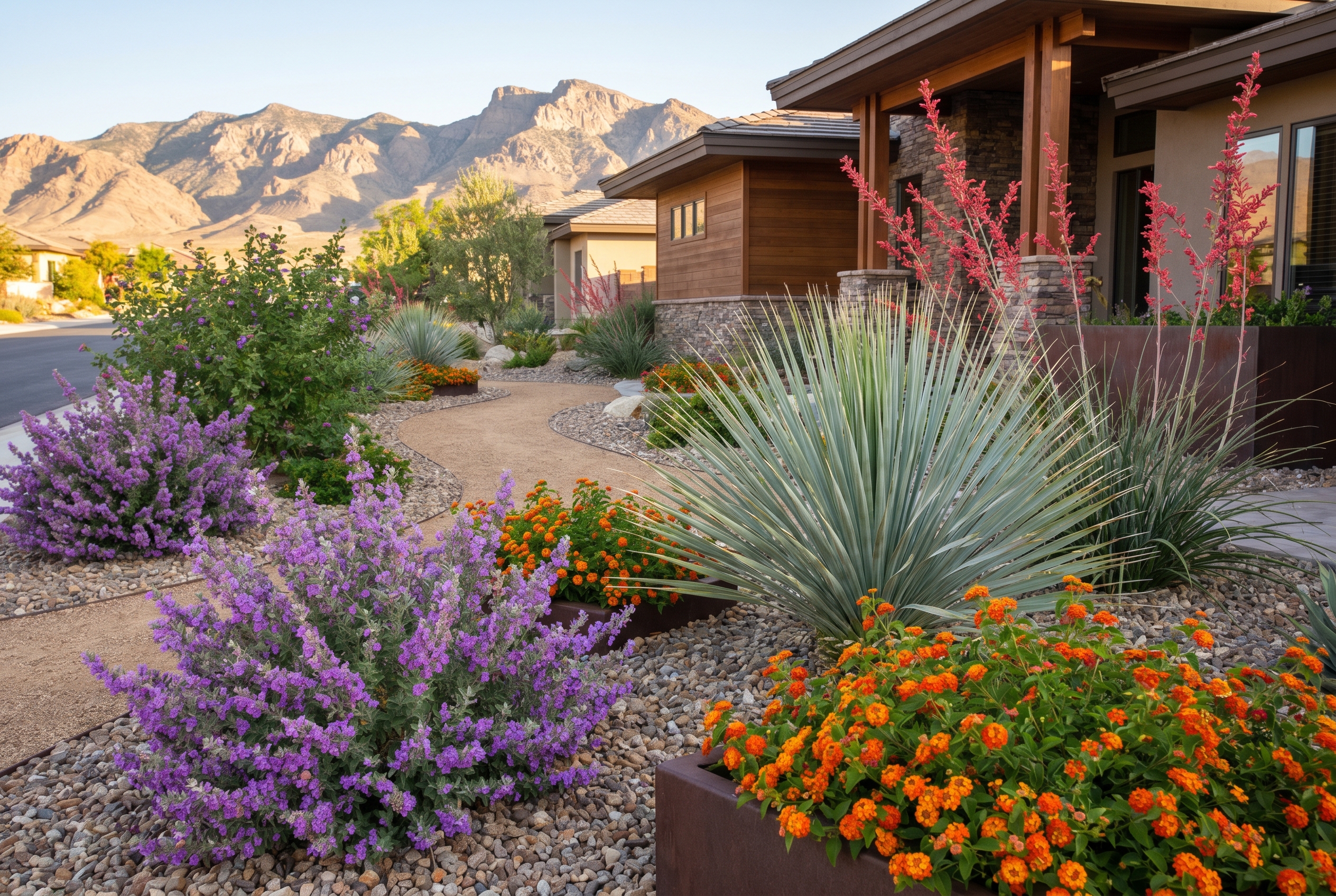
Shrubs form the backbone of successful Nevada landscaping directory landscapes. These hardy plants provide structure, seasonal color, and wildlife habitat while using minimal water once established.
Texas Sage (Leucophyllum species)
Texas sage ranks as the top choice for drought tolerant plants Nevada gardeners love. This silvery-leafed shrub produces masses of purple, pink, or white tubular flowers after summer rains. It thrives in both climate zones but performs exceptionally well in Las Vegas area heat.
Best varieties: 'Green Cloud', 'Compacta', 'Silver Cloud'
Size: 3-6 feet tall and wide
Water needs: Minimal after establishment
Desert Spoon (Dasylirion wheeleri)
Desert spoon creates dramatic architectural interest with its fountain of narrow, serrated leaves. This slow-growing plant eventually produces a spectacular 15-foot flower spike. It works in both Nevada climate zones but needs protection from extreme cold in Reno.
Mature size: 4-5 feet tall, 6 feet wide
Special feature: Striking flower spikes every few years
Placement: Full sun, well-draining soil
Apache Plume (Fallugia paradoxa)
Apache plume offers year-round interest with white rose-like flowers in spring and summer, followed by feathery seed heads that persist through winter. This native shrub handles both heat and cold exceptionally well.
Height: 3-6 feet
Bloom time: May through September
Wildlife value: Attracts butterflies and birds
Fairy Duster (Calliandra eriophylla)
Fairy duster produces delicate pink or red powder-puff flowers from February through May. This low-growing shrub works well as groundcover or in rock gardens. It's better suited to southern Nevada's milder winters.
Size: 1-3 feet tall, 3-4 feet wide
Cold tolerance: Hardy to 15°F
Special care: Prune lightly after blooming
Lantana (Lantana camara and L. horrida)
Lantana provides non-stop color from spring through fall with clusters of small flowers in yellow, orange, red, pink, or white. While not native, it's perfectly adapted to Nevada's hot, dry conditions. Treat as annual in northern Nevada.
Bloom period: April through October
Varieties: 'New Gold', 'Radiation', 'Miss Huff'
Maintenance: Deadhead for continuous blooms
Best Perennials and Wildflowers
Perennials and wildflowers add seasonal color and attract beneficial insects to Nevada landscapes. These drought tolerant plants Nevada natives have evolved to handle extreme conditions.
Penstemon (Penstemon species)
Penstemon species offer some of the most reliable color for Nevada gardens. These native wildflowers produce spikes of tubular flowers beloved by hummingbirds. Different species bloom from spring through fall.
Top species:
- Firecracker Penstemon (P. eatonii): Bright red flowers, 2-4 feet tall
- Palmer's Penstemon (P. palmeri): Pink flowers, 3-6 feet tall
- Beardtongue (P. barbatus): Red flowers, 2-3 feet tall
Desert Marigold (Baileya multiradiata)
Desert marigold produces cheerful yellow daisy flowers almost year-round in southern Nevada. This short-lived perennial readily self-seeds, creating natural drifts of color. It's less cold-hardy for northern Nevada.
Bloom time: March through November
Height: 1-3 feet
Best use: Mass plantings, wildflower gardens
Red Yucca (Hesperaloe parviflora)
Despite its name, red yucca isn't actually a yucca. This Texas native produces arching stems topped with coral-red tubular flowers that hummingbirds adore. It forms attractive grass-like clumps and handles both Nevada climate zones.
Flower color: Red, pink, or yellow varieties
Bloom period: May through October
Size: 2-3 feet tall, 3-4 feet wide
Blackfoot Daisy (Melampodium leucanthum)
Blackfoot daisy creates carpets of white flowers with yellow centers from spring through fall. This low-growing perennial works beautifully in rock gardens or as groundcover. It's hardy throughout Nevada.
Height: 6-12 inches
Spread: 12-18 inches
Soil needs: Excellent drainage essential
Angelita Daisy (Tetraneuris acaulis)
Angelita daisy produces bright yellow flowers on short stems above silvery foliage. This compact perennial blooms heaviest in spring but continues sporadically through summer. It handles cold better than many desert plants.
Bloom size: 1-2 inch flowers
Cold tolerance: Hardy to -10°F
Best placement: Rock gardens, borders
Ornamental Grasses That Thrive
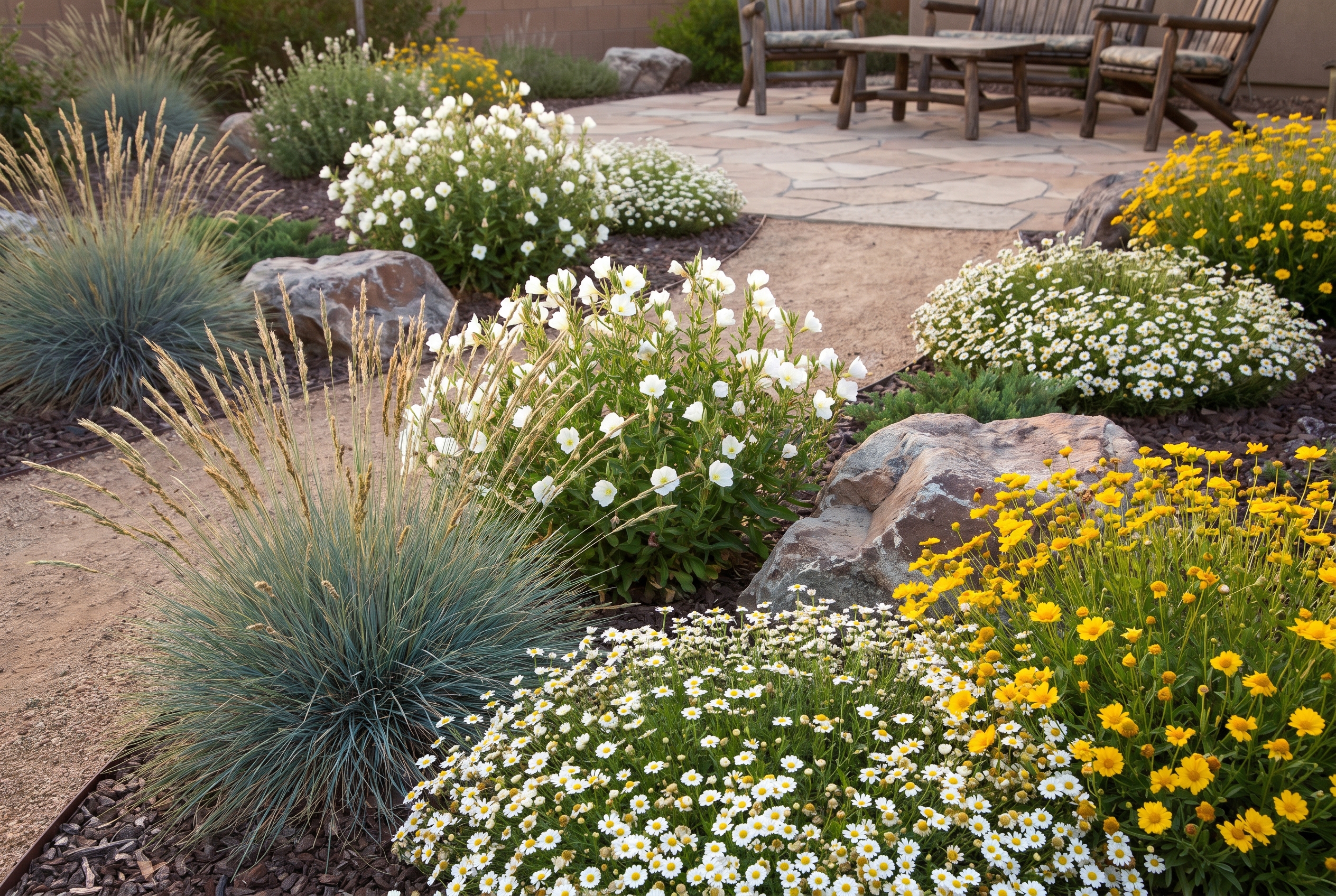
Ornamental grasses add movement, texture, and seasonal interest to Nevada landscapes. These drought tolerant plants Nevada gardeners appreciate for their low maintenance and wildlife value.
Blue Grama Grass (Bouteloua gracilis)
Blue grama grass serves as Nevada's most reliable native grass. It forms dense tufts of fine-textured foliage topped with distinctive eyelash-like seed heads. This grass stays green with minimal water and handles both climate zones.
Height: 12-18 inches
Seed heads: Distinctive curved flags
Maintenance: Cut back in late winter
Mexican Evening Primrose (Oenothera speciosa)
Mexican evening primrose spreads to form a groundcover carpet dotted with pink cup-shaped flowers. While aggressive, it's useful for erosion control on slopes. The flowers open in evening and close by midday.
Spread: Can be invasive
Bloom time: April through June
Best use: Naturalized areas, slopes
Winecup (Callirhoe involucrata)
Winecup produces deep magenta cup-shaped flowers over trailing stems. This prairie native works well as groundcover or cascading over walls. It goes dormant in winter and emerges late in spring.
Flower size: 1-2 inches across
Growth habit: Trailing, 6 inches tall
Drought tolerance: Excellent once established
Cacti and Succulents for Nevada Gardens
Cacti and succulents represent the ultimate drought tolerant plants Nevada landscapes can showcase. These water-storing plants offer unique forms, textures, and surprising flower displays.
Prickly Pear Cactus (Opuntia species)
Prickly pear cacti produce showy flowers in yellow, red, or pink followed by colorful edible fruits. Several species are native to Nevada and handle extreme cold better than most cacti.
Cold-hardy species:
- Opuntia polyacantha: Hardy to -20°F
- Opuntia fragilis: Hardy to -35°F
- Opuntia basilaris: Hardy to 0°F
Cholla (Cylindropuntia species)
Cholla cacti create striking architectural forms with their segmented, cylindrical stems. Tree cholla (C. imbricata) and pencil cholla (C. ramosissima) both occur naturally in Nevada and produce colorful spring flowers.
Tree Cholla: 3-8 feet tall, purple flowers
Pencil Cholla: 1-4 feet tall, yellow flowers
Caution: Handle with extreme care due to barbed spines
Trees for Water-Wise Landscapes
Joshua Tree (Yucca brevifolia)
Joshua trees create iconic Nevada landscapes in areas where they naturally occur. These slow-growing giants eventually reach 15-40 feet tall and produce clusters of white flowers. They're restricted to specific elevation zones in southern Nevada.
Growth rate: 1-2 inches per year
Lifespan: 100+ years
Requirements: Perfect drainage, minimal water
Creosote Bush (Larrea tridentata)
Creosote bush ranks among the most drought-tolerant plants on Earth. This evergreen shrub produces small yellow flowers and distinctive resinous leaves. It's better suited to southern Nevada's climate.
Size: 3-10 feet tall and wide
Special feature: Extremely long-lived
Fragrance: Distinctive after rain
Additional Standout Plants
Rabbitbrush (Ericameria nauseosa)
Rabbitbrush provides late-season color when most plants are finishing their show. This native shrub produces masses of bright yellow flowers in fall, attracting butterflies and beneficial insects.
Bloom time: August through October
Height: 2-4 feet
Wildlife value: Important pollinator plant
Mojave Aster (Xylorhiza tortifolia)
Mojave aster produces large white daisy flowers with yellow centers in spring. This low-growing perennial forms attractive rosettes of gray-green leaves and works well in rock gardens.
Flower size: 2-3 inches across
Bloom period: March through May
Cold tolerance: Hardy to 10°F
Planting and Care Tips
Success with drought tolerant plants Nevada depends on proper installation and establishment care. Even drought-tolerant plants need regular water their first year while developing deep root systems.
Soil Preparation:
- Improve drainage in heavy clay soils
- Add decomposed granite or coarse sand
- Avoid rich, organic amendments that retain moisture
Planting Schedule:
- Spring planting: March through May
- Fall planting: September through October
- Avoid summer installation in extreme heat
Establishment Care:
- Water deeply but infrequently
- Apply 2-3 inch mulch layer
- Reduce watering gradually over first year
Long-term Maintenance:
- Most plants need minimal supplemental water after year two
- Prune dead flowers and stems as needed
- Fertilize sparingly if at all
FAQ
Which drought-tolerant plants work best in Las Vegas versus Reno?
Las Vegas gardeners can grow heat-loving plants like lantana, fairy duster, and desert marigold that won't survive Reno winters. Reno gardeners should focus on cold-hardy options like Apache plume, blue grama grass, and hardy penstemon species that can handle subzero temperatures.
How much water do drought-tolerant plants actually need?
Most drought-tolerant plants need regular water their first year for establishment. After that, they typically need deep watering once or twice monthly during growing season, compared to weekly watering for traditional landscapes. Native plants often survive on rainfall alone after establishment.
When is the best time to plant drought-tolerant plants in Nevada?
Spring (March-May) and fall (September-October) offer the best planting windows. Spring planting gives plants a full growing season to establish before winter. Fall planting takes advantage of cooler temperatures and winter moisture for root development.
Do I need to amend Nevada's alkaline soil for these plants?
Most drought-tolerant plants actually prefer Nevada's alkaline soils and don't need amendments. The key is improving drainage rather than changing pH. Add coarse sand or decomposed granite to heavy clay soils, but avoid organic matter that retains moisture.
How long does it take for drought-tolerant plants to become established?
Most perennials and shrubs take 1-2 years to become fully established and drought-tolerant. Trees may need 3-5 years. During establishment, provide regular deep watering but gradually reduce frequency as plants develop extensive root systems.
Can I mix drought-tolerant plants with traditional landscape plants?
It's better to group plants with similar water needs together. Mixing drought-tolerant plants with water-loving plants often leads to overwatering the drought-tolerant species or underwatering the others. Create separate zones for different water requirements.
Conclusion
Creating a beautiful Nevada landscaping directory landscape doesn't require fighting your climate or wasting precious water. The right drought tolerant plants Nevada offers can provide year-round color, attract wildlife, and reduce maintenance while thriving in harsh desert conditions.
Know who you're letting into your yard when it comes to installation. Find the right landscaper for your yard through proper research and verification. Licensed, insured professionals understand proper planting techniques, soil preparation, and establishment care that makes the difference between success and failure.
Start with a few proven performers like Texas sage, penstemon, and blue grama grass. Build your confidence and knowledge before tackling more challenging species. Your water bill and your yard will thank you for making the switch to water-wise landscaping that works with Nevada's natural climate rather than against it.
Liked this guide? Follow us on Google Search
Related Directory Pages
- Browse Nevada Landscaping Pros
- Reno Landscaping Services
- Browse Landscaping Services in Nevada
- Also Read: Best Drought-Tolerant Plants for Arizona Landscapes
- Also Read: Best California Native Plants for Your Landscape
- Also Read: Best Native Plants for New Mexico Landscapes
- Also Read: Best Desert Landscaping Ideas for Phoenix Homes
- Search Nevada Landscapers
Find a Landscaper Near You
Browse NV landscaping professionals on LandscapeProsDirectory.
Search Landscapers